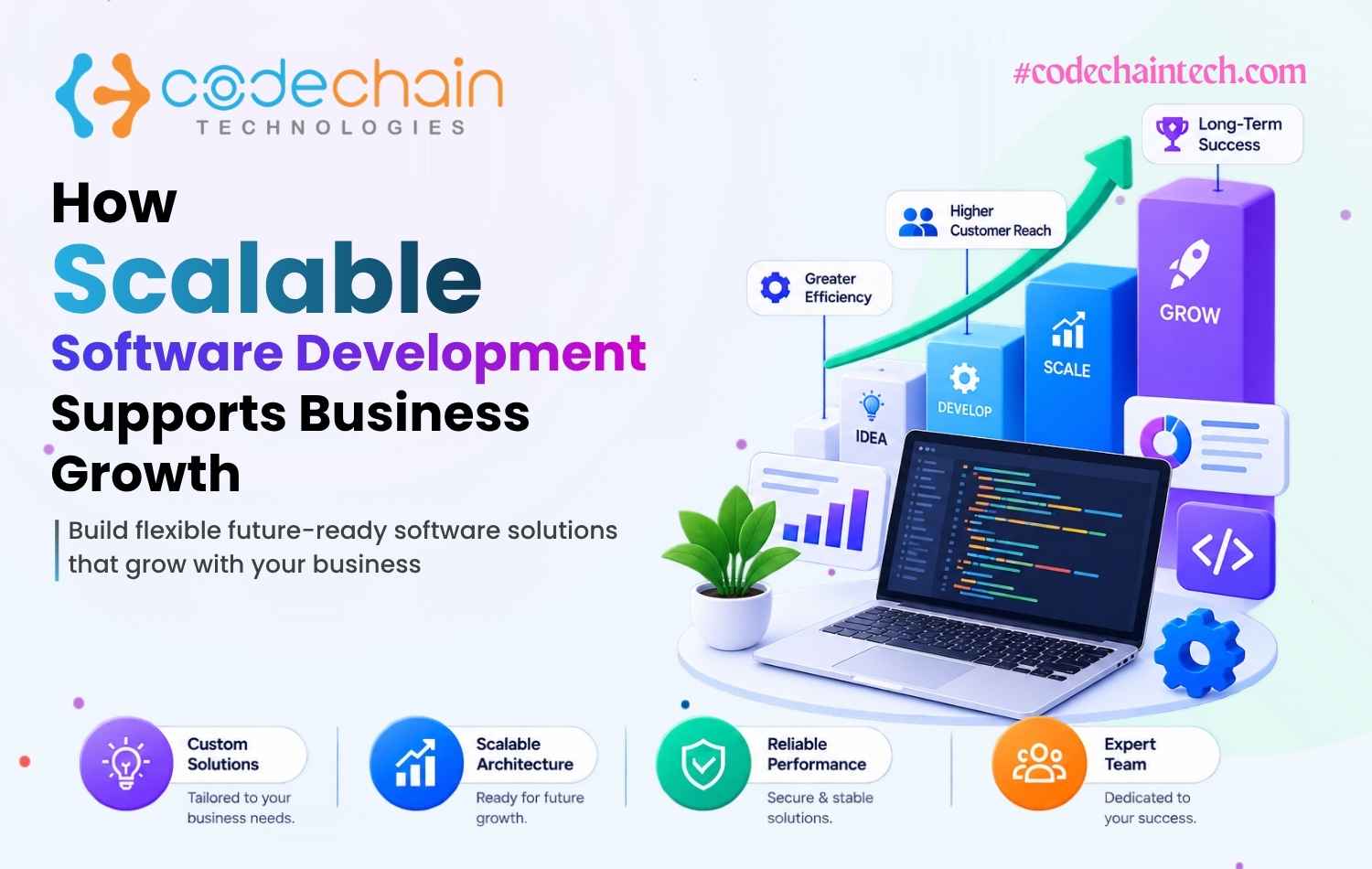
Scalable software development allows companies to develop software that can grow with the company. When a business grows, when it has more customers, employees, orders, data, and visitors to their website, their software should be able to accommodate the extra work without slowing down or becoming difficult to maintain.
A business can start with a simple website, application, CRM, or internal software. It might work well at first because only a few are using it. As the company grows, that same software may need to support thousands of users and much more information.
And that’s where scalability comes in. A scalable system can be upgraded and scaled as needs evolve, rather than having to replace the software when the business hits a new milestone. This lets businesses roll out new features, support more users, and scale more flexibly.
But for companies planning digital growth in the future, scalability is more than just a technical issue. It is also a business decision that can influence performance, customer experience, development costs, and future growth.
What is scalable software development?
Scalable software development is the development of software that can handle an increase in workload as the business grows. The idea is to make sure the app can handle more users, more data, more transactions, and more features without a big hit to performance.
Let us take a simple example. A new online store may start with a couple hundred visitors a day. The site is running fine; traffic is under control. A good marketing campaign can bring thousands of visitors to the business in a short time.
The software may not be built to cope with the higher traffic, and the website may be slow or even crash. Customers may be unable to browse products or make purchases.
A scalable application is designed to handle this type of growth. It is designed so that the business can make itself bigger when there is more demand.
Scalability is not about building the biggest and most complex software from day one. In fact, unnecessary complexity can make software expensive and difficult to maintain. Good custom software development is building a working base that can scale when the business really needs it.
This is especially beneficial to companies that are investing in custom software development, as the application can be developed according to the current operations with future requirements in mind.
Scalability matters for companies that are growing.
Growing a business isn’t just about growing revenue. This often means more customers, more employees, more transactions, more data, and more processes to manage.
Software that's good for a small business doesn't always work the same when the business grows. More users means more load on the servers and databases. The more data, the slower your searches and reports. New features can also make the application harder to maintain if not planned correctly from the start.
An employee or customer can be affected by a slow or unreliable system. Employees may have to wait longer for pages or reports to load. Customers may abandon a website if they cannot complete an action quickly.
It can also help enable future business change. For example, a firm could start selling products in one location and then grow to many cities. This could range from adding new payment methods, launching a mobile app, connecting a CRM, or even starting to sell internationally.
If the software is flexible enough, these changes can be made without having to replace the existing system altogether.
For businesses that rely on a strong online presence, scalable technology can be added to professional web design services to create websites and web applications that can be scaled more easily as needs grow.
That’s why it’s so important to think about scalability before you hit big growth, not when you start seeing software issues.
How Scalable Software Can Help Your Business Grow
One of the advantages of scalable software is that it can handle more customers without having to build the application over and over again.
As the user base grows, the software needs to continue to provide a reliable experience. "Scalable" means you can scale up the system to support more demand while maintaining availability of critical business functions.
This is especially true for applications that face customers. People may not know what technology is being used behind a website or app, but they know when things are slow, confusing, or not available.
Scalable software also makes it easier to roll out new features. A business might start with a simple app and then need more features like online payments, customer accounts, reports, notifications, inventory management, or analytics.
These are things that a well-designed application can add without breaking all the things that already work.
Another big benefit is better data management. The company grows. More customer records, orders, invoices, employee data, reports, and other business data are generated. By designing a scalable system in an efficient manner, we can handle the availability of more and more information.
And integrations can also be helped by scalability. Most modern businesses don’t run on a single software platform. These could include payment gateways, CRM platforms, accounting software, email services, analytics programs, and other applications.
Good APIs allow these systems to talk to each other. They allow companies to plug their processes into each other without adding more manual work.
Cloud technology can also help this growth. Depending on the project, the cloud platforms offer you the flexible infrastructure to scale resources up or down as the demand of your application changes.
For companies that need a dedicated app for customers or employees, app development services can be part of a larger, scalable technology strategy.
The end result is a software system that is better suited to the various stages of business growth.
What is Scalability in Software?
Scalability is not something that is only in one language or one framework. It involves the planning, web development, testing, and maintenance of a whole software system.
One of the most important things is well-organized architecture. By structuring different parts of an application properly, developers are able to fix or add to one part without causing problems in other parts of the system.
The data base is another big factor. A business is growing and can produce a large amount of information, and the database has to be efficiently designed for the increasing data. Good database structure, indexing, optimization, and the right database technology = better scalability.
APIs are also critical to modern apps. They allow software to talk to other systems and services. For example, an app may need to connect to a payment service, a CRM, an accounting platform, or an external business tool.
Caching can help performance if the same information is requested many times. Sometimes the most efficient way to serve frequently used information is to avoid processing every request from scratch.
Cloud infrastructure adds another level of flexibility. Cloud services are a great way for businesses to support applications and scale resources to deal with changes in demand.
Security also has to be included in the scalability plan. The more people that use an application, the more customer and business information that can potentially be stored within the system. Strong authentication, authorization, secure APIs, backups, and regular security updates become more important.
If your web application also needs a fast user interface that is easy to scale, professional frontend development services can help you create a better experience as your application grows.
Thus, scalable software should be flexible, maintainable, secure, and grow.
When To Invest In Scalable Software For Your Business?
There’s no magical size of business where all companies suddenly need scalable software. The right time depends on the goals of the company, expected growth, users, data, and the type of application.
A startup that expects to grow quickly in terms of users needs to be scalable from the start. A company that sells its products online may need this before starting a big marketing campaign. This might be needed when a growing company has more employees and departments using the same business software.
Here are some common signs that a business needs to start taking scalability seriously:
Application performance degrades with an increase in user traffic.
Adding new features is becoming more difficult or more expensive.
Business data is exploding.
Employees are working on one process on multiple disparate systems.
The company intends to expand into new locations or new markets.
Your current software is constantly requiring major changes to keep working.
Companies should not build more technology than they actually need.
The architecture of a large enterprise is not always similar to that of a small company. More often it makes sense to start out with a practical system and design it for growth later.
The key is to know where the business is today and where it realistically thinks it’s going.
How to Develop Software That Scales With Your Business
The first step in building scalable software is to understand the business, not to jump into a technology.
Before starting development, the team should know the main business processes, target users, expected load, data requirements, integrations, security needs, and future plans.
For example, a product management system, customer accounts, payments, orders, inventory, notifications, and reporting might be required in an eCommerce application. The needs for a health care app might be entirely different.
When the requirements are known, the developers are able to pick the right architecture and tech stack for the project.
Depending on the application, we can consider technologies like Node.js, Python, Golang, PHP, Laravel, React, Angular, Next.js, Flutter, and others. There is no right answer here. It is contingent upon what you need for your application. You don’t choose because the technology is popular.
Furthermore, for companies needing a specific backend technology, dedicated development is an option. Custom Golang development services can be useful in projects where the important requirements are performance and efficient backend processing.
The database planning also has to be done. The more data a business collects, the more developers have to think about how that data will be stored, accessed, protected, backed up, and expanded.
Testing is also a big part of it. You have to run your software under different workloads and see how it behaves when more users try to get to it at the same time.
Post-Launch Monitoring Can Catch Performance Issues Early Then companies can improve the system in incremental steps—rather than waiting until a big problem arises.
CodeChainTech can help companies who need professional guidance in planning and building software to support their business. The answer is to develop a solution that meets today’s needs and provides the business with a practical approach to growth.
Scalable software is the key to long-term business success.
As the business begins to evolve, the real value of scalable software becomes apparent.
A company might take on new customers, create new products, enter new markets, hire more staff, or offer new digital services. “Its technology has to evolve with it.”
Easy administration of these changes is a property of scalable systems.
This way, developers are able to improve parts of the system, rather than the whole application, every time the business has reached a new step. Add new features, add integrations, and add support for more users as you go.
This can also help companies better manage technology costs. While scalable design might require more upfront thought, it can reduce the risk of costly technology replacement down the road.
Top software development company in Surat can also improve the customer experience. When an app continues to perform well as usage scales, it makes it easier for customers to engage with the business.
For business owners, the key idea is simple. Software should enable the company to grow, not constrain it."
A future-ready app doesn't need to predict what will happen five or 10 years from now. It just has to be flexible enough to go with the business.”
Enterprise software development is the way to go for bigger digital systems with more complex requirements (multiple users, departments, workflows, integrations, etc.).
Conclusion
Developing scalable software also helps businesses to develop applications that can grow with their businesses. Scalable software gives you a foundation that can scale with the growth of customers, employees, transactions, and data.
It allows businesses to keep performance, add new features, connect systems, support growing data, and enable new opportunities without having to rebuild the entire application each time.
And scalability at the same time is not about building a super-complex system. The right way is to understand the business, determine realistic growth needs, select suitable technologies, and build an architecture that can scale up as and when needed.
When building a new business application or upgrading an existing one, planning for scalability can help keep your software useful as your company goes through different phases of growth.
FAQs
-
1
What does scalable software development mean?
Scalability in software development is the ability to develop software that will grow with the number of users, data, transactions, and workloads as a business grows. The system is designed to allow for capacity growth without reimplementation of the whole application.
-
2
Why scalable software is important to grow your business?
Scalable software allows a business to handle the rising demand without affecting the performance and reliability. It also simplifies the addition of new features, enables serving more users, and helps in tailoring the software to changing business requirements.
-
3
Can Small Businesses Use Expandable Software?
Yeah. Scalability is a major benefit for small businesses that expect to grow their customer base, operations, or data. The software does not need to be very complex, but it should be flexible enough to allow for realistic future requirements.
-
4
And is the cost of developing scalable software greater?
Cost depends on the features, architecture, technology, integrations, security requirements, and expected workload of your project. It may take more development effort to think about scalability, but it can save expensive rebuilding as the business grows.
-
5
Can we make existing software larger?
Yes, in many cases. Developers are able to change the application architecture, tune the database, improve APIs, upgrade infrastructure, or modify specific components. “The right answer depends on the condition and structure of the existing software.”
-
6
What are typical technologies for software scalability?
There is no silver bullet technology for making software scale. Our developers are versed in many technologies like Node.js, Python, Golang, PHP, Laravel, React, Angular, Next.js, and cloud platforms and different database technologies depending on the project.
-
7
How Can Cloud Technology Help Scale Software?
Cloud technology gives companies flexible infrastructure that allows them to scale up computing resources as demand requires. But the cloud itself does not make an application scalable automatically. Software architecture needs to be designed properly too.
-
8
The Importance of Scalability of Mobile Applications?
Yes. A mobile application can have more users and process more requests with time. As the application usage grows, a scalable backend, database, and API architecture can support it.
-
9
What's the difference between performance and scalability?
Performance is a measure of how software performs for a given workload. Scalability is the capacity of that software to keep on working as the workload gets bigger. A growing business typically has to consider both.
-
10
How to begin a scalable software development project?
Define your business goals, users, features, expected growth, data needs, and integrations. Then work with a development team to figure out the right architecture and technology stack. The software needs to be regularly monitored and tested so that it can be improved as the business grows.