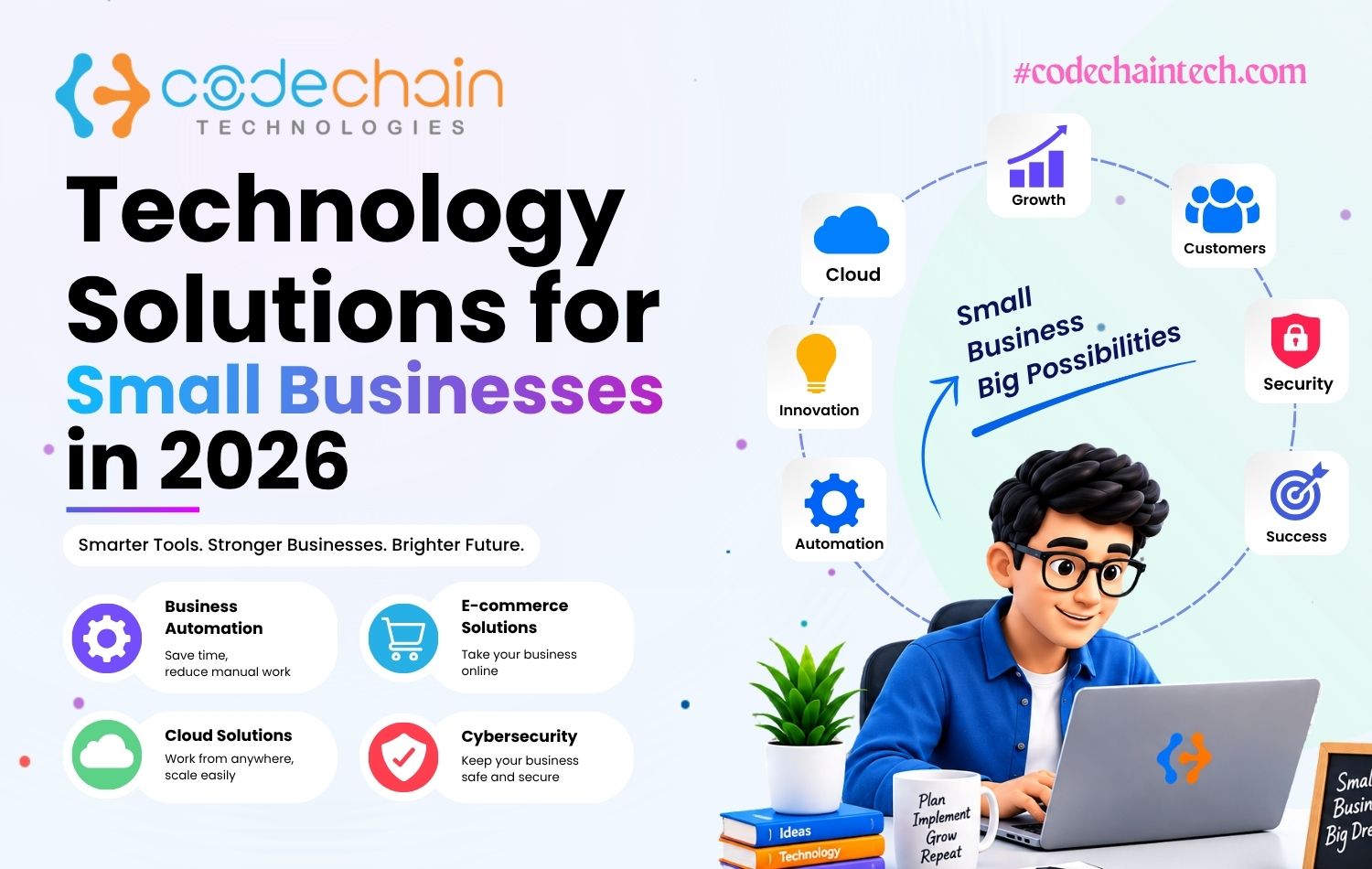
Technology solutions for small businesses are becoming an important part of business growth in 2026. From websites and mobile applications to custom software, CRM, ERP, cloud platforms, AI, and automation, the right technology can help a small business save time, improve customer service, reduce repetitive work, and compete more effectively. However, the goal should not be to adopt every new technology. Businesses should choose solutions that solve real problems and support their long-term growth.
What Are Technology Solutions for Small Businesses?
Technology solutions for small businesses are digital tools, software, platforms, and services that help a company manage operations, customers, sales, data, communication, and business growth.
For one business, the right solution may simply be a professional website. Another company may need a CRM to organize leads and customer communication. A growing organization may require ERP software, a mobile application, cloud infrastructure, AI automation, or a custom business management platform.
The important thing is that technology should support the way a business actually works. A solution that works well for a retail company may not be suitable for a healthcare provider, logistics company, educational business, or professional service firm.
When a business has unique workflows or requirements, custom software development can provide greater flexibility than forcing employees to work around the limitations of generic software.
Why Do Small Businesses Need Technology in 2026?
Technology has become more accessible to small businesses. Companies no longer need large internal IT departments to benefit from modern software, cloud platforms, automation, and AI.
One major reason businesses invest in technology is efficiency. Manual data entry, spreadsheets, repetitive communication, disconnected systems, and paper-based processes can consume valuable working hours. Digital solutions can automate many of these activities and allow employees to focus on more important work.
Technology can also improve customer experience. A professional website can make a business available 24/7, while a mobile application can make services more convenient. CRM software can help teams manage customer relationships, while AI can provide faster responses to common questions.
For businesses that need a strong online presence, web development services can help create responsive and scalable websites or web applications that support business goals.
Types of Technology Solutions for Small Businesses
There is no single technology solution that every small business needs. The right combination depends on the industry, business model, customers, employees, budget, and growth plans.
Business Websites and Web Applications
A business website is often the first digital interaction between a company and a potential customer. A good website should clearly communicate the company's products or services, provide simple navigation, work properly on mobile devices, and make it easy for visitors to take action.
Businesses with more complex requirements may need a web application instead of a standard website. Examples include customer portals, booking systems, inventory dashboards, learning platforms, SaaS products, and online marketplaces.
CodeChainTech's web development capabilities include modern technologies such as React, Node.js, Laravel, Python, Go, PHP, Angular, Next.js, and Vue.js.
Custom Software Development
Generic software is useful when business requirements are standard. However, some businesses have unique processes that cannot be handled efficiently by off-the-shelf tools.
Custom software can bring multiple business processes into one solution. For example, a distributor may need inventory management, customer records, order processing, reporting, employee access, and payment integration in one platform.
Another advantage is scalability. A custom application can be improved as the business grows, allowing new features and integrations to be added when required.
CodeChainTech's existing custom software development guide explains how customized software can help businesses improve efficiency and manage unique processes.
CRM Software
Customer relationships are important for almost every growing business. A CRM system helps organize customer information, leads, communication, follow-ups, sales activities, and customer interactions.
Instead of keeping customer information across spreadsheets, emails, and separate applications, a CRM can provide a centralized view of customer activity.
This can help sales teams follow up with leads, understand customer history, track opportunities, and improve communication.
Businesses looking for structured customer-management solutions can explore CRM services based on their workflows and requirements.
ERP Software
As a business grows, managing finance, inventory, sales, purchasing, employees, and other operations separately can become difficult.
ERP software connects important business processes in a centralized system. This can reduce duplicate data, improve visibility, simplify reporting, and help management make better decisions.
ERP can be particularly useful for businesses that have multiple departments or complex operational workflows.
CodeChainTech also provides ERP solutions as part of its enterprise services, alongside CRM, cloud, system integration, and other business solutions.
Mobile Applications
Mobile applications can give businesses a direct channel for customer engagement and service delivery.
Depending on the business model, an app can support online ordering, bookings, payments, loyalty programs, customer accounts, notifications, field operations, or internal workflows.
However, not every small business needs an app immediately. A mobile application becomes more valuable when customers frequently interact with the business through smartphones or when a mobile-specific experience can provide meaningful value.
Businesses can explore app development services when they need custom Android, iOS, or cross-platform applications. CodeChainTech lists Flutter, Android, and iOS development within its app-development services.
AI and Business Automation
Artificial intelligence is becoming increasingly practical for small businesses. AI can support customer service, data analysis, content workflows, document processing, recommendations, forecasting, and business automation.
For example, an AI chatbot can answer frequently asked customer questions, while an AI-powered workflow can process information and reduce repetitive manual work.
The best approach is usually to start with a specific business problem rather than implementing AI simply because it is a popular technology.
Businesses interested in AI can explore CodeChainTech's artificial intelligence solutions, which are part of its broader technology services.
How Technology Helps Small Businesses Grow
The value of technology should be measured by business outcomes, not simply by how many tools a company uses.
Save Time and Reduce Manual Work
Automation can handle repetitive tasks such as notifications, data processing, routine reports, customer responses, and workflow updates.
When employees spend less time on repetitive work, they can focus more on sales, customers, strategy, and other activities that require human decision-making.
Improve Customer Experience
Customers expect businesses to provide fast, convenient, and reliable digital experiences.
A responsive website, CRM, mobile application, or AI chatbot can make it easier for customers to find information, communicate with a business, place orders, book services, or receive support.
Improve Business Decisions
Centralized data can help business owners understand sales, customer behavior, inventory, employee performance, and operational results.
Instead of making decisions based only on assumptions, businesses can use accurate information to identify opportunities and problems.
Support Business Scalability
A technology solution should not only solve today's problem. It should also be able to support future growth.
Scalable software architecture, cloud infrastructure, flexible databases, and well-planned integrations can make it easier to support more users, customers, transactions, and data.
How Much Do Technology Solutions for Small Businesses Cost?
There is no universal price for technology solutions because every project has different requirements.
A basic business website may require a smaller investment than a custom web application, mobile app, ERP platform, or AI-powered system.
The final cost can depend on:
Businesses should therefore avoid choosing a technology provider only because it offers the lowest initial price.
A better approach is to identify the business problem, define essential features, establish a realistic budget, and then select technology that provides long-term value.
How to Choose the Right Technology Solution
Before investing in a new technology solution, a business should answer several practical questions.
What problem are we trying to solve?
Technology should have a clear purpose. If the business cannot identify the problem, it may not yet be ready to invest in a new system.
Who will use the solution?
Customers, employees, managers, administrators, and business owners can all have different requirements. Understanding users helps create better functionality and usability.
Can the solution scale?
A solution that works for a small number of customers may need changes when the business grows. Scalability should therefore be considered during the initial planning stage.
Can it integrate with existing systems?
A new application may need to connect with payment gateways, accounting software, CRM systems, databases, APIs, analytics platforms, or other business tools.
What happens after launch?
Software needs updates, monitoring, security improvements, bug fixes, and feature enhancements. Long-term maintenance should be considered part of the technology investment.
Businesses can also benefit from learning how to choose the right technology partner, especially when the project is expected to grow over time.
Cloud Technology for Small Businesses
Cloud technology can give small businesses access to scalable computing, storage, databases, application hosting, backups, and other infrastructure without requiring the same level of physical infrastructure investment.
Cloud platforms can also support remote access and make it easier to scale applications as usage increases.
For example, a growing business can host its web application and database in the cloud and increase resources when traffic or customer demand grows.
Businesses planning cloud adoption can learn more through CodeChainTech's guide to cloud technology, which covers cloud strategy, migration, cloud-native applications, infrastructure management, DevOps, and security.
Technology Solutions Based on Business Needs
The best technology solution depends on the problem a business wants to solve.
If a company needs a stronger online presence, a professional website may be the right starting point.
If the main problem is managing leads and customer communication, a CRM can provide better organization.
If several departments need to work with connected business data, ERP may be more appropriate.
If employees spend too much time on repetitive tasks, automation or AI can help.
If a business has unique workflows that generic tools cannot support, custom software may be the better option.
If customers frequently interact with the business through smartphones, a mobile application may provide additional value.
If the business needs scalable infrastructure, cloud technology can support future growth.
This problem-first approach prevents businesses from investing in technology simply because it is popular.
Technology Trends Small Businesses Should Watch in 2026
Small businesses do not need to adopt every technology trend. Instead, they should focus on technologies that can create measurable business value.
AI-powered automation is becoming more practical for customer support, workflows, analytics, personalization, and business operations.
AI agents are also developing beyond simple question-and-answer systems, allowing businesses to automate certain multi-step tasks.
Cloud-native applications continue to provide flexibility and scalability, while mobile-first experiences remain important for customer-facing businesses.
Data analytics can help companies understand customer behavior, sales performance, operational efficiency, and other business metrics.
Cybersecurity is another important consideration as more business operations move online. The U.S. Federal Trade Commission provides cybersecurity guidance for small businesses, including recommendations around software updates, backups, data protection, and common cyber risks.
A Practical Technology Roadmap for a Small Business
A small business does not need to transform everything at once. A phased approach can be more practical and cost-effective.
Identify the biggest business problem.
Start with the process that consumes the most time, creates the most errors, or limits growth.
Define measurable goals.
Decide what success should look like. It could be faster customer response, fewer manual tasks, better sales tracking, lower operating costs, or higher customer retention.
Select the right technology.
Choose the simplest technology that can solve the problem while leaving enough room for future growth.
Build or implement the solution.
Depending on the requirements, this may involve a website, mobile application, CRM, ERP, cloud platform, AI system, or custom software.
Test before scaling.
Start with essential functionality, collect feedback, identify issues, and improve the solution before expanding it.
Measure results.
Track business outcomes instead of focusing only on technical metrics.
Improve continuously.
As the business grows, the technology roadmap should evolve with new features, integrations, automation, security updates, and changing customer needs.
Why Choose CodeChainTech for Small Business Technology Solutions?
Choosing the right technology partner can have a major impact on the success of a digital project.
CodeChain Technologies positions itself as a custom software development partner for startups, SMEs, and enterprises, offering AI, custom software, SaaS platforms, web applications, mobile apps, cloud solutions, and digital transformation services. The company states that it has delivered 100+ projects and works across industries including healthcare, FinTech, education, retail, logistics, and real estate.
The company follows an end-to-end development process covering requirement analysis, UI/UX design, project planning, development, quality assurance, deployment, and maintenance.
For small businesses, this type of end-to-end approach can be useful when a project needs to grow over time. Instead of selecting technology first and then changing the business process around it, businesses can begin with their actual requirements and develop a solution around those needs.
If you are comparing IT companies in Surat, it is also useful to evaluate technical expertise, communication, project experience, scalability, support, and the company's understanding of your business requirements.
Conclusion
Technology solutions for small businesses can support much more than basic digital presence. The right combination of custom software, web applications, mobile apps, CRM, ERP, cloud technology, AI, and automation can help businesses improve productivity, serve customers better, manage information, and prepare for future growth.
The best technology is not necessarily the newest or most expensive option. It is the solution that solves a real business problem, fits the company's budget, provides measurable value, and can grow with the business.
For a small business planning its next digital investment, the best starting point is to identify the biggest operational or customer challenge, understand the available solutions, define measurable goals, and choose a technology partner that can support both implementation and long-term growth.
If you are planning custom software, a website, mobile application, AI solution, CRM, ERP, or another digital product, you can contact CodeChainTech to discuss your requirements and explore a practical technology roadmap.
FAQs
-
1
What are technology solutions for small businesses?
Technology solutions for small businesses are digital tools, software, platforms, and services that help companies manage operations, customers, sales, communication, data, automation, and growth.
-
2
What technology does a small business need?
The right technology depends on the business. Some companies may only need a website and cloud tools, while others may need CRM, ERP, custom software, mobile apps, or AI solutions.
-
3
How can technology help a small business grow?
Technology can help businesses save time, automate repetitive processes, improve customer experiences, manage data, increase productivity, and support business expansion.
-
4
Is custom software worth it for a small business?
Custom software can be worthwhile when a business has unique workflows or requirements that generic software cannot handle efficiently. It can also provide greater flexibility and scalability.
-
5
How much do technology solutions for small businesses cost?
Costs vary according to features, complexity, platform, integrations, design, security, infrastructure, AI requirements, testing, and maintenance. There is no single price that applies to every business.
-
6
Should a small business invest in a mobile app?
A mobile app can be useful when customers frequently interact with the business through smartphones or when the company needs mobile-specific features such as ordering, booking, payments, loyalty programs, or notifications.
-
7
How can small businesses use AI?
Small businesses can use AI for customer support, chatbots, automation, data analysis, document processing, recommendations, forecasting, personalization, and other repetitive or data-driven activities.
-
8
What is the difference between CRM and ERP?
CRM focuses mainly on customers, leads, sales, and relationships. ERP manages broader business operations such as finance, inventory, purchasing, employees, and connected workflows.
-
9
How do I choose the right technology partner?
Evaluate the provider's technical expertise, business understanding, project experience, communication, development process, scalability, security, maintenance, and long-term support.
-
10
Where should a small business start with digital transformation?
Start with one important business problem. Define the desired outcome, choose an appropriate technology, prioritize essential features, implement the solution, measure the results, and expand gradually.