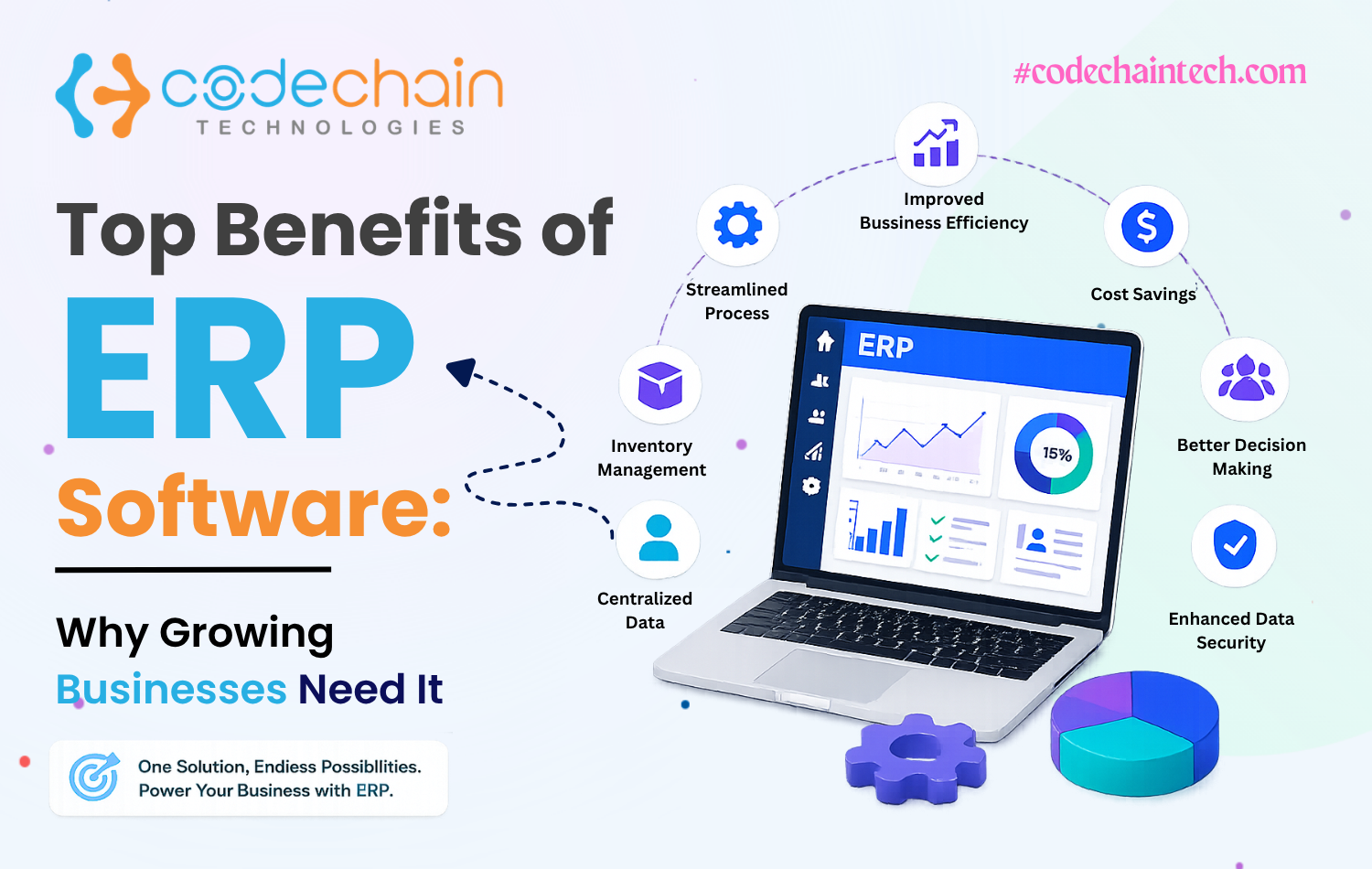
ERP software centralizes your main business operations, making department-specific, accurate, real-time data easily accessible. Rather than relying on disparate systems, teams from different departments (finance, sales, inventory, HR, procurement, and customer service) can now work with an integrated solution. The use of ERP software improves internal communications and overall business operations while decreasing expenses.
CodeChain Technologies specializes in developing custom, enterprise-class, business process automation ERP solutions. The core of the solutions we provide focuses on simplifying complex business operations, improving the efficiency of business operations, and helping businesses undergo long-term, much-needed digital transformation. Our custom ERP solutions are designed to meet the unique business needs of a range of industries and are built to be scalable and secure.
What Is ERP Software?
Using the same centralized data system across departments minimizes data duplication, increases collaboration, and accelerates the pace of informed decision-making.
Common ERP modules include:
Inventory
HR
Sales/CRM
Purchasing/Procurement
Supply Chain
Manufacturing
Project Management
Business Intelligence & Reporting
ERP systems are designed to integrate various business functions with the intention of maximizing productivity, increasing clarity, and simplifying the daily functions of the business.
What is the architecture behind ERP systems?
ERP systems are designed to integrate the various divisions of a business by combining disparate data into a centralized system. This centralized system functions as a real-time system of record across the organizational silos.
Automation is a common feature of ERP systems. When an order is received from a customer:
The process is monitored by database management through dashboards via real-time reporting.
Why Is ERP Software Important for Growing Businesses?
The use of ERP systems across a business enables the simplification of complex business processes while increasing productivity and satisfaction for both the customer and the business.
Common motives that lead companies to purchase ERP software include:
Concentrating on the relationships with customers and growing the business over the long term, instead of having to deal with many separate and uncoordinated systems, becomes the goal.
Key Features of ERP Software
ERP systems that are new and updated help with a broad range of business needs.
Centralized, protected data serves all business needs and protects the data.
Automated systems mean less time is wasted on manual work and errors.
It is easier to manage all aspects of a business and evaluate its performance with the use of live information.
ERP keeps track of purchase orders and the movement and availability of all products.
Various modules manage all aspects of business finances and enhance accuracy.
The system aids business in the management of all client interactions and even sales.
Data that are sensitive and business needs are protected through the control of system access.
Modern ERPs utilize cloud technology. Employee access to business information becomes time-independent and location-independent.
Top 10 Benefits of ERP Software
Increased productivity, efficiency, and sustained growth are all hallmarks of successful business software. ERP software embodies the spirit of technology. Here are some benefits of ERP systems.
Better efficiency becomes evident after deploying ERP. Centralized systems mean that transporting interdepartmental employees no longer becomes a time-consuming operation.
Automated workflows optimize the completion of repeated business tasks and ensure accuracy.
- Automated data entry
- Daily operation streamlining
- Collaborative team improvement
- Time spent business operation optimization
Data silos become a bane of modern business. ERP builds a solution.
Departments utilize real-time data to create a center of improved communication and reduced error.
- Improved data access speed
- Collaboration improves
- Data truthfulness
As businesses scale, so too do the challenges of managing business funds. ERP integrates all financial elements of business operations to build an ease of managing funds.
- Automated accounting
- More precise financial reporting
- Cash flow management improves
- Taxes become easier to manage
- Less accounting mistakes
During the workday, employees waste time entering data into different systems or looking for data that is missing.
Software development streamlines your processes by giving your employees access to the data they need to do their jobs efficiently.
Instead of wasting time on data entry and process management, employees can serve your customers and grow your business.
Business decisions should be based on data.
Current ERP systems come with sophisticated real-time data dashboards, reports, and analytics that assist managers in evaluating their business by monitoring and reporting on KPIs and creating business decisions quickly.
With dashboards and reports that assist managers in monitoring and evaluating their business, managers can be more responsive to the marketplace or their customers.
Managing inventory control becomes more difficult when the number of items or customer orders grows.
The real-time data features of ERP systems control your warehouses and automate purchasing from suppliers.
With ERP systems, inventory control and order fulfillment improve.
- View inventory at any time
- Inventory becomes easier to control and automate
- Control warehouse inventory better
- Reduce inventory costs
Customer satisfaction is the most important part of the success of your business.
ERP systems increase customer satisfaction by decreasing the time needed to answer customer inquiries by providing all of the information and data related to the customer in one location.
Customers appreciate when their time is valued.
As businesses grow, the processes become more complicated.
As your business expands and adds new employees, departments, products, and even operates from new locations, a main benefit of having an ERP system in place is that you won't need to get a new system to accommodate your growing business and its processes.
ERP systems are flexible and a long-term benefit to your business.
Business data is an asset to an organization's operations and overall success.
- Role-based access control
- Data encryption
- Automated backups
- Audit trails
- Multi-factor authentication
- Regulatory compliance support
ERP systems increase security for sensitive and proprietary business data and also meet the security and compliance needs of different industries.
There is a significant initial cost that comes with ERP systems, but they decrease operational costs that come in the years after implementation.
Manual work and paperwork are reduced, redundant systems are eliminated, and resources are better utilized. All of these decrease business errors that are costly. All of this positively impacts the profitability and ROI for businesses.
Industries That Benefit Most from ERP Software
ERP systems were once only accessible to large scale operations, but systems are now made to accommodate businesses of all sizes. ERP systems benefit every industry.
ERP systems benefit manufacturing by having a single system that is used to track every facet of the production, planning, and control processes, including all raw materials and suppliers and all logistics and quality control.
- Production planning
- Inventory management
- Supply chain tracking
- Quality assurance
- Vendor management
Retail businesses often manage thousands of orders and supplier communications. They may also handle thousands of customer transactions and update inventory counts. ERP software provides the ability to automate business processes and manage orders while tracking sales and inventory in real-time.
- Inventory synchronization
- Order management
- Customer relationship management
- Multi-store management
- Sales reporting
ERP software is useful for clinics, hospitals, and other healthcare providers to manage the administration of their business while keeping records of patients and finances. For healthcare industries and providers, ERP systems enhance the management of different sections of the practice and improve the overall experience of the patients.
- Patient management
- Billing and Finance
- Staff Scheduling
- Inventory Management
- Regulatory Compliance
ERP software provides logistics companies with the ability to manage transportation and suppliers and completely view shipments and warehouse operations.
- Shipment tracking
- Warehouse management
- Fleet management
- Route planning
- Procurement Automation
ERP software combines the ability to manage student admissions, attendance, examinations, collections of fees, records of employees, and communications into one system for educational institutions. This combines many systems and reduces the administrative load of the institutions while improving operational efficiency.
Financial institutions require systems that are highly secure and manage transactions along with compliance and reporting, customer accounts, and financial analytics. ERP software assists financial institutions in fulfilling their objective of enhancing transparency with regards to their operations.
Common Challenges During ERP Implementation
ERP software provides vast advantages; however, there are many challenges that will be faced when the software is used for the first time that require planning from the business.
Initial costs such as software purchase and design, implementation, and training come at a high price, but ERP systems are typically a good investment because the initial costs are offset by the considerable long-term benefits of the system.
New systems are typically met with employee resistance because of the comfort of the old, established systems; however, providing training and communicating properly can address resistance.
Data migration from legacy systems to a new ERP can be a difficult task, as it requires advanced data validation and planning in order to maintain data integrity.
Every system does not operate in the same way. ERP systems that provide the option of customized web development can be tailored to meet the unique requirements of each system.
To obtain the maximum benefit from an ERP system, it is essential that employees are adequately trained and ongoing support be provided to reinforce the use of the system.
Best Practices for Successful ERP Implementation
The installation of a new system does not equate to the successful implementation of ERP software. Engaging in best practices for ERP implementation can provide a substantial return on investment.
Understanding the problems that you want to solve for your business is the first step in selecting an ERP system.
Select a reputable ERP development partner who possesses knowledge of your business and the industry.
To ensure the system serves the requirements of the organization, incorporate end users and leadership of each function in the design.
ERP systems can be affected by the integrity of the data that is input; therefore, data needs to be cleaned and validated prior to ERP system population.
The system is of no benefit to the organization if employees are not trained to use it; therefore, training needs to be comprehensive and ongoing to promote employee use of the system.
After implementation, KPIs will help demonstrate how processes have changed and where improvement opportunities exist.
Future Trends in ERP Software
As digital transformation is adopted, the evolution of ERP technologies continues. The future of enterprise resource planning is shaped by many trends.
When embedded into ERP systems, automation, trend forecasting, and task management provide smarter recommendations and support the improvement of overall business decisions.
Flexible, remote, and easily updated ERP systems that reduce IT infrastructure requirements and costs can be found in the cloud services.
Faster business decisions can be made when reports and dashboards are accessible through mobile ERP systems.
ERP systems that include IoT networks provide operational data that can be utilized to improve efficiency and determine the need for maintenance.
Easy analysis and visualization of data provide support in the discovery of actionable business insights.
Why Choose CodeChain Technologies for ERP Software Development?
Having the right ERP development partner is integral to having the ideal ERP system. CodeChain Technologies builds tailored ERP solutions that fit our clients' business operations and requirements as well as the industry and their expected growth.
We provide:
Our developers build secure, scalable, and user-friendly ERPs that meet clients' operational needs and result in increased business efficiency.
Conclusion
Once a company reaches a certain scale, it becomes cumbersome to manage operations with disparate systems and manual processes. An ERP system integrates all business units within a single system and streamlines business processes by automating repetitive tasks and presenting data in real time to aid in more informed business decisions.
ERP systems not only maximize efficiency but also optimize the workplace environment by simplifying intricate processes and decreasing operating expenditures, as well as providing flexibility to adapt to evolving workplace demands and positioning an enterprise for the future with a sustained digital transformation.
CodeChain Technologies creates bespoke, highly specialized ERP solutions for any size company. Flexibility is the focus, with sustainable transformation the goal. An ongoing relationship with CodeChain Technologies is best for optimizing your enterprise's competitiveness with impeccable service and cutting-edge technology.
FAQs
-
1
What is ERP software?
Enterprise Resource Planning software helps businesses manage many of their departments, like Purchasing, Sales, Stock, HR, and Finance, using a single system.
-
2
Why do growing businesses need ERP software?
ERP software helps a business to perform department functions automatically, increase productivity, and reduce the number of manual business functions. It also provides the data to help employees make timely decisions.
-
3
What are the main benefits of ERP software?
ERP software helps a business grow by providing a way to work more efficiently. It also provides better data, helps employees collaborate, and reduces operational costs.
-
4
Which businesses should use ERP software?
ERP software helps many different types of businesses, from manufacturing and retail to healthcare, logistics, education, finance, and even real estate.
-
5
How does ERP software improve productivity?
ERP software stores all data and information in one system and helps employees by performing many business functions automatically.
-
6
What is the difference between ERP and CRM?
ERP systems help manage business operations. CRM systems help manage business sales, marketing, and customer relations.
-
7
Is ERP software suitable for small businesses?
Absolutely. ERP software can be customized to help small and medium-sized businesses and fit their budgets.
-
8
What modules are included in an ERP system?
ERP systems can help manage finance, HR, inventory, sales, CRM, purchasing, manufacturing, supply chain, and reporting, among other business functions.
-
9
How long does ERP implementation take?
It really depends on how big and how complex a business is. Some implementations can be done in a couple of weeks, and some take many months to install.
-
10
Why go for CodeChain Technologies for developing ERP software?
ERP solutions that are secure, scalable, and customized, which CodeChain Technologies delivers, ensure operational automation and optimization of efficiency for growing businesses, all sustained by the latest technologies and our specialists.