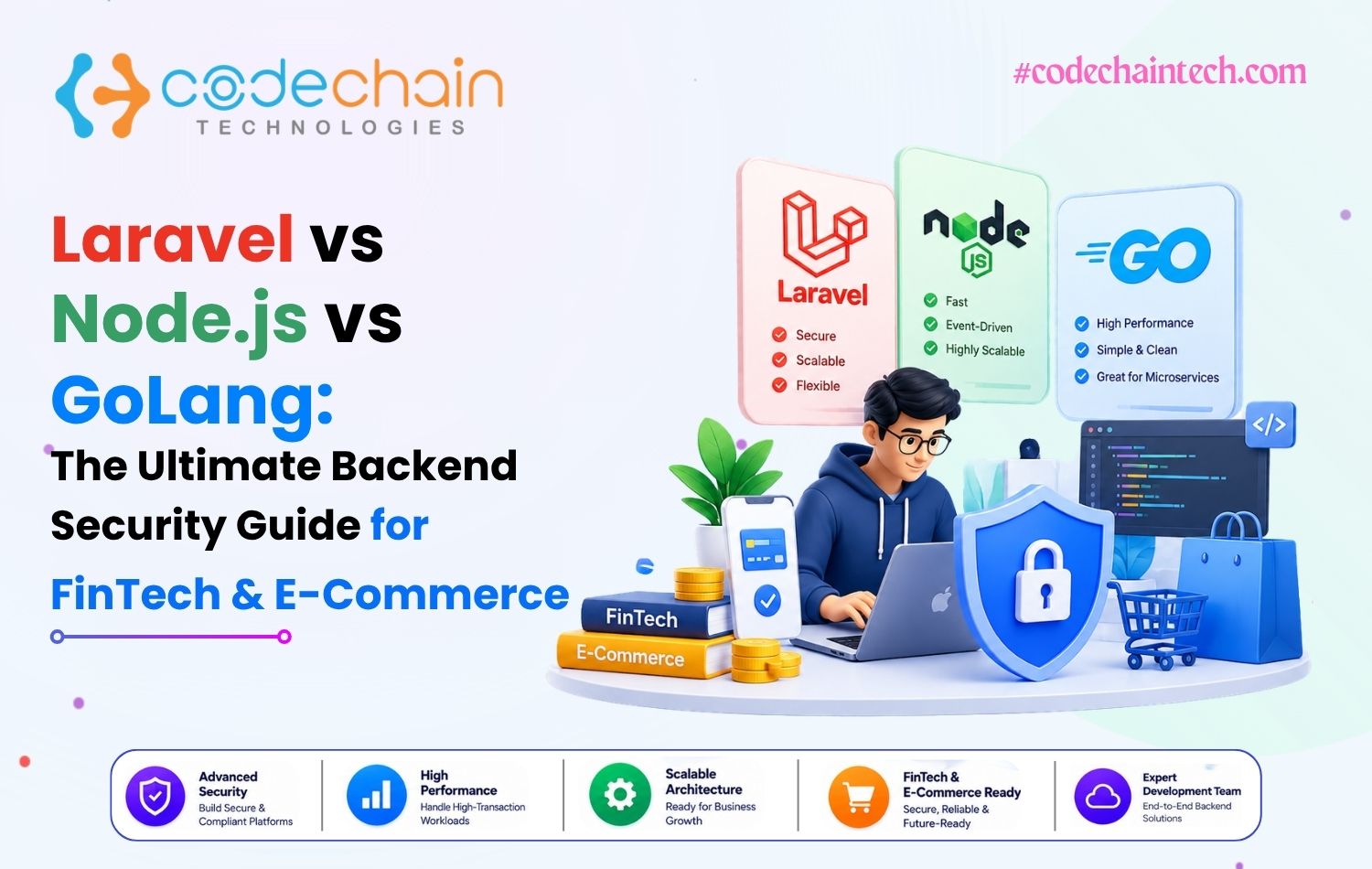
No backend is secure by default, but these three stacks differ in how much security they give you out of the box. For FinTech and E-Commerce platforms, GoLang offers the strongest built-in safety for high-transaction cores thanks to its compiled nature, strict type safety, and memory safety, while Laravel offers the fastest secure launch with ready-made protection against SQL injection, XSS, and CSRF. Node.js remains a top choice for real-time scalability, provided it is architected by experienced developers who manage dependencies carefully.
In this guide, we compare how each stack handles security, where each one fits best, and how to combine them. If you need expert help choosing, our backend development services cover all three.
Quick Comparison: Laravel vs GoLang vs Node.js
Why Backend Security Matters More in FinTech and E-Commerce
A weak backend in these industries does not just cause bugs. It leads to stolen customer data, fraudulent transactions, failed payments, legal trouble, and lost trust.
Platforms that handle money face a few constant pressures:
Sensitive data:
Card details, bank information, and personal records attract attackers.
Fraud attempts:
Fake accounts, payment abuse, and account takeovers happen every day.
Regulations:
Rules such as PCI DSS, RBI guidelines on payment data and India's DPDP Act apply to many platforms.
Downtime costs:
Every minute of failure during a sale or payment peak costs revenue.
That is why the backend decision should be made on security first, then speed and cost. See how we approach banking and fintech projects.
Technical Security Analysis
Here is how each technology handles security, and where it needs extra care.
Laravel: The Out-of-the-Box Shield
- Core architecture: A PHP framework built on a structured MVC pattern, with a clear separation between data, logic, and views.
- Security mechanisms: The Eloquent ORM and query builder use parameter binding to block SQL injection. Blade templates escape output by default to reduce Cross-Site Scripting (XSS), and built-in tokens protect forms against Cross-Site Request Forgery (CSRF). Laravel also provides password hashing, encryption, rate limiting, and authentication tools such as Sanctum.
- Where it needs care: Raw SQL queries, mass assignment mistakes, debug mode left on in production, and outdated packages can still create gaps.
- Best for FinTech and E-Commerce: Platforms that need secure user authentication, quick payment gateway integration, and strong defaults from day one.
Our team builds secure platforms with Laravel development for exactly these use cases.
GoLang: The Compiled, Memory-Safe Powerhouse
- Core architecture: A statically typed, compiled language created by Google for simple, fast, and highly concurrent services.
- Security mechanisms: Strict typing catches many errors at compile time. Go is memory-safe, so bounds checking and garbage collection prevent the classic buffer overflow bugs common in languages like C and C++. Its standard library offers solid cryptography and TLS support, and tools such as govulncheck scan your code for known vulnerabilities in dependencies.
- Where it needs care: A language cannot fix flawed logic. Injection, broken access control, and poor secret handling are still possible, and Go gives you fewer ready-made web protections than Laravel, so teams must assemble them carefully.
- Best for FinTech and E-Commerce: Payment gateways, digital wallets, ledgers, fraud-scoring services, and core banking microservices that process large volumes of concurrent transactions.
Node.js: The Flexible Real-Time Engine
- Core architecture: An asynchronous, event-driven JavaScript runtime built on Chrome's V8 engine, ideal for handling thousands of connections at once.
- Security mechanisms: Node.js includes built-in crypto and TLS modules and gets regular security releases, but its core stays minimal. Most protections come from libraries, such as Helmet for secure headers, validation libraries for input, and rate-limiting middleware. This means security depends heavily on developer skill and on auditing npm packages, because attacks through malicious or compromised packages have happened.
- Where it needs care: Large dependency trees, unvalidated input, weak token handling, and outdated packages.
- Best for FinTech and E-Commerce: Live bidding auctions, multi-vendor tracking dashboards, real-time stock allocation, and chat and notification systems where speed and open socket connections are vital.
When built by experienced engineers, our Node.js development projects handle real-time load securely.
Common Backend Security Risks (No Stack Is Immune)
Every technology above can fall into the same classic mistakes. The OWASP Top 10 lists the most critical web application risks, including:
Broken access control: Users reaching data or actions they should not.
Injection attacks: Malicious input that tricks the database or system.
Cryptographic failures: Weak encryption or exposed sensitive data.
Vulnerable and outdated components: Old libraries with known flaws.
Authentication failures: Weak passwords, sessions, and token handling.
Security misconfiguration: Debug mode, open ports, and default settings.
The framework choice reduces some of these risks, but never all of them. Secure design and regular testing matter just as much as the language.
Strategic Business Use Cases: Which One Should You Choose?
Choose Laravel if:
- You are launching a standard multi-vendor e-commerce portal, a subscription-based SaaS tool, or a consumer lending application.
- You need a secure release under a tight deadline.
Choose GoLang if:
- You are building an independent payment gateway, a high-volume crypto or neo-banking platform, or a ledger system. Our GoLang development team works on exactly this kind of architecture.
- A database lag or security breach would mean serious financial loss.
Choose Node.js if:
- Your platform depends on real-time data streaming, intensive chat features, or highly interactive frontends.
- You need fast microservices connectivity and instant updates.
Cost, Team, and Timeline: The Practical Side of the Decision
Security is the first filter, but budget and team also shape the final choice:
Laravel:
A large pool of PHP developers and a rich ecosystem keep development fast and affordable, which suits startups and growing stores.
GoLang:
Teams are er and Go developers are fewer, but the language is simple and efficient, so it pays off for long-running, high-volume services.
Node.js:
JavaScript on both frontend and backend lets one team cover more of the product, which helps real-time and API-heavy platforms.
A simple rule works well: start with the risk. If a breach or a database lag would cost you serious money, invest in the strongest foundation first. If speed to market matters most and the risk is moderate, choose the stack that gets you a secure launch fastest, then evolve the architecture as you grow.
Security Best Practices for Any Backend
Whichever stack you pick, follow these basics:
Never store raw card data. Use tokenization through PCI DSS-compliant payment gateways.
Encrypt data in transit and at rest. Use TLS everywhere and a mature database such as PostgreSQL with proper access controls.
Use parameterized queries and validate every input.
Protect authentication. Add multi-factor authentication, short-lived tokens, and secure session handling.
Apply least privilege. Give each user and service only the access it needs.
Add rate limiting and fraud monitoring to stop abuse early.
Scan dependencies regularly with tools such as npm audit, Composer audit, and govulncheck.
Log, monitor, and test. Run penetration tests and review logs for suspicious activity.
Can you combine Laravel, GoLang, and Node.js?
Yes, and many mature platforms do. A common architecture uses each technology where it is strongest:
Laravel
for the admin panel, storefront, and business logic
GoLang
for payment processing, ledgers, and high-volume transaction services
Node.js
for real-time notifications, live tracking, and chat
This approach keeps the most sensitive services on the strongest foundation while keeping development fast. For a deeper comparison of two of these options, read our guide on GoLang vs Node.js.
Engineering Secure, Scalable Backends with CodeChain Technologies
Security is designed into every architecture decision we make, not added at the end. Our backend team works across Laravel, GoLang, Node.js, and other stacks and recommends the one that fits your risk level, traffic, and timeline.
We have hands-on experience with money-handling software. Pay To All is a payments platform for mobile recharge, bill payments, and money transfers, where security measures include encryption, two-factor authentication, and fraud detection. Hisab Book is a digital ledger app with PIN and biometric protection, role-based access, and secure cloud backup.
With 10+ years of technology industry experience and 3000+ projects delivered, our team builds secure backends that are ready to scale.
Conclusion
GoLang gives you the strongest foundation for high-transaction financial cores, Laravel gives you the fastest route to a secure launch, and Node.js gives you real-time speed when it is built with care. The right choice depends on your risk level, traffic, and timeline.
Security is not a feature; it is the foundation of your digital ecosystem. Ready to engineer a scalable, secure backend for your next product? Contact CodeChain Technologies core backend architects today for a free consultation.
Need a secure backend?
Contact us today for a free consultation.
FAQs
-
1
Why is GoLang preferred over Node.js for high-security banking software?
GoLang is statically typed, compiled, and memory-safe, so it catches many errors before production and prevents classic memory bugs. It also tends to have smaller dependency trees than Node.js, which lowers supply-chain risk. Node.js can be secured well, but it relies more on third-party packages and developer discipline.
-
2
Can Laravel handle large-scale enterprise e-commerce transactions securely?
Yes, with the right architecture. Laravel’s built-in protections handle common web attacks, and caching, queues, database optimization, and horizontal scaling let it serve high traffic. For extremely heavy payment processing, teams often move that part to a dedicated GoLang service.
-
3
What are the top security risks when setting up a Node.js payment gateway?
The biggest risks are vulnerable or compromised npm packages, weak input validation, insecure token handling, missing rate limiting, exposed secrets, and unverified payment webhooks. Never store raw card data, and use PCI DSS-compliant gateways.
-
4
Is Laravel secure enough for FinTech applications?
Yes, for many FinTech products such as lending platforms, wallets, and payment dashboards, they are built with best practices and kept updated. For ultra-high-throughput cores, a GoLang service is often added.
-
5
Is Node.js safe for e-commerce?
Yes, when developers validate input, audit dependencies, use secure headers, and handle tokens properly. Safety comes from how it is built, not only from the runtime.
-
6
Can I use more than one backend technology in a single platform?
Yes. Many platforms use Laravel for business logic, GoLang for payments, and Node.js for real-time features, connected through APIs and microservices.
-
7
Does the programming language alone make an application secure?
No. Secure design, access control, encryption, testing, and regular updates matter as much as the language. Any stack can be insecure if it is built carelessly.
-
8
Which backend is fastest to launch for a secure e-commerce store?
Laravel is usually the fastest because it includes authentication, validation, and protection against common attacks out of the box.
-
9
What are the top 5 backend frameworks?
The top 5 backend frameworks widely used in modern web development are Express.js, Django, Spring Boot, Laravel, and ASP.NET Core
-
10
Which backend language is most in demand?
The most in-demand backend languages currently dominating the tech industry are Python and JavaScript (Node.js). Recent market data and recruiter reports indicate that Python leads with roughly 45.7% recruiter demand, closely followed by JavaScript at 41.5%.