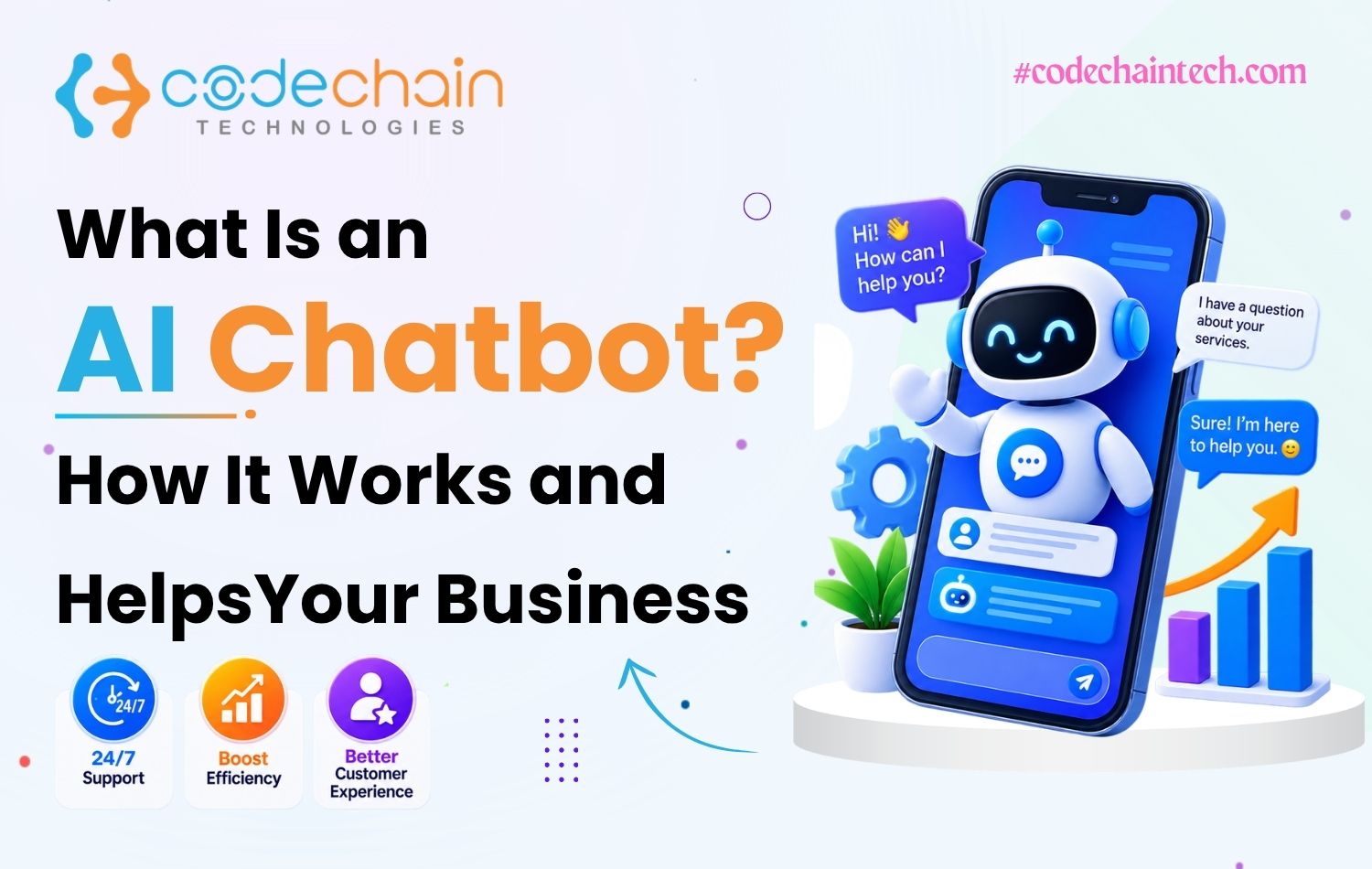
AI chatbots allow businesses to answer several basic questions and engage in advanced conversational modalities due to their ability to analyze and understand natural language. In comparison to traditional chatbots, AI chatbots create a novel avenue for businesses to communicate with their customers. They can help businesses engineer their customer support and automate their business processes and even help a business generate sales leads. AI chatbots are increasingly useful in today's economy where consumers are becoming more impatient and (your) business must prioritize personalization and speed of offerings. Since AI chatbots answer most frequently asked questions, your employees can prioritize more complex work. For your business to successfully utilize a smart assistant, you must first comprehend the technology and how it can best serve your business.
What Is AI Chatbot Technology, and How Does It Operate?
AI chatbots conduct messaging-based communication and are capable of deriving the meaning of an open-ended text-based question and providing an answer. The technology can be divided into the following steps.
New advancements in technology have enabled the integration of NLP, machine learning, and generative AI, as well as the use of APIs in the context of business data. As a result of all these software developments, advanced and more relevant and sophisticated conversations can take place.
Key Features of an AI Chatbot
What is an AI chatbot if we don't acknowledge its key building blocks? The features that distinguish an AI chatbot from a traditional automated chat system will become a lot more obvious.
Understanding Natural Language
AI chatbots make use of natural language processing (NLP) in understanding natural language commands and, therefore, do not require the use of command keywords.
Contextual Understanding of Conversations
Chatbots are programmed to understand the various aspects of a conversation. For example, if a user articulates interest in a specific product and subsequently asks about the price, a chatbot interprets "it" to mean the product of interest.
Personalized Responses
By making use of custom data drools, personalized and relevant answers may be provided based on the user.
AI Chatbots Meet Most Business Requests
AI chatbots work outside of business hours to meet support requests by most organizations. This means users can access support on weekends, holidays, and in the wee hours of the morning.
Multilingual Support
AI can help businesses overcome the barriers of language and customer support by offering multiple language support.
Integration with Business Systems
AI chatbots are able to engage beyond the answer to a simple query by integrating with various business systems, including CRMs, databases, e-commerce systems, and appointment systems.
How AI Chatbots Benefit Businesses
AI chatbots can improve client support, but how do we see them in a business context? A well-developed chatbot can be a part of a business's digital workflow.
1. Faster Client Support
At Codechaintech, customers expect, and indeed deserve, instant support. Behind-the-scenes systems mean chatbots can support customers' requests for the status of a delivery, return policies, price checks, available services, and queries about pest control or account-related queries without having to route a support request to a staff member.
2. Lead Generation
Chatbots make it easy to engage with customers to uncover their interests and collect critical contact info. Potential customers can be automatically transferred to sales staff. This is especially useful for service businesses, where customers require support and contact info collected before talking with sales staff.
3. Less Repetitive Work
Support staff resolve basic queries. This work involves a lot of repetition and takes time. If we automate repetitive conversations, support staff can use their time for important work.
4. An Improved Customer Experience
Customers lose patience with delays. Many customers leave unanswered requests, which means they will ask the same question again going forward. Customers can ask questions, get answers, and receive instant feedback with natural language communication.
5. Internal Employee Support System
AI can assist internal employees as well. Employees can find system files, company policies, and other important assets of the business.
AI Chatbot vs Traditional Chatbot
A traditional chatbot is programmed to respond to questions based on available data and rules. If a user asks a question outside the scope of programming, or the value and requests of the user do not align with the programming, the chatbot cannot respond.
AI chatbots, unlike their traditional counterparts, can understand language and rely on context beyond the given scenario.
In some cases, a simple FAQ bot may not need advanced AI. But AI-based chatbots help businesses with complex jobs and even more complex responses.
Common Use Cases of AI Chatbots
AI chatbots are used in many situations. They all interact with customers in different ways. AI chatbots make it easy for customers to find what they are looking for, take care of common interactions, and answer frequently asked questions and provide basic user guidance to aid in the purchase decision.
Healthcare
Chatbots are used as an aid to answer basic activities like helping users answer questions and offering prompt reminders. Chatbots cannot act as healthcare professionals in making clinical judgments.
Banking and Finance
AI chatbots can help answer basic questions regarding accounts and help guide a user through a transaction with bank services. It is critical that the customer's safety and security be prioritized.
Education
AI assistants can provide users with direct answers to common student questions, help with course admin tasks, and provide an overall improvement to communication within the administrative tasks of a university.
Real Estate
AI chatbots can help provide basic information, aid in data collection and lead qualification, and help schedule appointments for a sales team.
AI chatbots can use many different technologies in order to understand backend language, learn from usage patterns, and learn to respond with more complex messages. Along with the technologies of AI, most chatbots connect with other services through APIs to help give them additional functionalities.
Software and IT Services
For chatbot development, JavaScript frameworks like Angular, Vue, or React with back-end support in Python, Node.js, PHP, .NET, Flutter, or React Native can be used. Technology stacks should be determined by the expected traffic level, required integrations, budget, and security needs—not by passing trends.
How to Build an AI Chatbot for Your Business
We have discussed several use cases for AI chatbots, which brings us to how to build one—the next most critical aspect of the information we have shared.
AI chatbots must have advanced query routing.
Consider the following
AI chatbots should not be considered a complete replacement for human support.
If business data is not appropriate, AI chatbots often provide correct answers in chat sessions.
This may lead to other issues when integrating the chatbot into the company's systems and dealing with the security aspects, ease of use of X functionality, and the frustration of the users in the absence of human support.
Building an AI chatbot is a continuous process of testing, monitoring, reviews, and updates.
Why Every Business Needs AI Chatbots
AI chatbots solve support and communication problems for businesses dealing with a high volume of customer queries, cross-time zone operations, slow lead response times, and support automation.
Automating customer communication via conversational AI also expands beyond support. Intelligently automating conversations via context and customization brings real value to businesses.
CodeChainTech can help your business build the custom AI solutions you need to enhance your web, app, and backend tools and integrate databases and cloud services for your project.
Conclusion
Modern businesses can automate communication channels and easily provide quick communication to their customers using AI chatbots. Several businesses will continue to find new use cases for chatbots, from customer support to lead generation, internal task assistance, and beyond.
It's important for businesses to know that the value of an AI chatbot is not only measured by the automation of support. It will truly serve a business well when a chatbot is integrated with AI to contextualize business services.
Focus on the problem, contextualize how to use automation technologies, and avoid the mindless addition of a chatbot to your system.
FAQs
-
1
What is an AI chatbot?
AI chatbots are pieces of software that use artificial intelligence to engage in human-like conversations thanks to their ability to process human language.
-
2
How does an AI chatbot work?
AI chatbots work by interpreting the user’s message and replying with a message in human language using their natural language processing capabilities. More advanced AI chatbots can combine their natural language processing capabilities with other business services to create their responses.
-
3
What sets an AI chatbot apart from a regular chatbot?
AI chatbots can process human language, understand the context of a conversation, and provide answers that go beyond a predefined set of answers. By contrast, a regular chatbot can only answer questions based on the rules determined in advance.
-
4
Do AI chatbots work 24/7?
AI chatbots can work any hour of the day without the need for an agent to connect with every customer.
-
5
Do AI chatbots help with leads?
AI chatbots are able to carry on a conversation, understand the needs of a potential customer, collect lead data, and convey a lead to a sales representative.
-
6
AI chatbots can be implemented across company websites.?
Yes, AI chatbots can be added to company websites and integrated into the CRM and customer support services as well as the API platforms.
-
7
AI chatbots are a good idea for small businesses.?
Yes, AI chatbots are great for answering FAQs and providing customer support for small businesses. Further, chatbots can capture leads and provide support and aid customers during after hours and off business hours.
-
8
Do AI chatbots work across multiple languages?
Of course. AI chatbots can be built for a given business to support customers across multiple languages and multiple countries.
-
9
Do AI chatbots replace human employees?
AI chatbots and human employees can be utilized to accomplish work in complementary fashion. Basic and routine customer requests can be diverted to the AI chatbots, while human employees can be reserved for requests that may be sensitive or of high value.
-
10
AI Chatbot development cost?
There are multiple factors that come into play when considering the cost of web development: the level of complexity of the chatbot, the type of AI models employed, the number of integrations, how many chatbot installations will occur, the extent of customization, the security framework, and the estimated development period. More integrations with multisystem chatbot deployment will increase the cost, while a basic chatbot will be relatively less expensive.