AI coding tools have changed how people build software. What once required days of planning, coding, and debugging can sometimes begin with a simple prompt. Today, startup founders, developers, and business owners can generate interfaces, build prototypes, and experiment with applications faster than before.
But faster software development raises an important question: Can AI-generated code actually handle real customers, financial transactions, sensitive data, and long-term business growth?
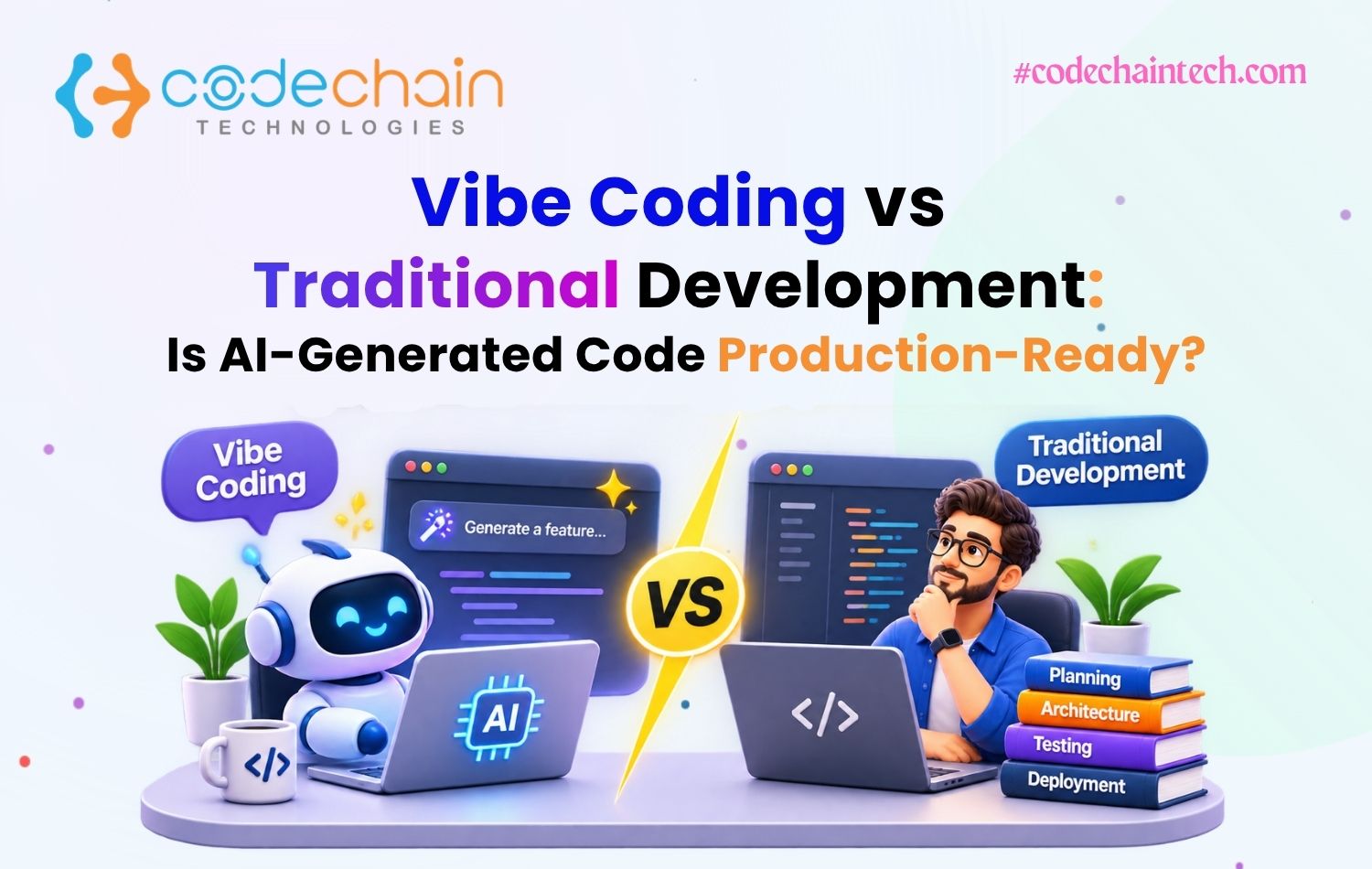
Vibe coding is a prompt-driven approach to software creation where AI generates code from natural-language instructions, while traditional development relies on structured engineering, deliberate architecture, testing, and code reviews. AI-generated code can become production-ready, but only when it meets appropriate security, reliability, performance, and maintainability standards.
The difference isn't simply AI versus human developers. Professional development teams increasingly use AI tools as part of their workflows.
For businesses, the real challenge is deciding when fast AI-generated development is sufficient and when a structured engineering process becomes essential.
This guide explores vibe coding vs traditional development, including their differences, benefits, security risks, costs, and suitability for production applications.
What Is Vibe Coding and How Does It Work?
Vibe coding is a software development approach in which users describe what they want in natural language and rely heavily on AI tools to generate and modify application code.
Instead of manually writing every function, developers or nontechnical users explain requirements through prompts.
For example, someone might enter:
"Build a customer dashboard with login functionality, order history, and payment status tracking."
An AI coding tool may generate interface components, application routes, and supporting logic.
Users can then request changes through additional prompts.
How the Vibe Coding Process Works
A typical workflow includes:
Describe the Idea: Explain the desired application or feature.
Generate Code: An AI coding tool creates an initial implementation.
Preview the Application: Run the generated software and inspect its functionality.
Refine Through Prompts: Request changes, new features, or bug fixes.
Review and Test: Evaluate whether the application meets functional and technical requirements.
Tools such as Cursor, GitHub Copilot, and Replit offer AI-assisted coding capabilities, although their workflows differ.
Importantly, not every use of AI coding tools qualifies as vibe coding.
A developer who understands and reviews generated code is practicing AI-assisted software development. Vibe coding generally involves greater reliance on generated output, sometimes without examining the underlying implementation in detail.
This distinction becomes important when applications move beyond experimentation.
Vibe Coding vs Traditional Development: Key Differences
Both approaches can produce working software, but they differ in how applications are planned, implemented, and validated.
Traditional development generally follows an engineering process involving requirements analysis, architecture planning, implementation, testing, and maintenance.
Vibe coding emphasizes rapid creation through natural-language instructions.
Comparison: Vibe Coding vs Traditional Software Development
Speed vs Long-Term Reliability
Vibe coding can accelerate the early stages of development.
A founder may create a functional demonstration without assembling a complete development team.
However, a working demonstration doesn't necessarily mean the application is ready for real users.
Traditional development usually involves more deliberate planning, especially when an application must support complex integrations, large datasets, or critical business operations.
The strongest approach is not always choosing one over the other.
Businesses can benefit from AI-generated code while maintaining professional engineering standards.
7 Risks of Using AI-Generated Code in Production
AI-generated code can look convincing and function correctly during a demonstration.
However, problems may remain hidden until the application handles unexpected requests, real transactions, or larger workloads.
Understanding these risks helps businesses avoid costly mistakes.
1. Security Vulnerabilities
AI-generated code can introduce insecure authentication, improper authorization, injection vulnerabilities, or exposed credentials.
For example, an AI-generated administrative dashboard may successfully display customer records but fail to verify whether the logged-in user has permission to access every record.
The application appears functional, yet sensitive information could be exposed.
The OWASP Top 10 identifies major web application security risks that developers should consider during implementation and testing.
Regardless of whether code is written by AI or humans, security controls must be deliberately implemented and verified.
2. Poor Architecture Decisions
Applications need a structure that supports maintenance, testing, and future improvements.
Prompt-driven development may produce code that works initially but lacks clear separation between business logic, database access, and user interfaces.
As features increase, these architectural weaknesses can make development more complicated.
A well-designed application should use appropriate components, consistent coding patterns, and clearly defined responsibilities.
3. Limited Scalability
An web application working perfectly for five users may struggle when thousands of users access it simultaneously.
Generated code might contain inefficient database queries, unnecessary API requests, or poorly managed background tasks.
Without performance testing, these problems can remain unnoticed.
Businesses expecting growth need architecture that considers traffic, database performance, caching, and infrastructure capacity.
4. Hidden Technical Debt
Technical debt occurs when implementation choices make future web development more difficult.
AI-generated applications may accumulate duplicate functions, inconsistent patterns, unnecessary dependencies, or complicated logic.
If nobody understands the codebase, even small changes can become time-consuming.
Regular refactoring, documentation, and code reviews help reduce these problems.
5. Unreliable Error Handling
Real applications must handle situations that demonstrations rarely cover.
Consider an e-commerce checkout system.
A payment request may succeed, but the customer's internet connection could fail before the confirmation appears.
If the application doesn't handle retries correctly, it might create duplicate orders or inconsistent records.
Reliable systems need transaction management, idempotency, validation, and appropriate recovery procedures.
6. Compliance and Data Privacy Risks
Healthcare, FinTech, and enterprise applications often process sensitive information.
These systems may face regulatory requirements involving personal data, financial records, and access controls.
AI-generated code doesn't automatically satisfy those requirements.
Organizations must evaluate applicable regulations, data handling, auditability, and security responsibilities.
7. Maintenance and Ownership Challenges
Businesses need to understand who will maintain their applications after launch.
If a system depends on generated code that nobody can explain, debugging and future upgrades become difficult.
Developers should understand application dependencies, database structures, deployment processes, and critical business logic.
The biggest risk of vibe coding isn't AI-generated code itself. It's deploying code without sufficient understanding, verification, or accountability.
Can AI-Generated Code Be Production-Ready?
Yes. AI-generated code can be production-ready when it satisfies the same quality, security, performance, and reliability requirements expected of professionally developed software.
The origin of the code matters less than its correctness and the processes used to validate it.
A developer may use AI to generate an authentication module, but the implementation still requires review for session security, password handling, authorization, and unexpected conditions.
Similarly, an AI-generated API can become part of a production application after appropriate testing and integration.
Production-Ready Code Checklist
Before deploying AI-generated software, businesses should verify:
Functional Requirements: Features behave correctly under expected conditions.
Code Quality: Developers understand and review critical implementation logic.
Authentication and Authorization: Access permissions are enforced securely.
Automated Testing: Important workflows have suitable test coverage.
Security Testing: Vulnerabilities, exposed secrets, and unsafe dependencies are addressed.
Performance Testing: Applications are evaluated under realistic workloads.
Monitoring and Logging: Teams can detect failures and investigate incidents.
Deployment and Recovery: Releases include appropriate rollback and backup procedures.
Production readiness is also risk-dependent.
A simple internal reporting dashboard does not necessarily require the same validation as a banking transaction platform.
However, even small applications require strong protections when handling sensitive information.
The goal is to establish evidence that the system works reliably, not simply demonstrate that its interface looks complete.
When Should Businesses Use Vibe Coding?
Vibe coding can be valuable when speed and experimentation matter more than sophisticated backend architecture.
It enables entrepreneurs and development teams to test ideas before committing substantial resources.
Best Use Cases for Vibe Coding
Rapid MVP Prototypes
Startups can create early versions of applications to demonstrate concepts and collect initial feedback.
Proof-of-Concept Applications
Businesses can experiment with potential features before deciding whether to develop them fully.
UI and Design Experiments
AI-generated interfaces can help teams explore layouts, navigation patterns, and user experiences.
Simple Internal Tools
Basic dashboards, calculators, and administrative utilities may be suitable when access and data sensitivity are appropriately controlled.
Workflow Demonstrations
Teams can prototype business automation concepts to understand how a future system might operate.
When Professional Development Is Essential
Structured engineering becomes particularly important for applications involving:
Financial transactions and payment gateways.
Healthcare records and sensitive customer information.
Enterprise ERP and CRM integrations.
Multi-tenant SaaS platforms.
Large E-Commerce marketplaces.
Complex authentication and authorization.
High-volume APIs and distributed services.
These projects require careful data management, security reviews, architecture decisions, and ongoing operational support.
Vibe coding can still contribute to their development, but critical implementation decisions should remain under qualified engineering oversight.
The Hybrid Approach: AI-Assisted Development Meets Human Expertise
The future of software development doesn't have to involve choosing between AI tools and traditional engineering.
A hybrid approach combines AI-assisted productivity with structured development practices.
Developers can use AI to generate routine code, prepare tests, explore implementation approaches, and accelerate documentation.
Human engineers remain responsible for deciding whether the generated output is correct, secure, and appropriate.
How Hybrid Development Works
A professional AI-assisted workflow may include:
Requirements Planning: Engineers define business goals and technical constraints.
Architecture Design: Developers establish application structure, data models, and integration patterns.
AI-Assisted Implementation: AI tools help generate code for suitable tasks.
Code Review: Developers inspect generated logic and verify important decisions.
Quality Assurance: Automated and manual testing validate application behavior.
Secure Deployment: DevOps processes support controlled releases and monitoring.
This approach allows teams to benefit from AI without abandoning engineering accountability.
Why Human Oversight Still Matters
AI coding tools can generate plausible solutions, but they don't inherently understand every business constraint or operational requirement.
A payment system needs correct financial workflows. A healthcare application needs appropriate data protection. An enterprise platform requires maintainable integrations.
These requirements demand deliberate decisions and validation.
The NIST AI Risk Management Framework provides useful guidance for organizations considering how to manage risks associated with AI systems.
For businesses, the strongest development strategy is often one that uses AI where it adds value while keeping people accountable for system quality and outcomes.
Cost, Speed, and ROI: What Should Startups Consider?
One of the biggest attractions of vibe coding is the possibility of reducing early development effort.
A startup founder may create a prototype without immediately investing in a complete engineering team.
This can be valuable when testing whether customers are interested in a new product.
However, the cost of building an application is only one part of its total cost.
Businesses must also consider maintenance, infrastructure, security, testing, debugging, and future enhancements.
Short-Term Savings vs Long-Term Costs
AI-generated code may reduce time spent on routine implementation.
But poorly structured code can increase the cost of future improvements.
For example, a prototype developed quickly may require significant restructuring before it can safely manage customer payments or multiple business accounts.
The most cost-effective approach depends on the application's complexity and expected lifespan.
Which Development Approach Fits Your Business?
Businesses should measure return on investment through more than development speed.
Useful indicators include time to launch, maintenance effort, security incidents, operational reliability, and customer satisfaction.
Saving development time is valuable only when the resulting software remains dependable and affordable to operate.
From AI-Generated Prototypes to Production-Ready Applications with CodeChain Technologies
Building a prototype is an important first step. Turning that prototype into software that customers can depend on requires a broader engineering process.
At CodeChain Technologies, we focus on custom web, mobile, and software development solutions aligned with business requirements.
Our technical capabilities include Laravel, Node.js, React.js, Next.js, PHP, MySQL, PostgreSQL, API integrations, AWS, and cloud deployment practices.
These technologies can support businesses planning to develop new applications, modernize existing platforms, or improve their backend infrastructure.
Building Beyond the Prototype
When evaluating an application created with AI coding tools, businesses should consider several questions:
Can developers understand and maintain the existing code?
Are sensitive operations properly protected?
Does the architecture support expected business growth?
Are database operations reliable?
Can the application integrate with existing services?
Are monitoring, testing, and deployment processes adequate?
Answering these questions helps identify whether an application needs targeted improvements, architectural changes, or further development.
CodeChain Technologies can help businesses explore software development approaches that prioritize maintainability, secure architecture, and practical implementation.
Ready to Turn Your Idea into a Reliable Application?
Have an AI-generated prototype but aren't sure whether it's ready for real customers?
Or are you planning a new SaaS platform, e-commerce application, or enterprise system?
Connect with CodeChain Technologies to discuss your software requirements and explore a development approach that balances AI-assisted productivity with professional engineering.
Conclusion
Vibe coding makes software experimentation faster and more accessible, but production-ready applications require more than working code.
Traditional engineering provides essential practices for security, reliability, scalability, and maintenance.
For businesses, combining AI-assisted development with professional expertise can offer a practical balance between speed and long-term quality.
Ready to build software that goes beyond the prototype? Contact CodeChain Technologies and discuss your next development project.
FAQs
-
1
What is vibe coding in software development?
Vibe coding is an AI-driven approach where users describe software requirements through natural-language prompts, and AI tools generate or modify code based on those instructions.
-
2
Can ChatGPT be used for vibe coding?
Vibe coding with ChatGPT means using plain, conversational language to build applications, fix errors, and generate software instead of writing code manually.
-
3
Can vibe-coded applications be used in production?
Yes, but they should undergo appropriate code reviews, security testing, performance evaluation, and operational validation before deployment. A working prototype alone is not sufficient.
-
4
What are the security risks of AI-generated code?
Common risks include insecure authentication, broken authorization, injection vulnerabilities, exposed credentials, vulnerable dependencies, and insufficient error handling. Appropriate engineering reviews can help identify these issues.
-
5
Which AI is better for vibe coding?
The best AI tool for vibe coding depends on your technical background and whether you want to write code or let the AI build the entire app from a prompt.
-
6
Is vibe coding suitable for SaaS startups?
Vibe coding can help SaaS startups validate ideas and create prototypes quickly. Production platforms usually require additional engineering for authentication, tenant isolation, billing, and scalability.
-
7
How can developers make AI-generated code production-ready?
Developers should review the code, validate requirements, implement security controls, add automated tests, evaluate performance, and establish monitoring, deployment, and recovery procedures.
-
8
Should businesses hire developers for AI-generated applications?
Professional developers can help businesses assess generated code, resolve architectural weaknesses, improve security, integrate external systems, and prepare applications for reliable long-term operation.
-
9
Is vibe coding and AI assisted coding the same?
No, vibe coding and AI-assisted coding are not the same thing. The primary difference comes down to who is in control and whether the programmer inspects the code.
-
10
How is vibe coding different from traditional coding?
Vibe coding and real (traditional) coding represent two fundamentally different philosophies of software creation in the AI era.