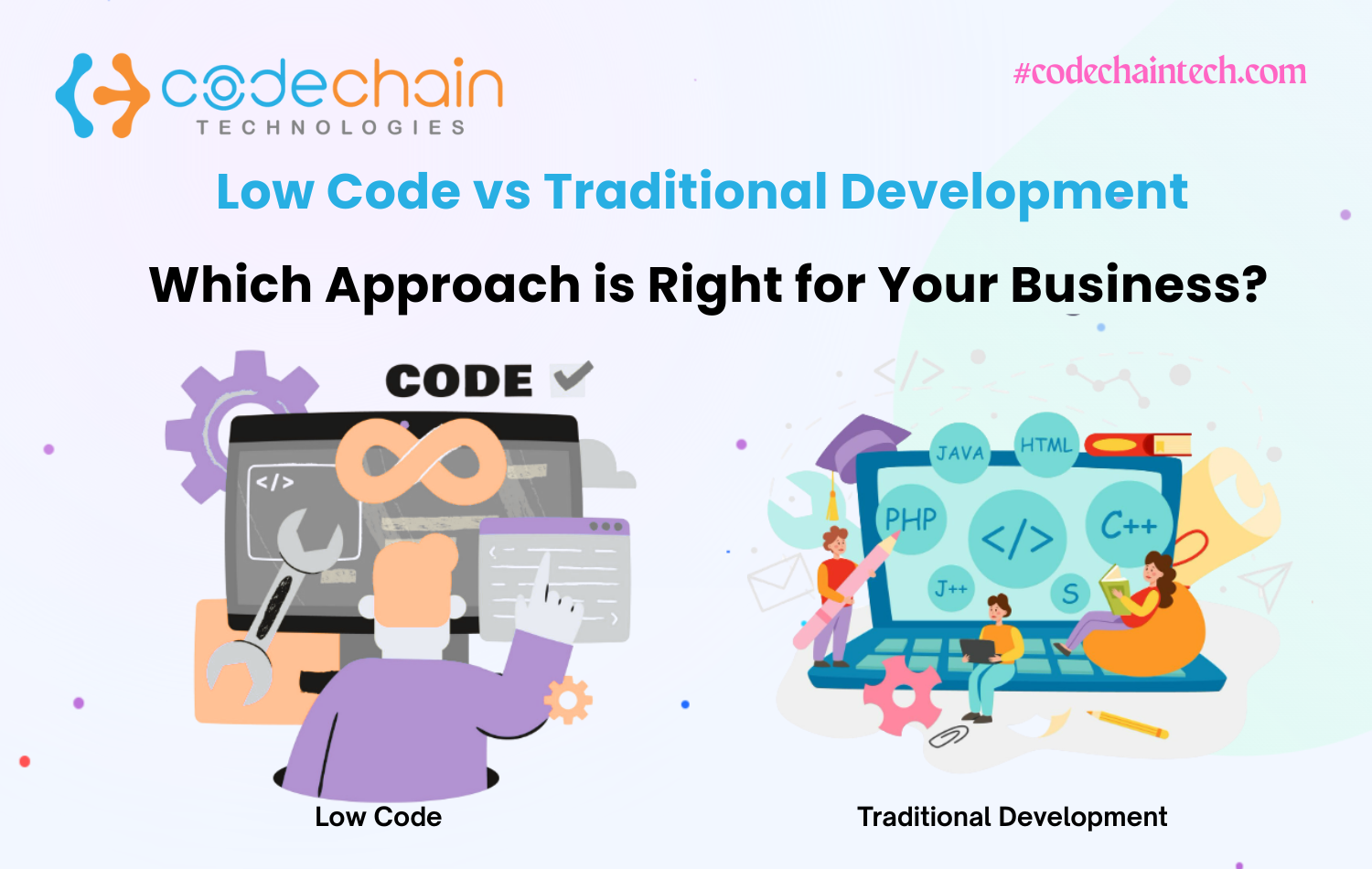
Low code vs traditional development has become one of the most discussed topics in modern software development as businesses look for faster, cost-effective, and scalable digital solutions. With increasing pressure to innovate quickly, organizations are evaluating whether low code platforms can replace or complement traditional software development approaches. At CodeChainTech, we help businesses choose the right development strategy based on their goals, complexity, and long-term growth plans.
At a glance comparison
speed · cost · control · scale
| Feature | Low Code | Traditional |
|---|---|---|
| Speed | ✓ Very Fast | ✓ Slower, robust |
| Cost | ✓ Lower upfront | ✓ Higher, better ROI |
| Customization | ✓ Limited | ✓ Full control |
| Scalability | ✓ Moderate | ✓ Unlimited |
| Security | ✓ Platform‑dependent | ✓ Customizable |
What Is Low Code Development?
Low code development is a modern software development approach that allows applications to be built using visual interfaces, drag-and-drop components, and minimal hand-coding. Low code platforms are designed to accelerate application development, enabling businesses to create functional applications in a shorter time frame. This approach is especially useful for internal tools, simple business applications, and rapid prototyping where speed is a top priority.
What Is Traditional Software Development?
Traditional development refers to building software applications using full-scale programming languages such as Java, Python, PHP, .NET, or JavaScript frameworks. This approach requires experienced developers who write custom code from scratch, offering complete control over architecture, functionality, performance, and security. Traditional development is ideal for complex, scalable, and highly customized software solutions.
Speed & Time-to-Market Comparison
One of the biggest advantages of low code development is speed. Applications can be built and deployed much faster compared to traditional development, making it attractive for startups and businesses with tight deadlines. Traditional development, on the other hand, requires more planning, coding, and testing, but results in robust and highly optimized applications. CodeChainTech often recommends low code for quick launches and traditional development for long-term, mission-critical systems.
Cost Efficiency & Budget
Low code platforms reduce development costs by minimizing coding efforts and development time. This makes low code an appealing option for small businesses and departments with limited budgets. However, traditional development may involve higher upfront costs but offers better long-term value for complex systems. At CodeChainTech, we help clients balance initial investment with future scalability and maintenance costs.
Customization & Flexibility
Customization is where traditional development clearly excels. Developers can design unique features, workflows, and integrations without platform limitations. Low code platforms, while flexible to a degree, may restrict customization due to predefined components and platform rules. For businesses requiring unique workflows or advanced integrations, traditional development remains the preferred choice.
Scalability & Performance
Scalability is a critical factor when choosing between low code and traditional development. Low code applications are suitable for moderate usage but may face limitations when scaling to handle high traffic or complex logic. Traditional development allows full control over performance optimization and system scalability. CodeChainTech recommends traditional development for enterprise-grade applications with long-term growth expectations.
Security & Compliance
Security is a major concern in software development. Low code platforms offer built-in security features, but businesses must rely on the platform provider's security standards. Traditional development provides greater control over security architecture, data handling, and compliance requirements. Industries such as finance, healthcare, and enterprise IT often prefer traditional development due to strict regulatory standards.
Maintenance & Long‑Term Control
Low code platforms simplify maintenance through automated updates and platform-managed infrastructure. However, businesses may face vendor lock-in and limited control over future changes. Traditional development offers full ownership of code, allowing businesses to maintain, upgrade, or migrate systems without dependency on a specific platform. CodeChainTech emphasizes long-term control as a key advantage of traditional development.
Skill Requirements & Team
Low code development enables non-technical users and business analysts to participate in application creation, reducing dependency on large development teams. Traditional development requires skilled software engineers with deep technical expertise. Depending on internal resources and technical maturity, businesses can choose the approach that best aligns with their team capabilities.
Use Cases for Low Code Development
Low code development is ideal for internal dashboards, workflow automation tools, MVPs, customer portals, and applications with standard business logic. It allows organizations to experiment, validate ideas, and respond quickly to changing business needs. CodeChainTech often uses low code solutions for rapid prototyping and proof-of-concept development.
Use Cases for Traditional Development
Traditional development is best suited for enterprise applications, SaaS platforms, eCommerce systems, fintech solutions, and complex integrations. When performance, customization, and scalability are critical, traditional development delivers unmatched reliability. CodeChainTech specializes in building custom software solutions using traditional development for businesses with long-term digital strategies.
Low Code and Traditional Development: A Hybrid Approach
Many businesses today adopt a hybrid approach, combining low code and traditional development. Low code is used for rapid development of simple modules, while traditional development handles core systems. CodeChainTech supports hybrid development strategies to help businesses maximize efficiency without compromising performance or scalability.
Choosing the Right Approach for Your Business
The choice between low code vs traditional development depends on business goals, project complexity, budget, scalability needs, and security requirements. Low code is suitable for speed and simplicity, while traditional development is ideal for customization and long-term growth. At CodeChainTech, we analyze each project carefully to recommend the most effective development approach.
Why CodeChainTech for Software Development?
CodeChainTech is a trusted software development company offering both low code and traditional development services. Our team helps startups, SMEs, and enterprises choose the right technology stack, development model, and architecture to achieve sustainable digital success. We focus on delivering secure, scalable, and business-driven software solutions.
Conclusion: Low Code vs Traditional in 2026
Low code vs traditional development is not about choosing one over the other, but about selecting the right approach for the right project. As businesses continue to evolve digitally in 2026, understanding the strengths and limitations of both methods is essential. With expert guidance from CodeChainTech, businesses can make informed decisions and build future-ready software solutions.
FAQs
-
1
What is low code development?
Low code development uses visual tools and minimal coding to build applications faster.
-
2
Is low code suitable for enterprise applications?
Low code can support some enterprise needs, but traditional development is better for complex systems.
-
3
Which is more cost-effective: low code or traditional development?
Low code has lower initial costs, while traditional development offers better long-term value.
-
4
Can low code replace traditional development?
No, low code complements traditional development but cannot fully replace it.
-
5
Is traditional development still relevant in 2026?
Yes, traditional development remains essential for scalable and custom software.
-
6
Which approach is more secure?
Traditional development offers greater control over security and compliance.
-
7
Does low code limit customization?
Yes, low code platforms may restrict advanced customization.
-
8
Can CodeChainTech deliver both approaches?
Yes, CodeChainTech provides low code, traditional, and hybrid development solutions.
-
9
What industries benefit most from traditional development?
Finance, healthcare, SaaS, and enterprise IT benefit most.
-
10
How do I choose the right approach for my business?
Consulting experts like CodeChainTech helps determine the best development strategy.