India is in the middle of a startup boom. For almost every new idea, from fintech to food delivery, a mobile app is no longer optional.
But most startups face the same two constraints: a tight budget and very little time.
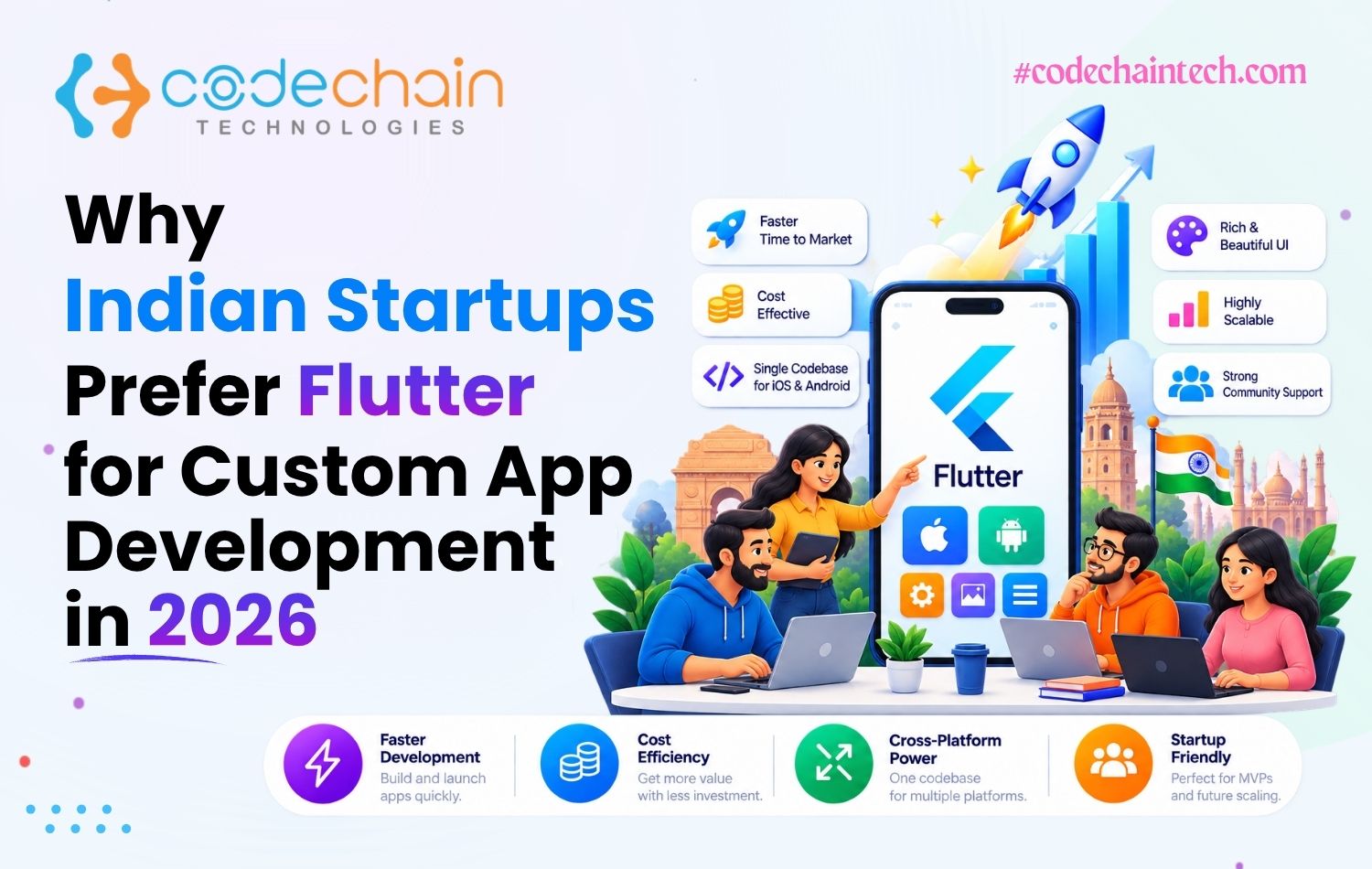
This is exactly where Flutter for custom app development has become the first choice for many Indian founders. One small team can build a high-quality app for both Android and iOS and launch it much faster.
In this guide, we explain why so many startups prefer Flutter in 2026, where it works best, and how to decide if it is right for your product.
What Is Flutter?
Flutter is an open-source UI toolkit created by Google. It lets developers build apps for mobile, web, and desktop from a single codebase.
Flutter apps are written in the Dart programming language and compiled to native code. This is why they run smoothly on both Android and iOS.
In simple terms, instead of building and maintaining two separate apps, a startup builds one app that works everywhere it needs to.
Why Startups Choose Custom Apps Over Ready-Made Ones
Ready-made apps and templates look cheap at first. But they limit your features, your branding, and your ability to stand out.
A custom app is built around your users and your business model. It can grow as your startup grows, without being locked into someone else's platform.
For a deeper comparison, read our guide on custom app development vs ready-made apps.
Flutter makes custom development affordable for startups, which is why the two go together so often.
1. Unmatched Cost Efficiency
For a startup, every rupee of funding matters.
Traditionally, building for both platforms meant hiring two teams: one for Android (Java or Kotlin) and one for iOS (Swift). Two teams meant two codebases, two sets of bugs, and two budgets.
With Flutter, one codebase produces both apps. Many Indian development teams estimate that this approach can reduce development cost by around 40% to 50% compared with building two separate native apps.
If you are researching mobile app development cost in India, these are the main factors that decide the final number:
Number and complexity of features
Design and animation requirements
Backend and third-party integrations
Team size and experience
Testing and post-launch support
Flutter reduces the biggest cost driver: duplicate development work. It also lowers maintenance costs, because every bug fix and new feature is written once instead of twice.
For an early-stage startup, this can be the difference between launching a full product and settling for a stripped-down version.
2. Faster Time-to-Market
In the Indian market, the idea that launches first often wins.
Flutter's hot reload feature shows code changes on screen within seconds, without restarting the app. Developers can fix bugs, adjust layouts, and test ideas almost instantly.
This speeds up both development and testing. A single codebase also means new features reach Android and iOS users at the same time.
As a result, startups can take their MVP (Minimum Viable Product) to market sooner. They can collect real user feedback, improve the product, and show traction to investors much earlier.
Speed works best with a clear process. Our guide to the mobile app development lifecycle explains each stage from idea to launch.
A typical Flutter MVP with core features often takes about 2 to 4 months, depending on complexity.
3. Native-Like Performance & Beautiful UI
Many founders worry that a cross-platform app will feel slow or clunky. Flutter removes that concern.
Flutter does not wrap a website inside an app. It draws every pixel itself using its own rendering engine (Skia and the newer Impeller). This delivers smooth performance at 60 fps and up to 120 fps on devices that support it.
Flutter's customizable widgets also make it easy to build a polished, premium interface. The app can look native on each platform or follow a fully custom brand design that stays identical on every device.
Good design matters even more for startups, because first impressions decide whether users stay. Pairing Flutter with strong UI/UX design helps your app look trustworthy from day one.
Key benefits:
Smooth animations and fast load times
Consistent look across Android and iOS devices
Ready-made material and Cupertino widgets
Easy to customize for your brand
4. Massive Developer Talent Pool in India
India's startup ecosystem is growing fast, backed by initiatives such as Startup India, and the country has a very strong appetite for Google technologies. As a result, finding skilled cross-platform app developers who work in Flutter is easier here than in many other markets.
Flutter developers are available at reasonable rates, which helps startups hire quickly and stay within budget.
This matters long after launch. As your user base grows, you will need to add features, fix issues, and scale the app. A large talent pool means you are never stuck depending on a single developer.
Flutter also has a growing community and a rich library of ready-made packages on pub. dev, so developers do not need to build every feature from scratch.
If you are comparing frameworks, our guide on Flutter vs React Native explains how the two stack up for business apps.
5. One Codebase Beyond Mobile
Startups rarely stay mobile-only forever. Customers often ask for a web version, an admin dashboard, or a desktop tool.
Flutter supports web and desktop from the same codebase, so you can extend your product without starting from scratch.
For complex websites or dashboards, you can also pair your app with professional web development, so every platform shares the same brand and data.
6. Easy Integration With Backends and Third-Party Services
A mobile app is only as strong as the backend behind it. Flutter works smoothly with REST APIs, Firebase, and the most popular backend technologies.
Startups in India commonly need to connect:
Payment gateways and UPI
Maps and location services
SMS, email, and push notifications
Analytics and CRM tools
A scalable backend development setup keeps the app fast as traffic grows, so your first 100 users and your first 100,000 users get the same smooth experience.
7. Ready for AI-Powered Features
Startups increasingly add smart features such as chatbots, recommendations, and automated support. Flutter apps connect to AI services through APIs, so adding these features later does not require a rebuild.
If AI is part of your roadmap, explore our AI development services to plan it from the start.
Flutter vs Native vs React Native: Quick Comparison
For most startups, Flutter offers the best balance of cost, speed, and quality. You can see the platforms it supports on the official Flutter website.
Startup Use Cases Where Flutter Works Well
Fintech and payments apps: A smooth UI and consistent behavior on every device help build user trust. See how we approach banking and fintech solutions.
E-commerce and marketplace apps: Fast browsing, rich product pages, and a consistent checkout experience.
On-demand and delivery apps: Real-time updates and quick iteration based on user feedback.
EdTech and learning apps: Interactive content that works the same on every device.
Healthcare and booking apps: Clean forms, appointment flows, and reminders.
SaaS companion apps: A mobile app that extends your web product.
When Native Development May Be Better
Flutter is not right for every project. Apps that depend heavily on advanced platform-specific features, such as complex AR, the newest OS features on release day, or specialized hardware access, may be better built natively. Flutter apps can also be slightly larger in file size than purely native apps.
For the vast majority of startup apps (lists, forms, payments, chat, maps, and dashboards), Flutter is more than enough. A good development partner will tell you honestly which option fits your product.
Common Mistakes Startups Make With Their First App
Even with the right technology, a few mistakes can slow down a launch or waste budget:
Building too many features at once: Launch with the core features and add the rest after user feedback.
Choosing a partner only on price: The cheapest quote often leads to rework and delays.
Ignoring UI/UX: A confusing interface drives users away, however good the code is.
Skipping testing on real devices: Apps should be tested on different screen sizes and Android and iOS versions.
Not planning for scale: A weak backend breaks when your user base grows.
Having no post-launch plan: Updates, bug fixes, and support are part of the product, not an extra.
How to Get Started With Flutter for Your Startup
Define the problem: Be clear about who your users are and what they need.
List must-have features: Keep the first version (MVP) focused.
Choose a development partner: Look for relevant experience and clear communication.
Design and prototype: Validate the flow with real users before full development.
Build, test, and launch: Release to both stores, then improve with feedback.
How to Choose the Right Flutter Development Partner
The framework is only half of the equation. The team matters just as much. When comparing custom app development companies in India, look for:
Proven experience: Ask for case studies and live apps, not just screenshots.
Full-stack ability: Design, frontend, backend, and testing under one roof.
Clear communication: Regular updates, demos, and a single point of contact.
Transparent pricing: A clear cost breakdown without hidden charges.
Post-launch support: Bug fixes, updates, and scaling after launch.
Code ownership: You should own the source code and intellectual property.
How CodeChain Helps Indian Startups Scale with Flutter
At CodeChain Technologies, we are one of the leading custom app development companies in India. We help early-stage startups and growing enterprises turn their ideas into high-performing Flutter applications.
With 10+ years of experience and 3000+ projects delivered, our team supports you from the first wireframe to a fully scaled product. Our Flutter-based app development services cover:
Discovery and product planning
UI/UX design
Flutter app development for Android and iOS
Backend and API development
Testing and quality assurance
Launch, maintenance, and scaling
We focus on clean architecture that is easy to extend, so your app keeps up as your startup grows.
Apps We Have Built and Published on Google Play
Our team does not only build apps for clients. We also design, build, and publish our own apps, so we understand the full journey from idea to Play Store listing. Apnaa Calculator brings 20+ financial calculators for loans, investments, tax, and business into one app, with offline support.
Hisab Book is an expense manager that helps individuals and small businesses track income and expenses, with month-wise reports and graphs.
For the diamond trade, DalaliBook works as a pricing and commission calculator for jewelers and brokers.
HiraBook is a diamond stock management app that records daily stock with price, total, and date.
To stay on top of daily work, we built Task Planner & Reminder Alarm, a task planner with reminder alarms.
We have also built TempGmailer, a temporary email app for quick, disposable inboxes.
Conclusion
In short, if you want lower cost, super-fast launch speed, and top-tier performance, Flutter is one of the best choices for Indian startups in 2026.
One codebase, a strong developer community, and near-native quality let small teams compete with much larger companies.
If you are planning your first app, CodeChain Technologies can help you choose the right approach and build it right.
Have an app idea? Contact us today for a free consultation.
FAQs
-
1
Why do Indian startups prefer Flutter?
One codebase serves both Android and iOS, which lowers cost, speeds up launch, and still delivers near-native performance and a polished UI.
-
2
How much does Flutter app development cost in India
It depends on features, design, and integrations. Because one codebase covers both platforms, Flutter typically costs less than building two separate native apps. Share your requirements for an accurate estimate.
-
3
Is Flutter good for building an MVP?
Yes. Hot reload and a single codebase let startups build, test, and launch an MVP quickly, then improve it based on user feedback.
-
4
Is Flutter as fast as native apps?
For most business apps, yes. Flutter compiles to native code and renders its own UI, which gives smooth performance. Only very specialized apps may need fully native development.
-
5
Can Flutter apps be published on the Play Store and App Store?
Yes. Flutter apps are built into standard Android and iOS packages and published the same way as native apps.
-
6
Is Flutter secure enough for fintech apps?
Yes, when built with proper practices such as secure storage, encrypted communication, and a secure backend. Security depends mainly on how the app is built, not just the framework.
-
7
Can I add a web or desktop version later?
Yes. Flutter supports web and desktop, so you can often reuse a large part of your existing code.
-
8
Is it easy to find Flutter developers in India?
Yes. Flutter has a large and growing community in India, which makes it easier to hire skilled developers at reasonable rates.
-
9
Should a startup choose Flutter or React Native?
Both are good options. Flutter offers a more consistent UI and strong performance, while React Native suits teams already strong in JavaScript.
-
10
How long does it take to build a Flutter MVP?
Usually 2 to 4 months for core features, depending on complexity, design, and integrations.