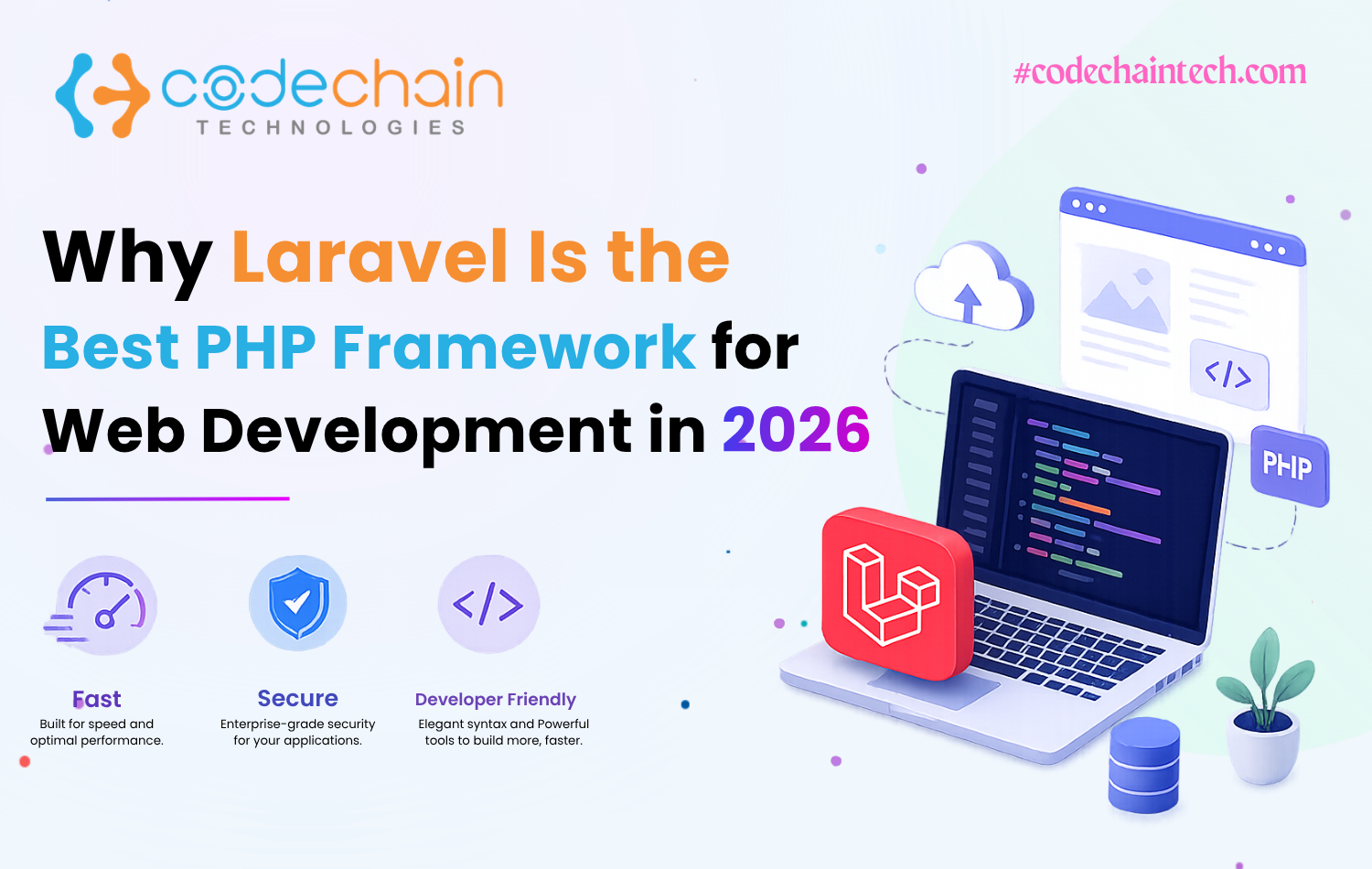
Laravel PHP framework for web development is the ultimate choice for building modern, secure, and scalable applications in 2026. The global digital landscape demands more from web platforms than ever before; they are no longer mere static digital brochures but have transformed into dynamic, ecosystem-connected engines designed to automate complex corporate workflows. They have evolved into live, linked ecosystems engineered for speed and safety to automate complex commercial operations. One of the most significant things that startup founders, corporate IT executives, and local company owners who want to go online have to consider throughout the game development lifecycle is choosing the correct backend technology stack. This will directly impact the speed of your platform in the long run, the safety of your data, the cost of maintenance, and the size for the future market.
Web development has dozens of competitive programming languages, frameworks, and backend technologies, but Laravel remains at the top.
Things change pretty fast these days (2026), yet Laravel is still the greatest PHP framework. This comprehensive book offers an in-depth explanation of why you should use Laravel for your contemporary development, including its technical capabilities, strategic business benefits, real-world use cases, and structural advantages. It also shows how partnering with a leading agency like CodeChain Technologies may speed up your company's digital transition.
What Is Laravel? A Modern Conceptual Overview
First, you need to know what Laravel is to realize how valuable it is. Laravel is, in its essence, a free, open-source PHP web framework designed to simplify, accelerate, and encourage collaboration in the development of contemporary online applications. It was developed by Taylor Otwell & it employs the model-view-controller (MVC) style of architecture. It isolates your app's data management (model), user interface design (view), and business logic (controller). It makes your code base tidy, modular, reusable, and extremely simple to maintain over many years.
Before Laravel and other comparable frameworks were popular all over the globe, software professionals had to start from scratch with every new web development project, writing the same boilerplate code again and again. Creating user logins, updating secure database tables, managing sessions, and developing email protocols were all weeks of hand-coding tasks. But then Laravel came along with its lovely, rich framework and powerful set of built-in tools, and it altered everything.
To make things easier for developers, Laravel provides a number of built-in components so they don't have to start every new project from scratch. Instead, they may use them to swiftly construct feature-rich business systems. Today, Laravel is used by many kinds of websites, including global corporate portals, multi-seller eCommerce marketplaces, complex Customer Relationship Management (CRM) systems, complex Enterprise Resource Planning (ERP) engines, healthcare apps and legacy systems across the world.
Why Laravel Is the Absolute Best PHP Framework for Web Development in 2026
The PHP world is undeniably ruled by the Laravel framework. It all boils down to its unique notion of making the developers more productive and organizations more adaptable swiftly without giving up the quality, speed of performance, or data integrity.
Here are the 10 key reasons why contemporary organizations go with using Laravel to build their primary web products.
1. Architectural Cleanliness and Long-Term Code Maintainability
One of the major issues in bespoke software engineering is avoiding "spaghetti code." This is a way of programming that is unorganized and hard to update without disrupting the whole web application. To prevent this, Laravel has tight restrictions on creating clean code.
A well-organized codebase benefits the company immediately in the following ways:
Find, debug, and resolve bugs faster
Internal QA teams and developers can accomplish it all in minutes instead of days of crawling through distinct files.
Easy feature improvements
When market trends shift, introducing a new payment method, data platform, or level of client loyalty is no longer a last-minute modification but a deliberate step-by-step procedure.
Lower Technical Debt
Clear code structure helps companies to save a lot of money on continuing software maintenance expenditures. This guarantees that initial IT expenditures will be worth it in the long term.
2. Radical Acceleration of the Development Lifecycle
In the highly competitive corporate world of 2026, time-to-market is typically the major element that separates successful organizations from failed ones. Launching a digital product 3 months before the competition may allow you to obtain investors and market shares swiftly. With Laravel you can speed up the engineering process by having ready-made infrastructure solutions for popular web operations like as
?️ The user authentication and access control should be done fully.
That means your software development team can go straight to work on implementing the unique business features that will truly offer your clients an advantage over their competition.
3. Enterprise-Grade Security Implementation by Default
Application security must not be an afterthought, particularly since data intrusions are becoming more widespread around the globe and privacy rules are increasing toughness everywhere. Security of data is one of the key aspects of Laravel's architecture. The platform has robust levels of security built right in to completely guard against the top risks outlined by the Open Web Application Security Project (OWASP).
The framework's built-in Blade template rendering engine automatically escapes raw HTML entities when the result is rendered. This inhibits attackers from executing malicious scripts on your users' browsers.
Protection Laravel automatically generates and verifies a CSRF token for every user session. This prevents other programs from obeying forced commands for a confirmed user.
With advanced hashing protocols, your database never stores confidential user data, such as passwords, in plain text. By default, Laravel employs powerful cryptographic hashing algorithms like Bcrypt and Argon2, which keeps all client data secure.
Features of the Laravel Core Structure
| Key Feature | Operational Purpose | Business and Technical Impact |
|---|---|---|
| MVC Architecture | Separates data processing, user interfaces, and business rules. | Code stays completely organized, clean, and highly maintainable. |
| Eloquent ORM | Interacts with databases using expressive, fluent PHP syntax. | Eliminates the need for manual SQL, speeding up data operations. |
| Blade Templating Engine | Renders lightweight, compiled frontend layouts smoothly. | Achieves fast loading speeds while supporting clean modular layouts. |
| Artisan Command Line | Automates repetitive tasks, test executions, and migrations via CLI. | Minimizes human error and dramatically boosts developer productivity. |
| Database Migrations | Provides version control functionality for database structures. | Keeps database updates perfectly synchronized across development teams. |
| Asynchronous Queues | Offloads resource-heavy jobs (like emails) to background processes. | Keeps the front-end user experience lightning-fast and responsive. |
4. Flawless Scalability for High-Volume Expansion
A classic technological risk for expanding organizations is rolling out an app on a platform that works OK for 500 early test users but totally falls apart when 50,000 people attempt to use it all at once during a large sales event or marketing push. Laravel is designed to expand and contract with contemporary cloud infrastructures without costly structural modifications.
The finest Laravel applications are configured by experts and can be quickly scaled to accommodate unexpected surges of hundreds of thousands of requests from users at a time. It also supports integration with Amazon Web Services (AWS), Google Cloud Platform (GCP), Redis memory stores, and distributed database groups, all of which are enterprise-level cloud services. It is the security of the structure that makes it the greatest alternative for courageous company owners who wish to attract consumers for life.
5. Eloquent ORM: Revolutionizing Database Management
When it comes to connecting to sophisticated relational systems, backend engineering typically gets stuck. Laravel can handle this since Eloquent ORM is an extremely versatile ActiveRecord implementation. Eloquent allows developers to interact with database tables, fields, and relationships by writing clean, legible PHP code, rather than performing lengthy, hard, and not-optimized raw SQL queries.
Eloquent entirely abstracts away the data layer, so it doesn't matter whether your firm is using MySQL or Postgres or SQLite or SQL Server as the architecture. If your firm ever makes the transfer from one database provider to another, Laravel makes the process shockingly straightforward. This will save your professional personnel hundreds of hours redoing everything manually.
6. Seamless Native Authentication and Role Management
Building user management systems from scratch is a time-consuming process (registration flows, login forms, secure password reset links, email verification systems, multi-factor authentication (MFA), varying access levels, etc.).
Laravel's Solution
Laravel offers straightforward, out-of-the-box authentication scaffolding that fully removes this expense. In hours, not weeks, development teams may build safe spaces for users, restrict management access, and allocate unique operational roles (e.g., Super Admin, Editor, Billing Manager, or Customer).
7. Native API-First Engineering for the Modern Omni-Channel Web
Businesses currently exist in a variety of digital touchpoints simultaneously. You may have a web-based administration platform to manage things, an iOS app for your clients, an Android tablet interface for personnel working in the field, and direct connectivity to third-party technology like AI engines or payment processing networks.
Laravel's API-First Approach
Laravel totally eliminates this operational challenge. It is home to one of the biggest, busiest, and most helpful communities of open-source devs in all of software engineering. Software teams can also swiftly address complex technical issues with a lot of official documentation, millions of community tutorials, and hundreds of proven open-source apps. This ensures that firms will have access to a robust global talent pool and a healthy foundation for many years to come.
This clean data layer can be utilized by any current front-end like React vs. Angular or Vue.js or cross-platform mobile like Flutter.
8. An Immense, Dynamic Global Developer Ecosystem
If a firm develops its digital goods on a tech stack that is not widely recognized or is extremely old, it takes a major organizational risk: if the key internal programmers depart, it is hard and costly to recruit qualified replacements.
Laravel totally eliminates this operational challenge. It is home to one of the biggest, busiest, and most helpful communities of open-source devs in all of software engineering. Software teams can also swiftly address complex technical issues with a lot of official documentation, millions of community tutorials, and hundreds of proven open-source apps. This ensures that firms will have access to a robust global talent pool and a healthy foundation for many years to come.
9. A Rich and Powerful Ecosystem of Pre-Built Tools
One of the greatest advantages of Laravel in 2026 is its massive, official ecosystem. Instead of hiring developers to spend months building complex infrastructure, businesses can leverage official, production-ready packages provided by the Laravel team itself. This significantly lowers technical risks and cuts overhead costs.
Some of the most powerful tools in this ecosystem include:
Provides an expressive, fluent interface to manage subscription billing services, handle coupons, swap subscriptions, and generate PDF invoices seamlessly via Stripe or PayPal.
Advanced, beautifully designed administration panels that allow developers to set up a fully functional backend dashboard for your business in a fraction of the time.
Revolutionary DevOps tools that handle server management and serverless deployment on cloud platforms like AWS (Amazon Web Services), ensuring zero downtime and automated scaling for your application.
Business Impact
By tapping into this rich ecosystem, agencies like CodeChain Technologies can assemble and deliver enterprise-grade applications with high precision, saving your business thousands of dollars in custom development fees.
10. True Structural Cost-Effectiveness
Laravel cuts down the overall amount of development hours you need to create and operate an app, thanks to its massive library of reusable components, state-of-the-art automated testing tools, and big ecosystem of pre-tested packages. More affordable engineering hours for corporate budgets correlates substantially with a high Return on Investment (ROI) and a much reduced Total Cost of Ownership (TCO) throughout the life of your digital product.
Real-World Use Cases: What Can You Build with Laravel?
This built-in flexibility makes Laravel a good framework option for a broad variety of business verticals.
Why Leading Global Enterprises Trust CodeChain Technologies for Custom Laravel Development
Going digital and choosing an excellent backend framework like Laravel is a terrific starting step. But that technology performance, security, and scalability will only be fully realized when employed by a team of extremely competent software engineers. Even the most powerful framework will be a drag if you don't put up a working database structure or use cloud caching properly.
And that's why progressive companies trust CodeChain Technologies with their most critical internet applications. "We don't believe in mass-produced software models that fit all needs. Instead, we partner with your team to build unique Laravel solutions that are fully in sync with your strategic company vision and operational objectives.
Why CodeChain Technologies Is Better For Engineering:
- Strict Adherence to International Coding Standards Our engineers adhere to PHP Standard Recommendations (PSR) and the flexible design principles of the Laravel framework. This makes sure that the code of your app is always highly clean, easy to understand, thoroughly documented, and ready for any future changes in technology.
- Open, Agile Project Execution: We do it all for your app, starting with technical blueprinting and product strategy, followed by wireframing, high-fidelity UI/UX design, core backend programming, advanced automated testing, cloud DevOps deployments, and continuous 24/7/365 maintenance post-launch.
- Comprehensive End-to-End Solutions: We do it all for your app, starting with technical blueprinting and product strategy, followed by wireframing, high-fidelity UI/UX design, core backend programming, advanced automated testing, cloud DevOps deployments, and continuous 24/7/365 maintenance post-launch.
- Future-Ready System Integrations: Your bespoke Laravel backend integrates with the latest technologies, such as high-performance cross-platform mobile applications, cloud serverless microservices, automated machine learning models, and AI systems.
Conclusion
It's not a question of the technical agreement. In 2026, if you want to build a cutting-edge web app that is automatically secure from evolving cyberthreats, is extremely simple to expand to meet the demands of a rising market, is very inexpensive to maintain, and is perfectly tuned for the present state of AI search, the ideal technology to employ is Laravel. It connects difficult enterprise-level software engineering with rapid and flexible company expansion in a powerful way.
Don't become stuck in sluggish, outdated legacy technology frameworks that hold your organization back from producing money long-term. Accelerate your digital transformation by partnering with a trusted engineering firm that understands how to scale software for the digital age.
FAQs
-
1
Does Laravel still matter in 2026?
Yes. Laravel is still important in 2026. It is constantly updated and has built-in capabilities for current AI integration and native support for serverless cloud systems.
-
2
What is the best PHP framework for Laravel?
It is the greatest since it has built-in facilities for security, routing, user login, and database management. It enables developers to design a sophisticated online platform rapidly without beginning from scratch.
-
3
What is Laravel's future in PHP?
The future is heavily focused on automation, real-time performance, and scaling cloud-ready web applications, making sure Laravel stays the worldwide standard for corporate backend ecosystems.
-
4
Is PHP a suitable language to learn for 2026?
Yes. More than 75% of all websites in the world run on PHP. If you learn PHP and a prominent framework (Laravel), you have a big and steady employment market for software developers.
-
5
Will AI take over PHP developers?
No, AI is just a productive instrument. AI technologies may aid in basic code production but cannot produce specialized business systems, maintain maximum security, or design sophisticated software.
-
6
PHP in 2026 - What will it be?
PHP is quicker, safer, and better than ever in 2026. The recent structural and technological changes have made it possible for it to handle data at enterprise speed, rivaling other high-performance backend programming languages.
-
7
Is PHP Laravel obsolete?
No way. Laravel is not old, and this misconception is absolutely false. Modern Laravel is a cutting-edge backend development environment using asynchronous tools and type-safe protocols.
-
8
Is PHP still worth it in 2026?
Yes. PHP has inexpensive implementation costs, a massive worldwide support network and a great ROI for startups and enterprises launching new products.
-
9
Laravel frontend or backend?
Laravel is mostly a good backend framework to handle database architecture and security but also can create interactive frontends utilizing internal modules like Livewire.
-
10
How can CodeChain Technologies assist me to create a Laravel application?
CodeChain Technologies develops secure bespoke Laravel systems (SaaS, ERP, eCommerce) specifically designed to meet your company objectives. Free Consultation – Contact Us