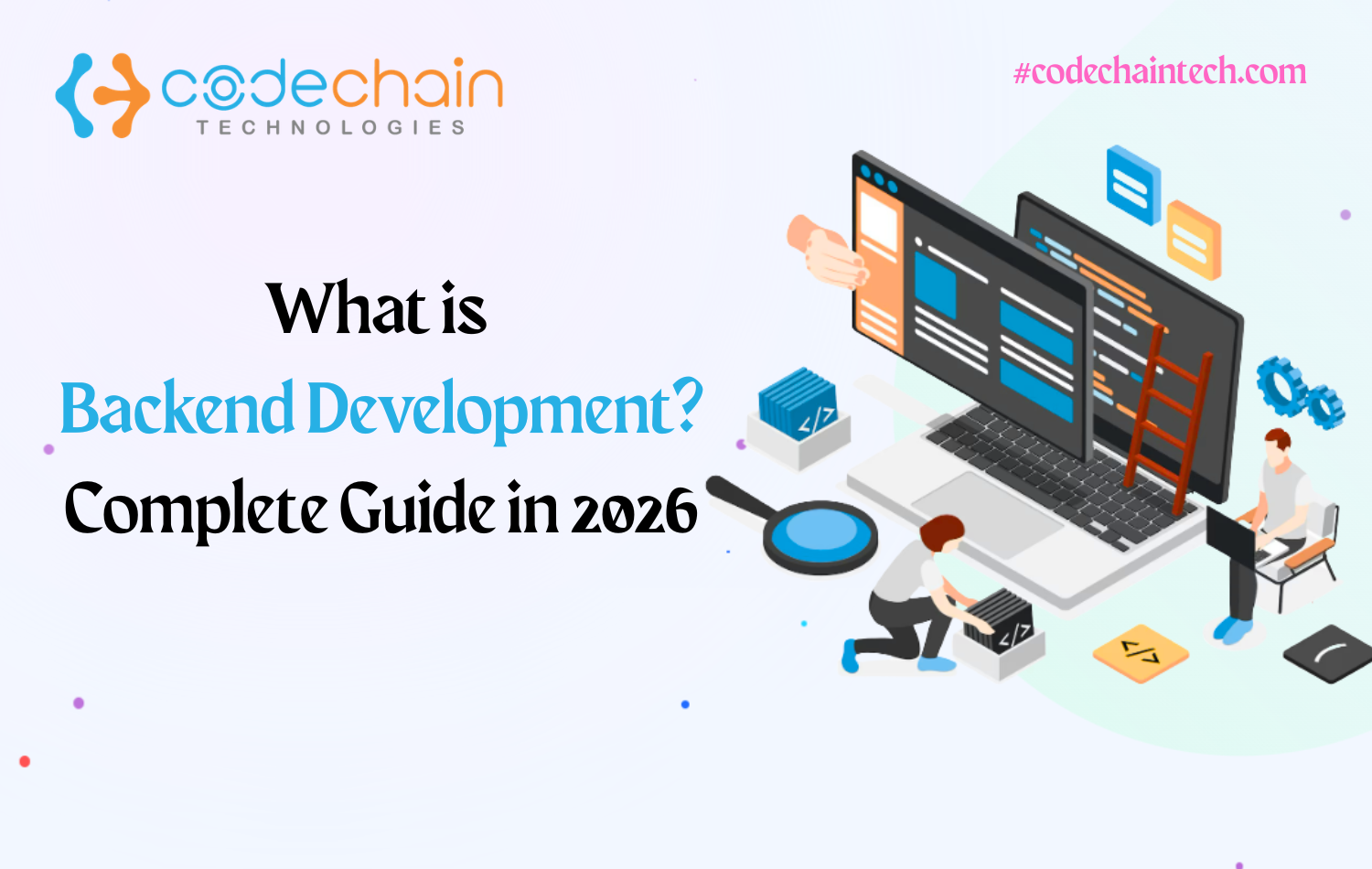
Backend development is the portion of software development that deals with databases, servers, APIs, authentication, and application logic. Manages user requests. Stores and retrieves data. Protection of data shows information to the front end. A solid backend makes websites and apps quick, dependable, secure, and able to handle thousands – or even millions – of users at once. This book will teach us what low-code development is, why it is important, how it works, the technology behind it, and the best practices that firms use to construct contemporary digital applications. If you want to construct a bespoke online or mobile application, an experienced development firm such as CodeChain Technologies can help you design a secure, scalable, and durable backend architecture.
What is backend development?
Backend development is a combination of numerous technologies to ensure applications run smoothly, securely, and effortlessly. It supports businesses like e-commerce, healthcare, banking, education, logistics, entertainment, and corporate software.
Main responsibilities:
Third-party services integration, including payment gateways, email services and cloud storage
A good backend architecture will not only handle the present needs of the company but will also allow the application to scale as the business and user traffic grow.
Why Backend Development Matters
Backend development is not simply throwing code to a server. It shows the performance of an application, security of the user information, and ease in adding new features in the future. Here are the main reasons why backend development matters:
Today’s apps manage sensitive data, including consumer profiles, financial data, medical records, and enterprise data. This information is protected from cyberattacks using encryption, secure authentication, role-based access control, and data protection mechanisms in backend systems.
Every application has some business rules. Calculating discounts, processing subscriptions, confirming transactions, maintaining inventory, authorizing user activity—all of this takes place in the backend. Such thinking makes the program operate well in many cases.span >
The backend is the bridge between the frontend, databases, cloud infrastructure, and third-party services. It processes queries, serves data via APIs, and makes sure all the components play along.
People want websites and apps to load fast and react immediately. An improved backend reduces response time and server load. It is also enabling us to handle hundreds of queries simultaneously without any degradation in performance.
As the firm grows, the applications need to accommodate more users, bigger databases, and more features. A scalable backend architecture allows a firm to grow without replacing the complete system. This will save money on web development down the road.
A professionally constructed backend is a foundation that gives development teams an opportunity to debug, distribute updates, add new features, and manage the software development more reliably. That means quicker release cycles and a better experience for developers and consumers alike.
The backend is not visible to users yet, but they feel the quality of it every time they use an application. Pages must load fast, logins must be safe, search results must be instantaneous, alerts must be real-time, and transactions must be dependable—all of this requires a sound backend architecture.
How Does Backend Development Operate?
The backend is responsible for receiving user requests, interacting with databases, applying business logic, and giving the proper answer to the front end. The user sees the UI of the website/application. The backend is where all the activities are that make the application useful, safe, and dependable.
A typical backend request might look like:
It starts when a user does anything on a website or mobile app, such signing in, looking for goods, or filling out a form.
Secure APIs are used to convey the request from the front-end to the back-end. These APIs are the communication between the UI and the server.
The server checks the request, applies business rules, checks user rights, and identifies the information required.
The backend communicates with the database and gets, changes, adds, or removes data if required.
Once done with the operation, the backend generates the response and sends it to the frontend.
The new information is then shown to the user on the frontend, providing a quick and smooth experience.
Usually the whole transaction takes just a few moments, which makes current apps seem speedy and dependable.
Which back-end language should I use?
There is no one right language for every project. The ideal choice relies on your company goals and technological needs.
Python Ideal for classical artificial intelligence systems, automation tools, and other data-heavy applications.
Node.js is great for real-time chat apps, streaming services, and collaboration tools.
PHP is still a solid choice for corporate websites, customer portals, and content management systems, especially with Laravel.
Java is used for monetary systems, healthcare platforms, and large-scale corporate applications where reliability and security matter.
C# with .NET is a strong option for business applications in the Microsoft ecosystem.
Golang is becoming popular for cloud-native apps, microservices, and high-performance APIs because of its speed and efficiency.
The CodeChain Technologies team selects the backend technology stack based on each customer's business objectives, scalability demands, security requirements, and long-term growth plans. This means each application is developed on the most appropriate technology, assuring uniform performance now and for future growth.
Best Back-End Frameworks
Backend frameworks provide developers a structured base for creating safe, scalable, and high-performing applications. Frameworks provide you with built-in tools, libraries, and security features that speed up development and improve code quality instead of coding every single feature from scratch.
For example, Laravel can be used for commercial web apps because it has a beautiful architecture and security features. Django is a great choice for AI-powered applications because it has a solid environment in Python. Express.js is suitable for real-time applications that require quick data processing.
Each project begins with a technical evaluation, and the most suitable backend framework for the project is chosen based on business goals, anticipated user load, expansion plans, and integration needs. This working method enables businesses to build apps that will stay stable and scale as they develop.
Backend Development Roadmap 2026
If you are aiming to become a backend developer or you want to grasp the technologies used in backend development, then an organized roadmap may make the learning process much simpler. As a successful modern back-end developer, you should know how to code, maintain databases, communicate with APIs, practice security, and understand cloud technologies.
Pick a backend language from the options below:
Learn fundamentals of programming, OOP, data structures, and problem-solving.
Learn how to manage and save the information in a database.
Some of the issues covered are:
If you are looking for a flexible approach to store data, then check into NoSQL databases like MongoDB.
Once you are experienced with a programming language, then opt for its famous framework.
Frameworks accelerate application development and promote industry-standard coding standards.
Today most programs "talk" to each other using APIs.
How to find out:
The creation of APIs is one of the most important back-end talents in software companies nowadays.
Security must be built in from the ground up.
Subjects for study such as:
They help safeguard the apps and user data from typical security problems.
Backend apps are usually hosted on cloud platforms. Learn the basics of:
Cloud experience helps developers build reliable, scalable, production-ready apps.
The best way to improve your backend skills is to work on real projects, such as:
Practical experience will improve your knowledge and prepare you for a career in software development.
Benefits of Backend Development
Backend development is the secret sauce of modern digital product success. Whether you're creating a startup app or deploying corporate software, a well-designed backend is an investment that pays off in the long run.
The back-end systems help in securing the firm's and customers' critical data and minimizing the risk of cyberattacks via authentication, authorization, encryption, and secure data storage.
A well-optimized backend can handle requests quickly, decrease response times, and provide a smooth user experience, even during peak loads.
A scalable backend is software that can manage more traffic, bigger databases, and more functionality as your customer base expands, all without a total redesign.
A well-organized backend codebase will make future upgrades, bug repairs, feature enhancements, and code maintenance quicker. It saves time and money in development over the long term.
Systems at the back end allow backing up, managing, storing application data suitably, and retrieving it. This helps to improve operational efficiency and business decision-making.
Today, apps depend on payment gateways, email services, analytical tools, cloud storage, and external APIs. Strong backend with secure and dependable connections.
As a developer you don't really get to touch the backend, but you do get to enjoy the benefits of quick loading, protected transactions, customizable content, and non-stop application performance.
A flexible backend architecture helps you to keep up with the changing business needs and add new features and new technology like AI without rebuilding the program.
Conclusion
Backend development is the engine of any successful website, web application, or mobile application. It makes sure that digital platforms are running smoothly in the background, from handling databases and user requests to safeguarding sensitive data and integrating third-party services.
No matter whether it is to learn backend development, create a new software project, or upgrade an existing program. The right technology and architecture are the foundation of long-term success. Specialists like CodeChain Technologies can help organizations build safe, scalable, and unique backend solutions aligned with future goals.
FAQs
-
1
What is the Backend Developer Roadmap in 2026?
The backend developer roadmap in 2026 includes learning a programming language, databases, APIs, backend frameworks, authentication, cloud deployment, and building real-world projects.
-
2
Which are the best backend web development languages?
Some of the best backend web development languages are Python, JavaScript (Node.js), PHP, Java, Go (Golang), and C#, depending on your project requirements.
-
3
What is the #1 backend developer roadmap for beginners?
The best roadmap is to learn one backend language, understand databases, build REST APIs, master a framework, and create practical projects before exploring cloud technologies.
-
4
What frontend and backend developer skills are required in 2026?
Frontend developers need HTML, CSS, JavaScript, and modern frameworks, while backend developers should know server-side programming, databases, APIs, security, and cloud platforms.
-
5
How can I become a backend developer?
Start by learning a backend programming language, practice database management, build APIs, work with frameworks, and gain hands-on experience through real projects.
-
6
Which backend framework should I learn first?
Laravel, Express.js, Django, and Spring Boot are excellent choices, with the best option depending on the programming language you choose.
-
7
Is backend development a good career in 2026?
Yes, backend development remains one of the most in-demand careers as businesses continue to build scalable web applications, SaaS platforms, and enterprise software.
-
8
What tools do backend developers use?
Backend developers commonly use Git, Docker, PostgreSQL, MySQL, MongoDB, Postman, VS Code, and cloud platforms like AWS, Azure, or Google Cloud.
-
9
What is the difference between frontend and backend development?
Frontend development focuses on the user interface, while backend development manages servers, databases, APIs, authentication, and application logic behind the scenes.
-
10
Why is backend development important for businesses?
Backend development ensures secure data management, fast application performance, seamless integrations, and scalability, making it essential for modern business applications.