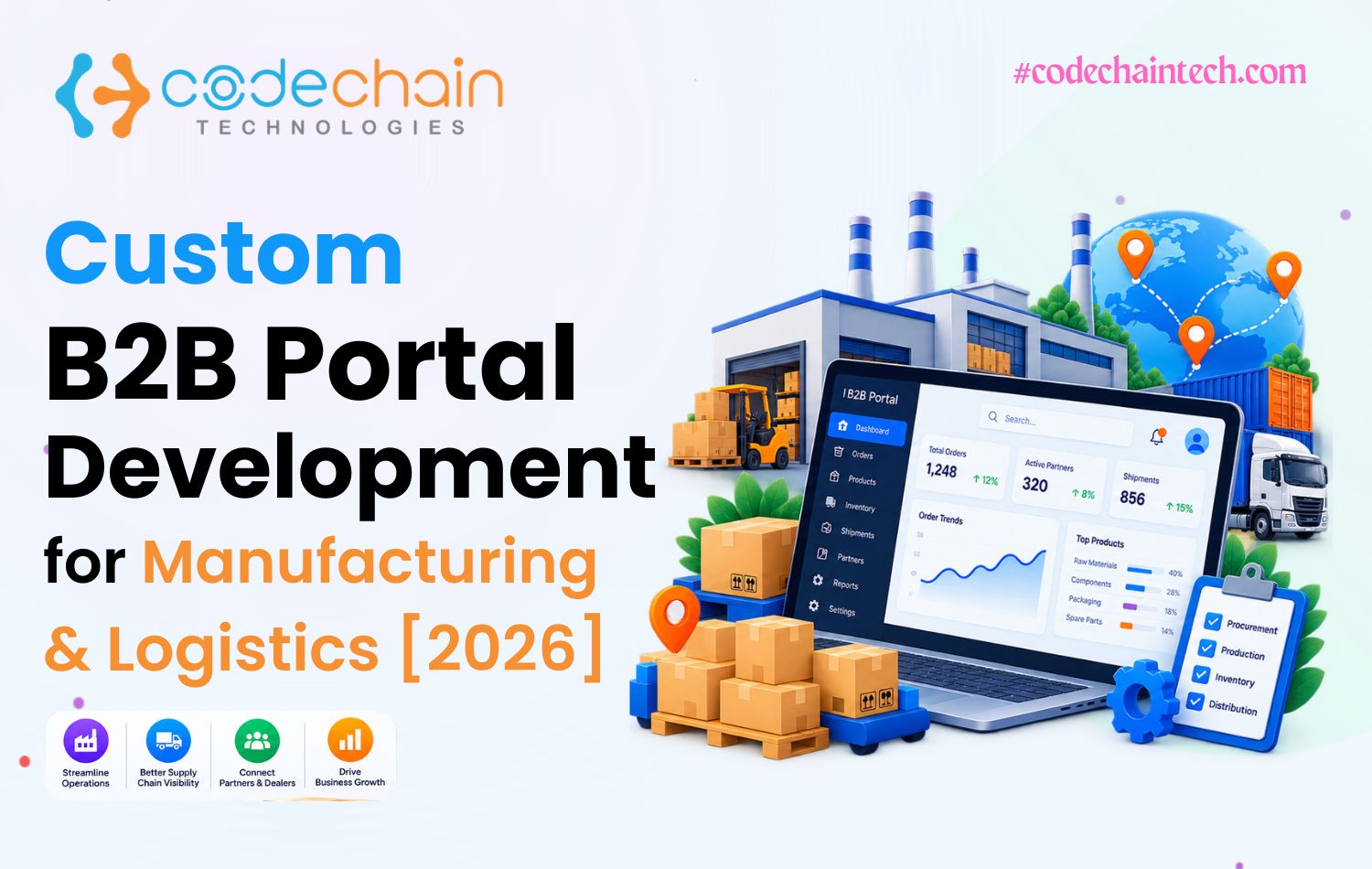
Custom B2B portal development is the process of building a secure, tailored web application that automates vendor management, streamlines supply chains, and integrates live logistics data under a single dashboard. It helps manufacturing and logistics businesses replace disconnected manual processes with a centralized system. Unlike ready-made software, a custom B2B portal is designed around a company's actual workflows, integrations, and operational requirements.
In 2026, digital transformation is becoming an important priority for manufacturers, distributors, freight forwarders, and logistics providers. Customers expect quicker responses, accurate order updates, and greater visibility into shipments. At the same time, businesses are under pressure to manage operating costs without compromising service quality.
However, many businesses still rely on Excel spreadsheets, WhatsApp messages, emails, and manual paperwork to manage their everyday operations.
Consider a manufacturing company receiving purchase orders through email, updating inventory in Excel, and contacting transport partners through WhatsApp. Each process may work independently, but connecting the information becomes difficult as transaction volumes increase.
An order may be confirmed without checking available stock. A shipment update may reach the sales team but not the customer. An invoice might require several manual approvals before payment processing can begin.
These small delays gradually create larger operational problems.
A custom B2B web portal brings these activities into one connected environment. Employees, vendors, distributors, transport partners, and customers can access relevant information according to their assigned permissions.
Businesses can manage purchase orders, inventory, quotations, shipment tracking, invoices, and operational reports without constantly switching between applications.
Organizations looking to connect these operations can explore custom software development services to understand how business-specific applications can support existing workflows.
For growing manufacturing and logistics companies, custom B2B portal development is not simply about replacing spreadsheets. It is about building a reliable digital foundation that supports better decisions, smoother collaboration, and long-term business growth.
Why Ready-Made SaaS Solutions Often Fall Short for Manufacturing and Logistics
Software-as-a-Service (SaaS) platforms offer a convenient starting point for businesses looking to digitize their operations.
They are usually faster to activate, require less initial development, and provide familiar features such as order management, reporting, and customer databases.
However, challenges can appear when business workflows become more complicated.
The Subscription Trap: Rising Per-User Costs
Many SaaS providers charge businesses according to the number of users, features, locations, or transaction volumes.
For a small team, these expenses may seem manageable. But manufacturers and logistics companies often need accounts for warehouse employees, dispatch teams, purchase managers, vendors, distributors, and administrative staff.
Imagine a business using a SaaS platform that charges ₹1,500 per user per month.
For 100 users, the subscription alone would cost ₹150,000 monthly, or ₹1,800,000 annually.
This is an illustrative example, not a universal SaaS price.
As the business expands, subscription expenses may increase further.
A custom B2B portal generally requires a higher initial development investment. However, businesses can avoid mandatory per-user license charges imposed by third-party SaaS vendors when using a suitably licensed custom solution.
Hosting, maintenance, cybersecurity, integrations, and technical support still involve ongoing expenses.
The real advantage is greater control over how these costs evolve.
Integration Bottlenecks with Existing Business Systems
Manufacturing and logistics companies rarely operate using just one software application.
They may already use SAP, Oracle, Tally, accounting software, warehouse management tools, payment gateways, and transportation platforms.
Connecting these systems with ready-made SaaS products can become complicated.
For example, an Indian logistics company may need to integrate transport tracking providers, GST-related workflows, e-way bill services, and local payment platforms.
Some SaaS tools support these integrations directly. Others may require expensive add-ons, third-party middleware, or manual data transfers.
A custom portal allows businesses to design integrations around their existing systems, subject to available APIs, permissions, and technical compatibility.
Limited Flexibility for Industry-Specific Workflows
Every manufacturing facility and logistics company operates differently.
One manufacturer may require raw material approval before production begins. Another may need multiple quality checks before dispatch.
Similarly, freight forwarders may need container tracking, customs documentation, shipping instructions, and warehouse movement records.
A standard SaaS workflow may not accommodate every requirement.
Businesses sometimes end up changing their processes to match the software instead of using software that supports their processes.
Custom development offers greater flexibility to design approval chains, user roles, reporting formats, and operational rules.
This is where enterprise web application development can help businesses create interfaces and workflows that match their operational requirements.
SaaS vs Custom B2B Portal: A Practical Comparison
The best choice depends on business complexity. SaaS may be sufficient for standardized operations, while custom B2B portal development becomes more attractive when workflows, integrations, and ownership requirements demand greater flexibility.
Key Benefits of Custom B2B Portal Development
A well-designed B2B portal can improve how manufacturers, suppliers, distributors, and logistics partners collaborate.
Its value comes from reducing repetitive work, connecting business information, and making operational decisions easier.
Supply Chain Automation: From Orders to Invoices
Supply chain operations involve multiple steps, including purchase requests, vendor approvals, stock verification, production scheduling, shipment planning, and invoicing.
When these activities are managed manually, employees spend considerable time entering the same information into different systems.
A custom B2B portal can automate routine activities through predefined workflows.
For example, when a distributor places an order, the portal can verify inventory availability, notify the relevant team, initiate approval processes, and generate the required order records.
Once the order progresses, authorized users can view its current status without requesting updates through phone calls or emails.
Important automation features include:
Automated purchase order creation and approval.
Inventory availability checks.
Quotation and invoice generation.
Order status notifications.
Delivery scheduling and dispatch coordination.
Customer-specific pricing and payment terms.
Integration with accounting and ERP systems.
Automation does not eliminate every manual task. Instead, it allows employees to focus on exceptions, customer relationships, and decisions requiring human attention.
Vendor Management System: Better Supplier Collaboration
Managing multiple suppliers becomes increasingly difficult when quotations, documents, and purchase orders are scattered across email threads.
A custom Vendor Management System (VMS) creates a dedicated digital workspace for suppliers.
Vendors can log in securely, view purchase requests, submit quotations, update product availability, and track their orders.
Procurement teams can compare supplier responses, monitor delivery performance, and maintain organized records.
For manufacturing businesses, this improves visibility into material availability and purchasing activities.
Useful vendor portal capabilities include:
Supplier registration and verification.
Vendor-specific dashboards.
Digital quotation submission.
Purchase order acceptance.
Product catalog and stock updates.
Document uploads and compliance records.
Supplier performance reporting.
A centralized vendor management system also reduces dependence on individual employees for retrieving important supplier information.
Real-Time Freight and Logistics Tracking
Shipment visibility is particularly important for freight forwarders, transport companies, distributors, and e-commerce supply chains.
Customers want to know whether their goods have been dispatched, reached a warehouse, cleared a checkpoint, or arrived at the destination.
A custom logistics portal can collect shipment data from transportation systems, GPS providers, carrier APIs, and warehouse applications.
This information can then appear in a centralized tracking dashboard.
Depending on the data provider and infrastructure, event-driven integrations can deliver updates with very low latency, including sub-second delivery for supported events.
However, genuine end-to-end tracking speed depends on how frequently the original tracking source produces new data.
Practical features include
Shipment and container status tracking.
Transport vehicle location visibility.
Estimated delivery information.
Warehouse movement records.
Delivery confirmation.
Delay notifications.
Shipment document management.
For logistics businesses handling multiple shipments daily, centralized tracking can significantly reduce routine customer inquiries.
Data Ownership, Security, and Long-Term Cost Control
Data is a valuable business asset.
Manufacturing and logistics companies manage sensitive information such as customer contracts, negotiated pricing, supplier agreements, financial records, and shipment details.
With custom development, businesses can establish clearer control over application data, hosting arrangements, access permissions, and retention policies.
Security features can include role-based access control, encryption, audit logs, multifactor authentication, and automated backups.
For a practical security reference, the OWASP Top 10 outlines common web application security risks that development teams should understand and address.
Importantly, a custom-built application does not automatically guarantee complete data ownership or zero recurring costs.
Ownership depends on development agreements, intellectual property terms, third-party components, and infrastructure arrangements.
Similarly, businesses must budget for maintenance, cloud hosting, monitoring, and future improvements.
The benefit is the ability to make these decisions according to business priorities rather than relying entirely on a SaaS provider's licensing structure.
Measuring the Return on Investment
To evaluate ROI, businesses should compare implementation and operating costs against measurable improvements.
Useful indicators include:
Hours saved on manual data entry.
Reduction in order processing errors.
Faster quotation and approval turnaround.
Fewer shipment status inquiries.
Reduced software subscription spending.
Improved employee productivity.
For example, reducing manual order processing by ten minutes across hundreds of monthly orders can create meaningful time savings.
When combined with better accuracy and customer communication, those improvements can justify investment in a custom portal over time.
Architecture and Ideal Technology Stack for Custom B2B Portals
Technology selection plays an important role in determining how securely and efficiently a B2B portal operates.
A suitable architecture should support business workflows, system integrations, transaction processing, reporting, and future expansion.
For most projects, the right stack depends on the complexity of the application rather than the popularity of a particular technology.
Frontend Development: React.js or Next.js
The frontend is the part of the application employees, vendors, and customers interact with every day.
Manufacturing and logistics portals often include complex tables, inventory records, shipment timelines, approval forms, and reporting dashboards.
React.js provides a component-based approach that supports interactive interfaces and reusable application elements.
Next.js, built around React, offers additional rendering, routing, and performance capabilities.
Both can support responsive web applications that work across desktop computers, tablets, and mobile devices.
Businesses planning interactive dashboards can consider React.js web development services for building reusable interfaces and data-driven components.
A well-designed interface helps warehouse employees, procurement teams, and managers complete tasks with fewer unnecessary steps.
Backend Development: Laravel vs GoLang
The backend controls business rules, permissions, API requests, database operations, and integrations.
Laravel and GoLang can both be effective choices, although they serve different architectural priorities.
Laravel for Business Logic
Laravel is well suited to portals requiring structured workflows, authentication, approval systems, database operations, and administrative functionality.
Its established ecosystem can accelerate development of purchasing, inventory, invoicing, and reporting modules.
GoLang for High-Concurrency API Services
GoLang is particularly useful for backend services requiring efficient concurrency and high-throughput processing.
It can be considered for shipment event ingestion, large-scale API integrations, and specialized processing services.
Businesses evaluating these technologies can also read our comparison of Laravel vs Node.js vs GoLang for secure backend development to understand their suitability for transaction-intensive platforms.
Some enterprise platforms may combine Laravel for core operational workflows with Go for selected high-volume services.
However, this additional complexity should be justified by actual performance and scalability requirements.
Database Development: PostgreSQL and MySQL
A reliable database is essential for maintaining order records, stock quantities, vendor information, invoices, and shipment history.
PostgreSQL and MySQL are established relational database systems suitable for many enterprise applications.
Both support transactions, indexing, access controls, and data integrity mechanisms.
For teams evaluating database design and security capabilities, the official PostgreSQL documentation provides detailed information about transactions, roles, privileges, and database administration.
The selection should consider reporting needs, expected workloads, developer experience, integration requirements, and operational preferences.
A secure architecture should also include API authentication, role-based permissions, encrypted communication, regular backups, monitoring, and tested recovery procedures.
The ideal B2B portal architecture is one that remains secure, maintainable, and practical as the business grows.
Custom B2B Portal Development Roadmap: Step-by-Step Guide
Successful custom B2B portal development begins with understanding business operations before writing application code.
A structured roadmap helps reduce unnecessary features, integration surprises, and costly changes later in development.
Step 1: Requirement Gathering and Blueprint Design
The development process starts by identifying existing workflows, operational challenges, and business goals.
This involves discussions with managers, procurement teams, warehouse employees, vendors, and other users.
Developers document how orders move through the organization, which approvals are required, and how information is shared.
The resulting blueprint defines user roles, modules, workflow diagrams, integration needs, and essential reporting requirements.
For example, a logistics portal may need separate dashboards for customers, transport coordinators, warehouse managers, and administrators.
Clearly defining these requirements helps prioritize the initial release.
Step 2: Secure Database Architecture Planning
Once requirements are finalized, the development team designs the application's data structure.
This includes organizing customers, suppliers, products, purchase orders, invoices, shipment records, and user permissions.
Database architecture must account for relationships between records, concurrent updates, and transaction integrity.
Security planning should include appropriate access restrictions, encryption requirements, backup procedures, and audit logging.
For businesses migrating from spreadsheets or existing software, data cleaning and migration rules should also be established.
Step 3: Core API Development and ERP/CRM Integration
Backend development connects the application's business workflows with databases and external services.
Developers build APIs for order creation, inventory updates, vendor management, reporting, and shipment tracking.
Where supported, the portal can integrate with existing SAP, Oracle, CRM, accounting, and logistics platforms.
Integration planning must consider API availability, authentication methods, data formats, rate limits, and synchronization requirements.
Businesses with complex operational requirements may benefit from experienced backend development services when designing APIs and connecting enterprise applications.
Reliable error handling is especially important when external systems become temporarily unavailable.
Step 4: Rigorous QA Testing and Security Audits
Before launch, the portal should undergo functional, integration, performance, and security testing.
Functional testing verifies whether purchase orders, approvals, stock updates, and reporting features work correctly.
Load testing evaluates how the system behaves when multiple users access it simultaneously.
Security reviews examine authentication, authorization, input validation, API protection, and dependency risks.
Testing should also cover failed transactions, duplicate requests, interrupted integrations, and recovery scenarios.
Identifying these issues before deployment reduces disruption to business operations.
Step 5: Deployment and Smooth Staff Onboarding
After testing, the application is deployed to the selected hosting infrastructure.
The team configures the production environment, monitoring tools, backups, access controls, and operational support processes.
Employee onboarding is equally important.
Warehouse staff, purchase managers, administrators, and vendors need practical training based on their responsibilities.
A phased rollout can help organizations introduce the portal gradually without interrupting existing operations.
After launch, ongoing monitoring, user feedback, and planned improvements help the software remain aligned with changing business needs.
Conclusion
Manufacturing and logistics businesses need connected systems that improve efficiency, reduce manual work, and support long-term growth.
Custom B2B portal development provides a practical way to automate supply chains, manage vendors, track shipments, and integrate existing enterprise applications.
At CodeChain Technologies, we focus on building custom enterprise solutions designed around real business requirements.
Ready to automate your manufacturing or logistics operations?
Move beyond disconnected Excel spreadsheets and manual workflows.
Contact CodeChain Technologies today for a free one-on-one technical consultation and explore how a custom B2B portal can help your business grow.
FAQs
-
1
What are the top 5 B2B portals in India?
Five well-known B2B platforms in India are IndiaMART, TradeIndia, Udaan, ExportersIndia, and Moglix. These platforms support supplier discovery, wholesale purchasing, industrial procurement, and business trade.
-
2
What is the best B2B export portal?
IndiaMART, TradeIndia, and ExportersIndia are popular options for Indian exporters. The best platform depends on your industry, target countries, supplier network, and international lead-generation requirements.
-
3
Which B2B travel portal is the best in India?
TBO.com, Riya Travel, and TripJack are established B2B travel platforms in India. The best choice depends on agent pricing, hotel inventory, flight availability, booking tools, and customer support.
-
4
Which is India's biggest B2B company?
Reliance Industries is among India's largest companies operating extensively in B2B markets. For online B2B marketplaces, IndiaMART is one of India's most prominent platforms. The answer depends on whether size is measured by revenue, market value, or platform reach.
-
5
How long does it take to develop a custom B2B portal?
A basic custom B2B portal typically takes 8–12 weeks to develop. Advanced manufacturing and logistics portals with ERP integration, vendor management, and real-time tracking may require 4–8 months or longer.
-
6
Can a custom B2B portal integrate with our existing SAP or Oracle ERP?
Yes. Custom B2B portals can integrate with SAP, Oracle, and other ERP systems through supported APIs or middleware. This enables data synchronization across inventory, orders, finance, and supply chain operations.
-
7
How is data security maintained in B2B web applications?
B2B portal security involves data encryption, secure authentication, role-based access control, API protection, regular security testing, and automated backups. These measures help protect sensitive business and customer information.
-
8
What is custom B2B portal development?
Custom B2B portal development involves building business-specific web applications to manage vendors, orders, inventory, payments, and logistics. It helps companies automate workflows and connect business operations through a centralized platform.
-
9
How much does custom B2B portal development cost in India?
Development costs depend on features, integrations, security requirements, and project complexity. A basic portal may cost a few lakh rupees, while advanced enterprise platforms can require substantially higher budgets.
-
10
What are the benefits of custom B2B portals for manufacturing companies?
Custom B2B portals help manufacturers automate purchase orders, manage suppliers, monitor inventory, reduce manual errors, and improve production coordination. They also provide better visibility into supply chain operations.