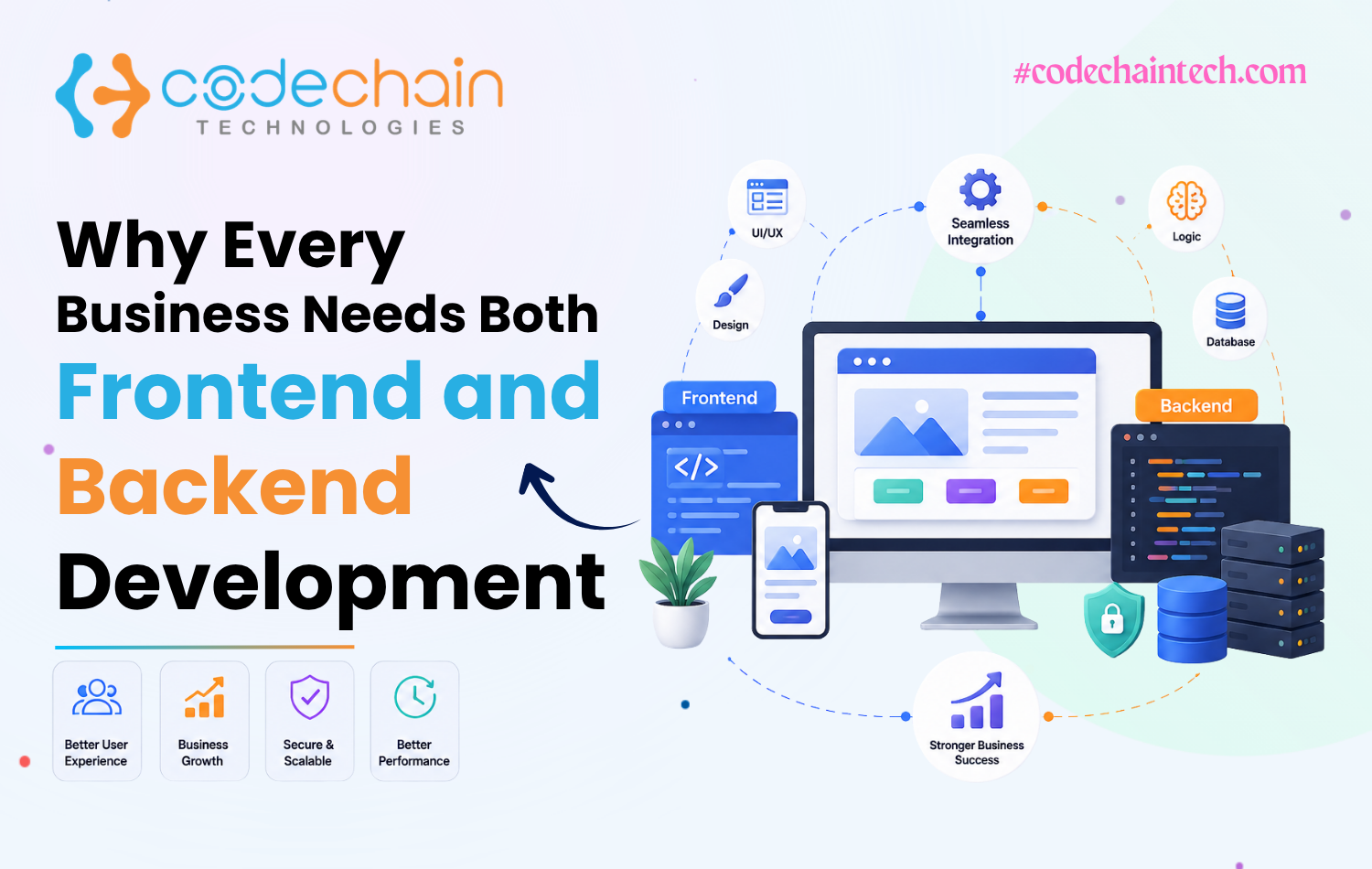
Frontend development includes everything that a user can see and interact with on a website. Backend development is all the application's logic, databases, security, and the activities of the server. Both parts are important for a business because an attractive interface without a dependable backend cannot perform the necessary duties and a robust backend without a user-friendly user interface cannot provide a great client experience. Together, they provide a safe, scalable, and high-performance digital system.
Imagine shopping online and easily booking a hotel room, shopping on an e-commerce site, or just checking in to a customer dashboard in a few easy steps. Frontend development is all about creating the visual and interactive aspects of a web application. Everything that users can see and interact with via web browsers is part of frontend development. Most users access apps and web pages via browsers. Frontend development is the process of creating an engaging user experience by integrating data and application logic. When you create a safe, scalable, and high-performance digital system, you provide a great client experience by engaging your users through interactive web pages.
What is front-end development?
Frontend development is creating the visual and interactive element of a web application. Everything that users can see or interact with via browsers is part of frontend development.
Modern frontend development has become more than beautiful design. Now, things such as user experience, accessibility, responsiveness, and if a web application can handle the load are taken into consideration to make a web application. Each of these individual things needs to be addressed for every website.
Frontend Development Responsibilities
- Designing user interfaces that are intuitive
- Developing websites with responsive layouts
- Enhancing User Experience (UX)
- Make the website faster
- Set performance metrics
- Interactive element creation
- Mobile Performance Optimization
- Setting guidelines for accessibility
- Support for cross-browser compatibility
Why Frontend Is Important for Businesses
Customers decide within a couple of seconds whether they want to stay on a website or not. Whether a web application is easy-to-use and has a nice design really matters.
A good frontend can assist businesses:
- Enhance client engagement
- Increase conversion rates
- Lower bounce rates
- Establish Brand Credibility
- Improve mobile user experience
Support faster loading pages for improved search engine ranking.
Simply said, frontend development is about creating the experience your clients remember when they visit your website.
What is backend development?
The frontend is what the user sees. Backend development takes place behind the scenes. The server, application logic, database, authentication, and all the processes needed to keep a website running successfully are managed by it.
The backend is responsible for almost every critical business function on a website, although users never directly interact with it.
The backend has to do several things at the same time when a person buys a product from an online store, for example. It confirms that the product is in stock, determines the price, takes the payment, adjusts stock levels, saves customer information, creates an order confirmation, and sends out notification emails. All this takes place in seconds without the client knowing that all these complicated processes are occurring in the background.
Backend Development Core Responsibilities
- Database Management
- Business logic processing
- User Authentication Handling
- Keeping Confidential Information Safe
- API Management
- Third-party service integration
- Online payment processing
- Supporting cloud infrastructure services
- App performance monitoring
Why Are Backends Important for Business?
A solid backend guarantees each client interaction is handled accurately and securely. Without it, even the most attractive website is useless for basic business activities.
A robust backend assists businesses:
- Safeguard customer data
- Speed up application performance
- Handle rising visitors on your website
- Allow safe online transactions
- Integrate with payment systems, ERP, and CRM
Enable future business development without the need to re-architect the application.
The more businesses there are, the more important backend development becomes, since it gives the stability, flexibility, and scalability that are needed to deal with rising client requirements and digital activities.
Frontend vs Backend Development: Complete Comparison
Frontend and backend development have separate functions, but they work in conjunction. One is concerned with offering a smooth user experience while the other makes sure every feature works properly in the background. Knowing the distinction helps companies make smarter technology decisions and design digital solutions that operate effectively today and have the capacity to grow throughout time.
Why Frontend and Backend Development Are Important for Businesses
Business web pages must allow users to take action. Business strategies that focus on the needs of the consumer rely on trust, data protection, and secured data to thrive. Frontend and backend development are crucial to these goals and generate digital experiences that are both engaging and reliable. Here are some of the top reasons to invest in both of them in a business.
Provide an Outstanding Customer Experience
Customers want simple, speedy, and easy-to-use websites. If consumers cannot discover the information they need or finish a task, they are most likely to leave and go to a competitor.
Your frontend development work results in clean layouts, straightforward navigation, and responsive designs that make browsing a breeze. At the same time, backend development makes sure that each click, search, form submission, and account request is handled properly.
Improve Website Performance and Speed
Consider a visitor looking for a product in an online store. The frontend shows a search bar and product cards; the backend searches the database and finds matched products and transmits the results quickly. They team up to give you a seamless shopping experience.
Worked together, companies gain:
- Faster loading times
- Better navigation
- Mobile performance enhancements
- Fewer people bouncing
- Increased client interaction
A swift website development not only appeases customers, but it helps make your site appear professional and safe to use.
More Business and Customer Data Safety
Because every business has valuable information, such as client information, financial records, appointments, and internal business information. It is imperative to keep this information protected because it can influence customer safety.
The frontend can help avoid user input mistakes, but real security begins in the backend. Safe authentication and secure data storage, controlled access, and server-side validation security applications against unauthorized access and cyber attacks.
Consider an online banking system. While the interface allows customers to monitor account balances and transfer funds conveniently, all transactions are validated, encrypted, and processed securely by the backend before they are completed.
Your Business Made It Easier to Grow Without Starting from Scratch
The requirements and growth a business experiences are dynamic and evolve with the growth of the business. As a business grows, it launches new products, obtains new customers, enters new markets, offers new services, and engages with its customers and the world digitally.
A startup, for example, might start out as a simple service website. This can include client accounts, online payments, appointment booking, analytics dashboards, and mobile apps as the company grows. A good frontend and backend design helps make it much easier to expand.
Scalable software development saves time and costs, and it helps support and sustain the success of a business.
Simplify everyday business processes
Digital devices are now vital to almost every business as they introduce automation to streamline repetitive and monotonous tasks. Web applications can be leveraged by businesses to automatically populate customer data, bills, inventory, appointments, or any other data a business may need.
As one example, a customer filling out a form to open a service request may take only a few seconds to fill out the form. However, the backend can perform the task automatically:
- The request is saved in the database.
- Contact the support team.
- Assign the task to an employee.
- Ticket No.
- You have the confirmation email.
The automation lessens manual effort, lowers errors, and gives teams the ability to focus on the tasks that hold more value.
Easily allow third-party integrations
Software solutions play a necessary part in most businesses, as they help automate the repetitive and monotonous tasks required to perform the day-to-day operations of a business. Most businesses need multiple applications to perform their operations.
A website normally has to communicate with the payment gateways, CRM systems, ERP tools, marketing systems, email systems, analytics systems, and shipping companies.
As one example, when a customer submits an order through a website, several things happen from an automated perspective:
- Order confirmation received
- Order inventory refreshed.
- Order data passed on to the shipping partner
- Customer ticket number assigned
- You sent the confirmation email to the customer
- Sales reports done
All of this now takes one automated click for the customer. In the background, multiple services automatically coordinate various systems and integrate them for a seamless and automated process and/or task.
Well-planned integrations eliminate repetitive manual work, improve data accuracy, and increase operational efficiency.
Improve search visibility and enhance technical SEO
Many companies think SEO is just about the keywords and the content on a website. Of course, the performance of a website and the technical architecture of a website also play a significant role in the placement of a website in the Search Engine Result Pages (SERPs).
Many companies rely on a wide variety of software applications to automate the repetitive and monotonous tasks needed to perform the day-to-
Frontend optimization focuses on enhancing:
- Page load speeds
- Mobile responsiveness
- User experiences
- Accessibility
- Core Web Vitals
Backend optimization focuses on enhancing:
- Server response times
- Fast database queries
- Securing HTTPS connections
- Providing XML sitemaps
- Implementing correct redirects
- Structured data provision
By bringing together frontend and backend systems, search engine crawlers are better able to understand and navigate through a website. Overall, this improves website performance and design.
Build Customer Trust and Brand Credibility
To meet customer expectations, websites must function seamlessly. The failure of any webpage to create, load, or display content in a timely manner will create distrust in a firm.
The following are considered good practice, as they increase customer confidence:
- Good design
- Uniformity in branding
- Easy-to-follow design
- Design that is flexible and responsive
- Secure server and fast database response
- Secure HTTPS connections
- Secure XML sitemaps
- Correct redirects
- Provision of valid structured data
These, when brought together in both the frontend and backend systems, make it easy to add these functionalities.
Support Innovation for the Future
Web technology rapidly progresses, and firms are continually extending their digital capabilities. The following would be considered examples supporting the future of innovation and technology.
- Chatbots created using AI
- Customer portals
- Tailored recommendations
- Business dashboards
- Appointment booking
- Subscription control
- Mobile apps
When both frontend and backend systems embrace scalability, the introduction of these functionalities becomes a lot easier.
Deliver Seamless Experiences Across Devices
The following practices, both in frontend and backend development, will ensure seamless user experiences across devices.
Backend development is augmented with practices to ensure fast server response times, quick database queries, and secure HTTPS connections to provide valid SSL certificates, XML sitemaps, and supported correct redirects and will provide valid structured data when required.
Frontend development practices focused on seamless user experiences across devices will include responsive design, optimized images, and efficient client-side processing.
A consumer might engage in the following behaviors:
- Shop via mobile device.
- Save items to a wishlist.
- Shop via laptop at a later time.
- Make a purchase via desktop computer.
The back end of the system syncs customer data to provide consistent and seamless shopping experiences via all user devices.
Real-Life Business Examples
Real-World Business Examples Provide a better understanding of how the front and back ends function together.
1. E-commerce Website
An e-commerce online business requires both frontend and backend to offer a seamless shopping experience.
Frontend
- Product Pages
- Filter Search
- Shopping Cart
- Product Pictures
- Customer Reviews
- Checkout User Interface
Backend
- Product Database
- Inventory Control
- Order Processing
- Payment Confirmation
- Consumer Accounts
- Integration of Logistics
Without a capable backend, customers will not be able to purchase goods.
2. HealthCare Portal
Healthcare platforms offer online services that help healthcare professionals offer their services to the public.
Frontend
- Appointment Scheduling
- Doctor Profile Pages
- Patient Portal Pages
- Medical Studies
- View Prescriptions
Backend
- Patient Records
- Doctor's Appointment Scheduling
- Secure Login
- Integration of Logistics
The backend of the healthcare platform is responsible for securing patient records, while the frontend handles scheduling.
3. CRM Software
CRM platforms are designed to meet the daily needs of sales teams in managing meetings or schedules with both prospective and current clients.
Frontend
- Sales Dashboard
- Lead Management Screens
- Customer Profile Pages
- Activity History
- Reports
Backend
- Customer Database
- Lead Monitoring
- Workflow Automation
- Mail Integration
- Processing of Analytics
The two layers work together to increase productivity and help make better business decisions.
4. Online Banking System
Banking applications require high performance and security.
Front End
- Dashboard Account
- Funds Transfer Screens
- Transactions History
- Bill Pay Screen
Back End
- Verification of Transaction
- Balance Calculations
- Fraud Detection
- Security Surveillance
- Account Management
Behind every finance transaction are procedures humming away in the back-end while the front-end offers customers a frictionless banking experience.
What Occurs If You Purposefully Ignore One Side?
Exceptional design and development of both sides of a website are not necessarily prioritized in the same way by all businesses. Other companies simply care about website functionality instead of user experience. Different approaches have some common disadvantages.
If You Only Focus On Frontend Development
Even if you have the most attractive website in the world, without a robust backend, you cannot perform any critical business activities.
- No user authentication
- No database connection
- Non-working contact forms
- Failed payments
- Customer dashboard not accessible
- No handling orders
- Scalability was limited
The website may appear professional but cannot serve the business activities properly.
When you only care about backend development
Because no matter how powerful your backend is, it won't matter if your clients are having trouble using your website.
- Legacy UI
- The navigation system is confusing
- Mobile Experience Is Awful
- Low participation
- Increased bounce rates
- Less conversion rates
Users will usually decide on a business within a few seconds, and bad usability can deter them from looking at the products or services offered.
Common Mistakes Companies Make
Even the best business ideas can run into problems if you don't pay attention to the crucial parts of web design. But avoiding these frequent blunders will save you time and money.
Form vs. Function
A nice-looking website is great, but it has to perform reliably. No matter how pretty the interface is, it can't make up for poor performance or faulty functionality.
Scalability Ignored
Many companies develop for their immediate requirements solely, with no consideration for future expansion. Old architecture is costly and difficult to upgrade when traffic increases.
Ignoring Website Security
Weak authentication, poor data protection, and outdated software are more likely to result in cyberattacks and data breaches.
Mobile Experience Sucks
A large number of users view webpages on cellphones. Pages that are difficult to navigate on smaller displays can cost organizations precious customers.
Websites that load slowly
Large graphics, inefficient code, and poorly optimized databases slow down a website. Pages that load slowly often result in higher bounce rates.
Weak API design
Businesses often connect payment gateways, CRM systems, social media marketing tools, and third-party services. A poor API architecture might lead to compatibility concerns.
Hiring Only Based on Cost
The cheapest development choice may look good at first, but bad development frequently means higher maintenance expenses, delays, and future redevelopments.
In the long run, working with an experienced development partner usually brings more value.
Choosing the Right Development Company
The correct technology partner is key to any digital project's success. A competent development team should have a clear understanding of the technical requirements and business goals.
Think over the following before making your selection.
Look at Past Projects
Have a look at the company's portfolio to get a feel for the quality of their work, the sectors they service, and their expertise with similar projects.
Evaluate Technical Skills
An experienced developer partner should have experience with modern frontend frameworks, backend technologies, cloud platforms, databases, and API integrations.
Understand how they are developed
A successful project rests on clear planning, transparent communication, consistent progress updates, testing, and post-launch support.
Enquire About Scalability
Your business will keep evolving. Make sure that the development team designs solutions that can support future expansion without major redesign.
Security First
Describe how the organization handles authentication, encryption, secure code, backups, and continuous maintenance.
Think long-term support
Web applications need to be updated, secured, patched, and improved with features over time. A partner that provides ongoing support helps keep your platform secure and up-to-date.
Why Businesses Prefer CodeChainTech
It can be difficult for businesses to balance customer needs and continually changing market preferences while maintaining application performance and security.
At CodeChainTech, we have a development team that will understand your business application requirements and will utilize the most current technology for your application in order to drive measurable business success.
We don't follow a one-size-fits-all approach. Because of this, we don't design digital solutions that will remain reliable as customers want and market expectations keep changing.
Conclusion
Currently, a good website or application developed for a business is expected to be more than just pretty. It must provide a good user experience, handle data securely, interface with multiple corporate systems, and be flexible as customer demands grow.
At CodeChainTech, we pride ourselves on our development team's effort in knowledge and application of skills in the concerned areas for our clients in order to maintain application performance and security.
Frontend development delivers the appealing interfaces and engaging user experiences that are required, while backend development fulfills the intelligence, security, and reliability requirements for every corporate function. Without the other, it cannot reach its full potential.
No matter what your firm is focusing on, whether it be creating a new web application, updating a current infrastructure, or even guiding its digital transformation journey, working with a capable development team can help your firm. CodeChainTech can help your firm construct modern web applications with economically priced services.
FAQs
-
1
What Is Frontend and Backend Development?
Frontend development is about the visible interface that the user sees and interacts with, whereas backend development is about the servers, databases, application logic, and security that power the program behind the scenes.
-
2
Can you build a website without backend development?
For simple informational websites, a backend is not necessary, but if the website requires logins, payments, databases, or dynamic content, backend development is needed.
-
3
What is more significant, the front end or the back end?
Both are of equal importance. The frontend promotes customer satisfaction, and the backend makes sure the website is working securely and efficiently.
-
4
What are the most used front-end technologies nowadays?
React, Angular, Vue.js, HTML5, CSS3, JavaScript, Golang, TypeScript, etc., are popular front-end technologies.
-
5
Choosing the best backend technology for businesses?
The right choice will rely on the project’s requirements. Node.js, Laravel, Python, Django, PHP, .NET, and Java are all popular for various types of business apps.
-
6
Importance of Scalability in Web Design?
Scalable systems can handle additional users, new features, and business growth without needing to be completely redeveloped.
-
7
How do frontend and backend work?
The frontend is the part that takes user input and shows information. The backend is where the requests are received, data is processed, business logic is applied, and the right response is sent back to the interface.
-
8
Why is the website's security mostly taken care of by the backend?
Backend systems are responsible for authentication, encryption, database protection, and server-side validation. As such, backend systems are crucial in protecting critical corporate and consumer data.
-
9
What benefits can full-stack development bring to businesses?
Full-stack development is a combination of frontend and backend development skills that can construct integrated and efficient online apps that are scalable and easier to manage.
-
10
Why should you choose CodeChainTech for web development services?
CodeChainTech builds custom web solutions that combine modern frontend design with powerful backend development to help organizations construct safe, scalable, and future-proof digital platforms that align with their aims.