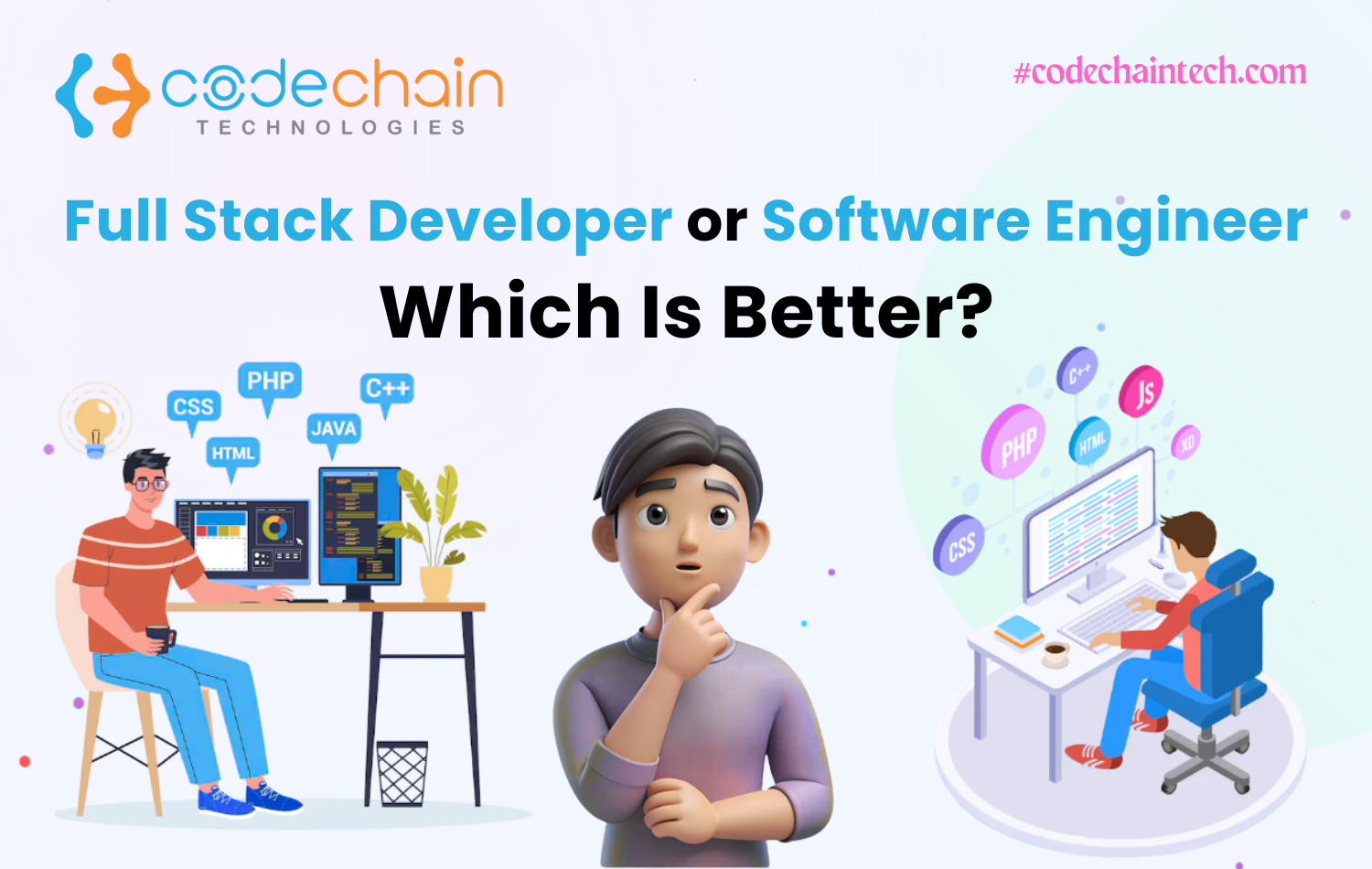
Full-stack developers and software engineers are two of the most sought-after tech jobs right now, but many companies have a hard time deciding which one they really need. Picking the wrong job could mean more costs, longer schedules, problems with scaling, or even the project's ultimate failure. We work with startups, small and medium-sized businesses, and large companies at CodeChainTech, and this question comes up at practically every project meeting.
This blog isn't just a list of definitions; it's a useful resource for recruiting. By the conclusion, you'll know who to recruit, when to hire, and why, all based on your business goals.
Hire Smarter
Make the right choice for your team
Why This Choice Is Important for Companies
It's not simply a technical choice to hire a developer; it's also a business choice. Your choice has a direct effect on:
A lot of companies think that a software engineer and a full-stack developer are the same thing. No, they aren't. Each role has a separate job to do, and knowing the difference might save you months of labor and thousands of dollars.
What does it mean to be a full-stack developer?
A full-stack developer is someone who can work on both the front end and the back end of a website. They work on all parts of the program lifecycle, from the user interface to the server logic and databases.
Main Duties
- Frontend development (putting UI/UX into action)
- Backend development (APIs, logic, and databases)
- Adding services from other companies
- Basic server management and deployment
- Feature development from start to finish
Common Tech Stack
CodeChainTech often gives full-stack developers MVPs, startup products, and tasks that need to be done quickly and flexibly instead of deep system engineering.
What does a software engineer do?
An engineer's way of thinking is how a software engineer tackles development. They don't just write code; they also think about system design, scalability, performance, security, and maintainability.
Main Duties
- Designing the architecture of software
- Making code that can grow and be fixed
- Improving performance
- Putting security in place
- Managing complicated procedures and integrations
- Long-term care for the system
Common Tech Stack
CodeChainTech's software developers mostly work on business software, SaaS platforms, and systems that get a lot of traffic.
A Simple Explanation of the Main Differences
What you need to do
Full Stack: broad knowledge
Software Engineer: deep expertise
Speed vs. Stability
Full-stack: faster delivery
Software Engineer: long-lasting systems
Project Complexity
Full-stack: simple to medium
Software Engineer: complex, large-scale
When is it time to hire a full-stack developer?
If you need a full-stack developer, you should employ one.
Startups need to be quick, adaptable, and cheap. A full-stack developer can quickly build an MVP.
Full-stack developers are great for testing markets, validating concepts.
Costs less than two separate engineers.
Perfect when scope is not too complicated.
Best uses:
When is it time to hire a software engineer
If you need a software engineer, you should hire one.
If your product will quickly gain more customers, data, or features, engineering principles are very important.
Businesses need stability, security, and compliance, which are all things that software engineers are good at.
Engineered solutions are needed for high-load systems, finance apps, and healthcare platforms.
Software engineers make systems that are easy to upgrade and keep running.
Best uses:
full-stack developers vs. software engineers
| Aspect | Full-Stack Developer | Software Engineer |
|---|---|---|
| Scope | Front end + Back end | Entire software lifecycle |
| Focus | Web application development | Engineering & system design |
| Skill Depth | Broad knowledge | Deep technical expertise |
| Common Use | Startups, small teams | Enterprises, large systems |
| Output | Websites, web apps | Software products & platforms |
Real-Life Hiring Situations
SaaS Startup
Start with full-stack developers and add software engineers as your user base grows.
Digital Transformation
Software engineers from the start
Online Store
Full-stack for frontend, software engineers for backend and scalability.
Why Companies Pick CodeChainTech
CodeChainTech and software engineers are two of the most sought-after tech jobs right now, but many companies have a hard time deciding which one they really need. Picking the wrong job could mean more costs, longer schedules, problems with scaling, or even the project's ultimate failure. We work with startups, small and medium-sized businesses, and large companies at CodeChainTech, and this question comes up at practically every project meeting.
Trusted by 500+ businesses
India's leading IT solutions partner
Conclusion
It's not about which role is better overall when you choose between a full-stack developer and a software engineer. It's about whether one is right for your project. Full-stack developers are great for new businesses, MVPs, and projects that need to be done quickly, be flexible, and save money. They help companies quickly turn ideas into actions. Software engineers, on the other hand, are better at working on big, complicated, and long-term systems where performance, security, scalability, and stability are very important.
For companies that want to grow in the future, hiring the proper people early on can help them avoid technical debt and expensive rework. Before you pick a development role, you need to know your project's goals, budget, timeframe, and how it needs to be able to grow.
FAQs
-
1
Is it better to be a full stack developer or a software engineer?
It depends on career goals. A full stack developer is better for versatility and faster project delivery, while a software engineer is better for building scalable, complex, and long-term systems.
-
2
Which pays more, a software engineer or a full stack developer?
In most cases, software engineers earn more due to their focus on system design, scalability, and advanced engineering skills, especially at senior and enterprise levels.
-
3
Who earns more, a software engineer or a developer?
A software engineer generally earns more than a developer because of deeper technical expertise, architectural responsibilities, and long-term system ownership.
-
4
Can a software engineer be a full stack developer?
Yes. A software engineer can become a full stack developer by learning frontend technologies, while a full stack developer can grow into a software engineer with deeper system and architecture knowledge.
-
5
Full stack developer vs. software developer—which is better?
A full-stack developer is better for end-to-end development and faster delivery, while a software developer is better for specialized coding tasks. The better choice depends on project size and complexity.
-
6
Full stack developer vs software engineer—which is better?
A full-stack developer is ideal for startups and MVPs, whereas a software engineer is better for large-scale, secure, and highly scalable applications.
-
7
Full stack developer or software engineer—which is better on Reddit?
Most Reddit discussions suggest full-stack developers for versatility and startups and software engineers for long-term career growth and enterprise projects.
-
8
Are full-stack developer and software engineer the same?
No. A full stack developer focuses on both frontend and backend development, while a software engineer applies engineering principles to build scalable and complex systems.
-
9
Can a full stack developer become a software engineer?
Yes. A full stack devloper can become a software engineer by gaining deeper knowledge in system design, scalability, algorithms, and architecture.
-
10
Full stack developer or software engineer—which is better in India?
In India, full stack developers have more entry-level and startup opportunities, while software engineers usually earn more at mid-senior and enterprise levels.