
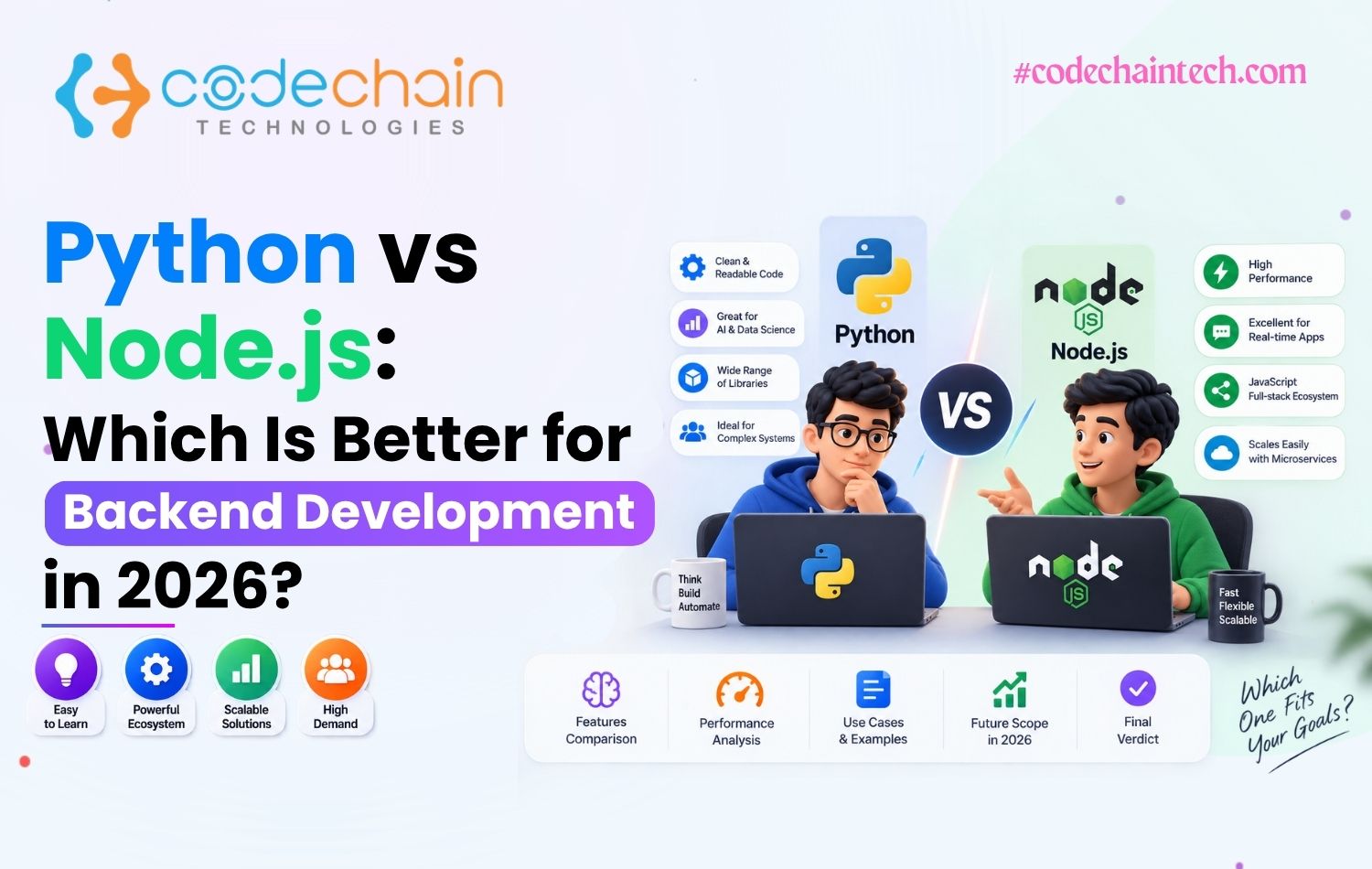
Python vs Node.js is one of the most common comparisons businesses and developers make when choosing a backend technology for a new web application, mobile app, SaaS platform, or custom software solution. Both are powerful, widely used, and capable of supporting scalable applications, but they approach backend development differently.
Python is known for its clean syntax, large ecosystem, and strong capabilities in artificial intelligence, machine learning, data processing, and business applications. Node.js, on the other hand, uses JavaScript on the server side and is popular for real-time applications, APIs, high-concurrency systems, and modern web platforms.
So, which one is better for backend development in 2026?
There is no universal winner. Python is often a better choice for AI-driven, data-heavy, and business applications, while Node.js can be an excellent option for real-time, API-focused, and highly interactive applications. The right choice depends on your project's requirements, performance expectations, development team, budget, and long-term goals.
What Is Python Backend Development?
Python is a high-level programming language widely used for backend development. Its simple and readable syntax makes it easier for developers to build, maintain, and expand applications.
For backend development, Python is commonly used with frameworks such as Django and other Python-based technologies. It can handle everything from business applications and REST APIs to data-driven platforms and AI-powered software.
One of Python's biggest advantages is its ecosystem. Developers can connect backend applications with databases, machine learning libraries, automation tools, cloud platforms, and third-party APIs without having to build everything from scratch.
Python is particularly useful when a project involves:
For businesses planning AI-enabled products, Python can be especially valuable because the language fits naturally into AI and machine learning workflows.
What Is Node.js Backend Development?
Node.js is a JavaScript runtime that allows developers to run JavaScript outside the browser. This makes it possible to use JavaScript for both frontend and backend development.
Node.js is built around an event-driven, non-blocking architecture. This makes it well suited for applications that need to handle many simultaneous requests without waiting for each operation to finish before processing another.
Node.js is frequently used for:
REST APIs
Real-time applications
Chat applications
Streaming platforms
E-commerce systems
SaaS products
Microservices
Web applications
Backend services
One practical advantage is that teams can use JavaScript or TypeScript across different parts of an application. This can simplify development when the frontend is already built with technologies such as React vs Angular.
For companies building modern web platforms where responsiveness and real-time communication are important, Node.js can be a strong backend option.
Python vs Node.js: Key Differences
When comparing Python vs Node.js, it is important to look beyond programming language popularity. The better technology depends on what the application actually needs.
The comparison is not about finding a technology that wins every category. It is about matching the technology to the product.
Python vs Node.js: Performance
Performance is one of the first questions businesses ask when comparing backend technologies.
Node.js performs particularly well for applications that handle a large number of concurrent I/O operations, such as API requests, real-time communication, and data exchange between services. Its non-blocking architecture allows it to efficiently handle many connections.
Python can also deliver strong application performance when it is properly designed and optimized. However, Python may not always be the first choice for applications where extremely high concurrency and real-time communication are the primary requirements.
That does not mean Node.js is always faster than Python. Actual performance depends on the application's architecture, database queries, hosting environment, code quality, caching strategy, traffic, and workload.
For real-time and I/O-heavy applications, Node.js often has an advantage. For data processing, AI workloads, and applications where development productivity is more important than raw request throughput, Python can be the better fit.
Which Is Better for Scalability?
Both Python and Node.js can be used to build scalable applications.
The important point is that scalability does not come from the programming language alone. It depends on how the complete system is designed.
A scalable backend may require:
Node.js works particularly well for horizontally scalable services and applications handling many simultaneous network requests.
Python can also scale successfully when developers use suitable frameworks, application architecture, asynchronous processing where appropriate, caching, and cloud infrastructure.
For a growing business, the web development team's experience and architecture decisions may matter more than choosing Python simply because it is popular or Node.js simply because it is considered fast.
Which Is Better for AI and Machine Learning?
If artificial intelligence or machine learning is a major part of your product, Python is usually the stronger choice.
Python has a mature ecosystem for AI, machine learning, data analysis, automation, and scientific computing. This makes it easier to connect an application's backend with AI models, data-processing workflows, and machine learning services.
For example, a business may use Python to build a backend that supports:
Recommendation systems
Predictive analytics
AI-powered search
Natural language processing
Image analysis
Data classification
Generative AI features
Intelligent automation
Node.js can still communicate with AI services through APIs and can be used successfully in AI-enabled applications. A practical architecture may even use Node.js for the main application backend and Python for specialized AI or data-processing services.
This is an important point: you do not always have to choose only one technology for the entire product.
Which Is More Cost-Effective?
Development cost depends on much more than the programming language.
Project scope, developer availability, application complexity, integrations, UI requirements, testing, hosting, maintenance, and future changes all affect the final budget.
Python can be cost-effective because its syntax is relatively straightforward and its ecosystem contains many ready-to-use libraries.
Node.js can also reduce development effort, especially when a team already works with JavaScript or TypeScript on the frontend. Using related technologies across the tech stack can make collaboration and development workflows simpler.
For example, a product using React on the frontend and Node.js on the backend may allow a team to work primarily within the JavaScript/TypeScript ecosystem.
Python vs Node.js for Different Types of Projects
There is no single backend technology that fits every project.
Choose Python when you are building:
- AI or machine learning applications
- Data-heavy platforms
- Analytics systems
- Complex business software
- Enterprise applications
- Automation platforms
- Custom software with advanced data processing
- Applications where Python-based libraries provide a major advantage
Choose Node.js when you are building:
- Real-time applications
- Chat and collaboration platforms
- API-driven applications
- Streaming applications
- High-concurrency web services
- SaaS products
- Microservices
- Interactive web applications
Consider both when:
Your application has different workloads.
For example, Node.js could handle the primary API layer while Python manages machine learning or data-processing services. This type of architecture can provide flexibility when the product requires different technologies for different jobs.
How CodeChainTech Can Help You Choose the Right Backend
Choosing a backend technology should start with the business requirement rather than the technology trend.
At CodeChainTech, backend development can be planned around the specific requirements of your application, including performance, scalability, integrations, security, and future maintenance.
Our technology capabilities include Python, Node.js, PHP, .NET, Java, Laravel, Django, and Ruby on Rails, allowing the backend stack to be selected according to the project's actual needs.
For the frontend, CodeChainTech works with technologies such as ReactJS, AngularJS, Vue.js, JavaScript, TypeScript, HTML5, CSS3, and WordPress. For mobile applications, the technology stack includes Flutter, React Native, Android, and iOS.
This becomes particularly useful for businesses that need a complete software solution rather than an isolated backend API.
For example, a project might combine ReactJS with Node.js for a modern web application, or use Python and Django when AI, analytics, or complex business processing is central to the product.
The goal should always be to build a technology stack that supports the product—not to force the product around a particular technology.
Final Verdict
The Python vs Node.js decision should not be based on which technology is more popular. Both can power reliable, scalable, and production-ready applications when they are used in the right environment.
When your application depends heavily on AI, machine learning, data processing, analytics, or complex business logic.
When your application requires real-time communication, efficient API handling, high concurrency, or a JavaScript-based development ecosystem.
And if your application has multiple types of workloads, combining technologies can be a smarter architectural decision.
For businesses, the best backend is ultimately the one that fits the product requirements, budget, team expertise, performance expectations, and long-term growth strategy.
With the right architecture and development approach, both Python and Node.js can provide a strong foundation for modern web applications, mobile backends, SaaS products, and custom software solutions.
FAQs
-
1
What type of application are you building?
A real-time platform may benefit from Node.js, while an AI-powered application may benefit more from Python.
-
2
How complex is the data processing?
If advanced analytics or machine learning is central to the application, Python can provide a significant advantage.
-
3
Do you need real-time communication?
Chat, live notifications, collaboration tools, and similar features can make Node.js an attractive option.
-
4
What technologies does your existing team know?
Using technologies your team already understands can reduce onboarding and development time.
-
5
What will the application look like in three to five years?
Consider future integrations, traffic, features, users, and maintenance before selecting the stack.
-
6
Do you need multiple backend technologies?
For larger systems, a combination of technologies may sometimes be more practical than relying on one language for everything.
-
7
Is Python or Node.js better for startups?
Both can be good choices for startups. Python is useful for AI, data-driven, and complex business applications, while Node.js is often suitable for real-time platforms, APIs, and applications that need fast software development with JavaScript.
-
8
Can Python and Node.js be used together?
Yes. A large application can use both technologies for different purposes. For example, Node.js can manage APIs and application services, while Python can handle machine learning, AI, or advanced data-processing tasks.
-
9
Which is easier to learn, Python or Node.js?
Python is generally considered easier for beginners because of its simple and readable syntax. Node.js can also be relatively easy to learn, especially for developers who already have experience with JavaScript.
-
10
Which technology should I choose for a new web application in 2026?
The right choice depends on your application's requirements. Choose Python when AI, machine learning, analytics, or complex data processing is important. Node.js can be a strong choice for real-time applications, APIs, SaaS platforms, and high-concurrency web services.