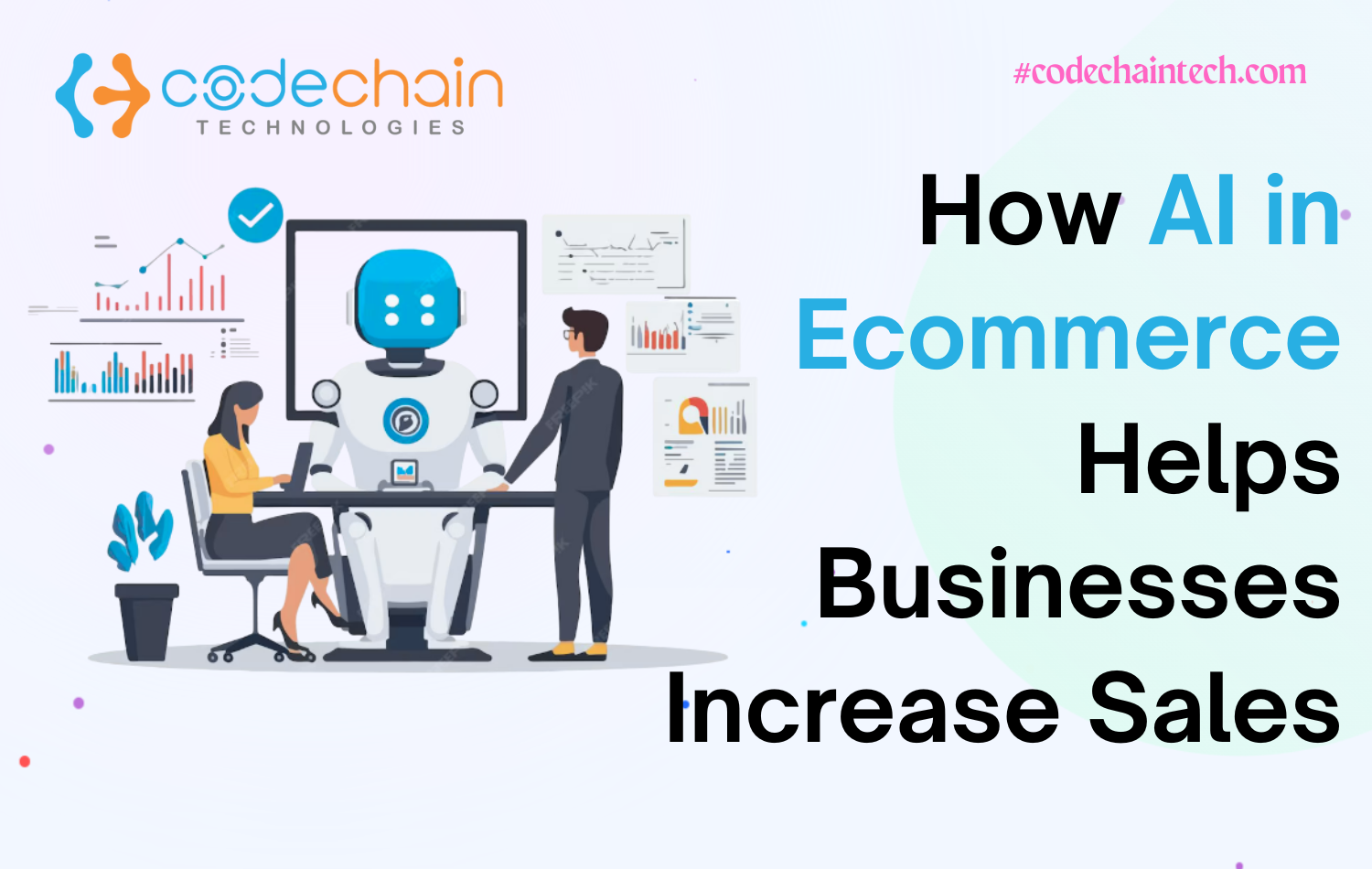
AI in ecommerce is changing how online businesses attract customers, recommend products, provide support, and increase sales. From personalized product recommendations and intelligent search to AI chatbots, predictive analytics, and automated marketing, artificial intelligence is helping ecommerce businesses create faster, smarter, and more relevant shopping experiences.
Customers today expect more than a basic online store. They want products that match their interests, quick answers to their questions, simple navigation, personalized offers, and a smooth checkout experience. AI can help businesses understand customer behavior, identify purchasing patterns, automate repetitive tasks, and make data-driven decisions that improve both customer experience and business performance.
However, successful AI adoption is not about adding technology simply because it is popular. Ecommerce businesses need to identify the right problems, choose useful AI applications, and integrate them with a reliable technology foundation. When implemented strategically, AI can support higher conversions, better customer engagement, improved operational efficiency, and long-term ecommerce growth.
What Is AI in Ecommerce?
AI in ecommerce refers to the use of artificial intelligence technologies such as machine learning, natural language processing, predictive analytics, computer vision, and intelligent automation to improve online shopping and ecommerce operations.
AI systems can process large amounts of customer and business data to identify patterns and make useful predictions. For example, an ecommerce platform can analyze what customers search for, which products they view, what they purchase, when they leave their carts, and which offers they respond to.
Businesses can use these insights to recommend relevant products, improve search results, personalize marketing campaigns, automate customer support, forecast demand, and improve business operations.
For companies that want to introduce these capabilities into their existing systems, AI solutions for businesses can include predictive analytics, natural language processing, intelligent automation, computer vision, and customized AI development.
Why Is AI Important for Ecommerce Growth?
Traditional ecommerce websites often provide a similar experience to different visitors. But every customer has different interests, budgets, preferences, and buying behavior.
AI makes it possible to create a more personalized shopping journey.
For example, a returning customer may see recommendations based on previous purchases, while a new visitor can receive suggestions based on current browsing activity. AI can also help identify customers who may abandon their carts, predict product demand, and provide faster answers through intelligent assistants.
AI is also changing the way websites and applications interact with customers. Businesses can explore AI in web and app development to understand how intelligent search, recommendation systems, automation, and AI-powered customer experiences can be integrated into digital products.
The result is an ecommerce ecosystem where customer-facing experiences and backend operations can work together more intelligently.
How AI in Ecommerce Helps Increase Sales
1. Personalized Product Recommendations
One of the most practical applications of AI in ecommerce is personalized product recommendations.
AI can analyze browsing history, purchase history, search behavior, cart activity, product interactions, and customer preferences. Based on these signals, it can recommend products that are more relevant to individual shoppers.
For example, an online fashion store can recommend matching accessories after a customer views a particular outfit. An electronics store can suggest compatible accessories after someone adds a laptop or smartphone to the cart.
This can support cross-selling and upselling while making product discovery easier.
AI personalization can also be used on homepages, product pages, emails, search results, and promotional campaigns. Businesses can learn more about this approach through AI personalization in ecommerce.
The goal should always be relevance. Customers should receive recommendations that genuinely help them rather than seeing unrelated products.
2. AI-Powered Search and Product Discovery
Customers do not always search for products using the exact words listed in an online catalog.
AI-powered search can understand the intent behind a query instead of depending only on exact keyword matching. It can support semantic search, autocomplete, voice search, visual search, and personalized product rankings.
For example, a customer may search for "comfortable shoes for daily office use." An intelligent search system can understand the meaning behind the query and show products that better match the customer's requirements.
Better product discovery reduces the time customers spend searching and can make the buying journey smoother.
This is particularly useful for ecommerce businesses with large product catalogs, multiple categories, or thousands of product variations.
3. AI Chatbots for Ecommerce Customer Support
Customer support can directly affect ecommerce conversions. When customers cannot quickly get answers about products, shipping, returns, payments, or orders, they may leave the website.
An AI chatbot can provide support around the clock. It can answer common questions, help customers discover products, provide order information, explain return policies, and guide shoppers through basic purchasing decisions.
Businesses that want to understand the technology in greater detail can read AI chatbot for ecommerce.
AI chatbots can also reduce repetitive work for customer support teams. Instead of answering the same basic questions again and again, employees can focus on complex customer issues that require human attention.
This combination of faster responses and reduced manual work can improve customer satisfaction and create a smoother buying experience.
4. AI Agents for Ecommerce Automation
AI agents take ecommerce automation beyond basic chatbot functionality.
An AI agent can understand a task, process information, interact with connected systems, and perform actions based on defined objectives. In ecommerce, this could include helping customers discover products, checking order information, answering questions, or supporting internal workflows.
Businesses interested in advanced automation can explore AI agent development.
AI agents can be particularly useful for businesses that handle large volumes of customer requests or repetitive processes. When connected with APIs, databases, CRM systems, and ecommerce platforms, AI agents can become part of a broader automation strategy.
5. Smart Pricing and Promotional Decisions
Pricing has a direct impact on ecommerce conversions and profitability.
AI can analyze demand patterns, historical sales, inventory levels, customer behavior, and other business signals to support better pricing decisions.
For example, if demand for a particular product increases while inventory decreases, an AI system can identify the pattern and help businesses make better pricing or promotional decisions.
AI can also help identify which customer groups are more likely to respond to specific offers. Instead of giving the same discount to every customer, businesses can create more targeted promotions.
The objective is not simply to reduce prices. It is to find the right balance between customer demand, conversion, inventory, and profitability.
6. Predictive Analytics for Inventory and Demand
Inventory problems can directly affect ecommerce revenue.
If a popular product becomes unavailable, customers may purchase from another store. On the other hand, keeping too much inventory can increase storage and operational costs.
AI-powered demand forecasting can analyze historical sales, seasonal patterns, product performance, and other business data to estimate future demand.
For example, an ecommerce business selling seasonal products can analyze previous sales patterns to identify when demand is likely to increase. The business can then prepare inventory before demand reaches its peak.
This makes AI useful not only for customer-facing features but also for important ecommerce backend operations.
7. Reducing Cart Abandonment
Cart abandonment is a common challenge for online stores.
AI can identify behavioral signals that indicate when a customer may leave without completing a purchase. Businesses can then use appropriate actions such as personalized reminders, relevant product recommendations, targeted offers, or follow-up communication.
For example, if a returning customer adds products to a cart but leaves before checkout, an AI system can recognize this behavior and support a relevant follow-up.
The strategy should focus on relevance rather than sending unnecessary discounts or messages to every customer.
8. AI-Based Customer Segmentation and Marketing
Every ecommerce customer has different needs and purchasing behavior.
AI can segment customers based on purchase history, browsing behavior, spending patterns, engagement, product interests, and other signals.
These segments can support more targeted marketing campaigns.
For example, an ecommerce company could create separate campaigns for first-time buyers, repeat customers, high-value customers, inactive customers, or shoppers interested in a particular product category.
AI helps businesses identify these patterns faster and make marketing more relevant. This can improve engagement while helping companies use their marketing budget more efficiently.
AI in Ecommerce for B2B Businesses
AI is not limited to consumer-focused online stores. B2B businesses can also use artificial intelligence to improve digital purchasing experiences.
B2B platforms can use AI for product recommendations, demand forecasting, automated customer support, intelligent search, repeat-order predictions, customer segmentation, and personalized purchasing journeys.
Businesses interested in this area can explore B2B eCommerce trends, including AI personalization, automation, mobile commerce, and modern digital purchasing experiences.
For larger organizations, ecommerce platforms may also need to connect with ERP, CRM, cloud infrastructure, databases, and internal business applications. Enterprise services can help businesses build scalable systems, integrate existing platforms, manage data, and support complex operational requirements.
Better Ecommerce Experience Through AI and Development
AI features cannot deliver their full value if the underlying ecommerce platform is slow, difficult to navigate, or poorly structured.
Customers still expect fast-loading pages, responsive layouts, clear product information, easy navigation, and a simple checkout experience.
This is why AI should work together with strong frontend development and user experience. Frontend development services can help businesses create responsive and high-performance interfaces that support modern ecommerce experiences.
For businesses that want AI-powered shopping experiences across mobile devices, app development services can also help create Android, iOS, or cross-platform applications with intelligent functionality.
The strongest ecommerce experience is therefore not created by AI alone. It comes from combining artificial intelligence, development, design, data, and business strategy.
What Are the Benefits of AI in Ecommerce?
The benefits of AI in ecommerce go beyond increasing sales.
First, AI can improve product discovery by helping customers find products that are more relevant to their needs. Second, automated customer support can reduce response times and help businesses manage repetitive questions.
AI can also support customer retention by creating more personalized experiences. When customers receive useful recommendations, faster support, and smoother shopping journeys, they may be more likely to return.
Another major benefit is data-driven decision-making. Instead of relying only on assumptions, businesses can use AI to identify patterns in customer behavior, sales, inventory, and marketing performance.
AI can also support scalable growth. As customer numbers, product catalogs, and transactions increase, automated systems can handle many repetitive tasks without requiring the same amount of manual effort.
For businesses with unique processes and requirements, custom software development can help create technology around specific workflows instead of relying only on generic tools.
How to Implement AI in an Ecommerce Business
Businesses should start AI implementation with a clear business objective.
The first step is to identify the main problem. It could be low conversion rates, poor product discovery, customer support workload, cart abandonment, inventory challenges, or weak personalization.
The second step is to evaluate available data. AI depends heavily on useful and well-structured information, so customer data, product information, order history, and behavioral data should be organized properly.
Next, businesses should select the right AI use case. There is no need to implement every AI feature at the same time. Starting with one high-value application allows a business to measure its impact before expanding.
Integration is another important consideration. AI may need to connect with ecommerce platforms, APIs, CRM systems, ERP software, databases, payment systems, analytics platforms, and mobile applications.
Finally, businesses should continuously monitor and optimize the solution. AI implementation is not a one-time activity. Accuracy, performance, security, customer feedback, and business results should be reviewed regularly.
When AI needs to be integrated into a complete digital product, a professional web and app development company can help connect AI functionality with the website, mobile application, backend systems, APIs, and other business technologies.
Future of AI in Ecommerce
The future of AI in ecommerce is moving toward more personalized, automated, and conversational shopping experiences.
Conversational Discovery
AI-powered shopping assistants can help customers discover products through natural conversations. Recommendation systems can become more context-aware, while visual and voice search can make product discovery easier.
Multi-Stage AI Agents
AI agents may also become capable of supporting multiple stages of the customer journey. Instead of simply answering a question, an intelligent system could help customers discover products, compare options, answer questions, and support the next step of the buying process.
Businesses will also need to focus on responsible data usage, security, transparency, and customer trust.
The strongest ecommerce strategies will not use AI simply because it is popular. They will connect AI capabilities with real customer needs, reliable data, strong technology architecture, and a simple user experience.
Conclusion
AI in ecommerce is changing how businesses attract customers, recommend products, provide support, manage inventory, personalize marketing, and make business decisions.
From personalized recommendations and intelligent search to AI chatbots, AI agents, predictive analytics, customer segmentation, and automated workflows, businesses have many opportunities to use artificial intelligence throughout the ecommerce journey.
However, successful implementation is not about adding as many AI features as possible. Businesses should start with a clear problem, choose the right AI use case, connect it with quality data, measure the results, and expand gradually.
CodeChainTech helps businesses build customized AI, web, mobile, and software solutions around their specific requirements. By combining AI with modern development, scalable architecture, and user-focused experiences, businesses can turn AI in ecommerce into a practical strategy for improving customer experience, operational efficiency, conversions, and long-term growth.
FAQs
-
1
How does AI in ecommerce help increase sales?
AI can improve ecommerce sales by personalizing product recommendations, improving product search, automating customer support, reducing cart abandonment, optimizing marketing, and helping businesses understand customer behavior.
-
2
What are the most common uses of AI in ecommerce?
Common uses include personalized product recommendations, AI chatbots, intelligent search, customer segmentation, demand forecasting, inventory management, fraud detection, marketing automation, and personalized shopping experiences.
-
3
Can small ecommerce businesses use AI?
Yes. Small ecommerce businesses can start with focused AI solutions such as chatbots, recommendation systems, automated marketing, or intelligent search. These capabilities can be expanded as the business grows.
-
4
How do AI chatbots increase ecommerce sales?
AI chatbots provide instant answers, help customers discover products, answer product questions, support order tracking, and reduce delays during the buying journey. Faster and more relevant support can reduce friction during checkout.
-
5
What is the role of AI agents in ecommerce?
AI agents can perform more advanced tasks than traditional chatbots. They can interact with connected systems, follow workflows, assist customers, and automate repetitive ecommerce processes.
-
6
Can AI reduce ecommerce cart abandonment?
AI can identify behavioral patterns that indicate potential cart abandonment and support targeted actions such as reminders, relevant recommendations, and personalized offers.
-
7
How does AI improve ecommerce personalization?
AI analyzes customer behavior, browsing activity, purchase history, product interactions, and other signals to provide more relevant recommendations, content, offers, and shopping experiences.
-
8
Is AI expensive for ecommerce businesses?
The cost depends on the AI functionality, data requirements, integrations, infrastructure, and overall project complexity. Businesses can start with one practical use case and expand gradually.
-
9
Should an ecommerce business build custom AI software?
Custom AI development can be useful when a business has unique workflows, proprietary data, complex integrations, or specific customer requirements that standard AI tools cannot effectively support.
-
10
How can CodeChainTech help with AI in ecommerce?
CodeChainTech can help businesses plan and develop customized AI, web, mobile, and software solutions. AI features can be integrated with ecommerce platforms, APIs, databases, CRM, ERP, and other business systems based on project requirements.