For many companies, the integration of an effective enterprise resource planning (ERP) system is a means to optimize costs and improve control over business processes. Managing a business's operations is never easy, and, as the business grows, integrating and managing the different functions of the business using separated systems becomes more burdensome. These functions include finance, inventory, sales, HR, the supply chain, and reporting. An ERP system is designed to integrate all of these functions.
Investing in an ERP system is not the end of the decision-making process. The business must also determine the deployment method of the system. The common deployment options are cloud ERP and on-premise ERP.
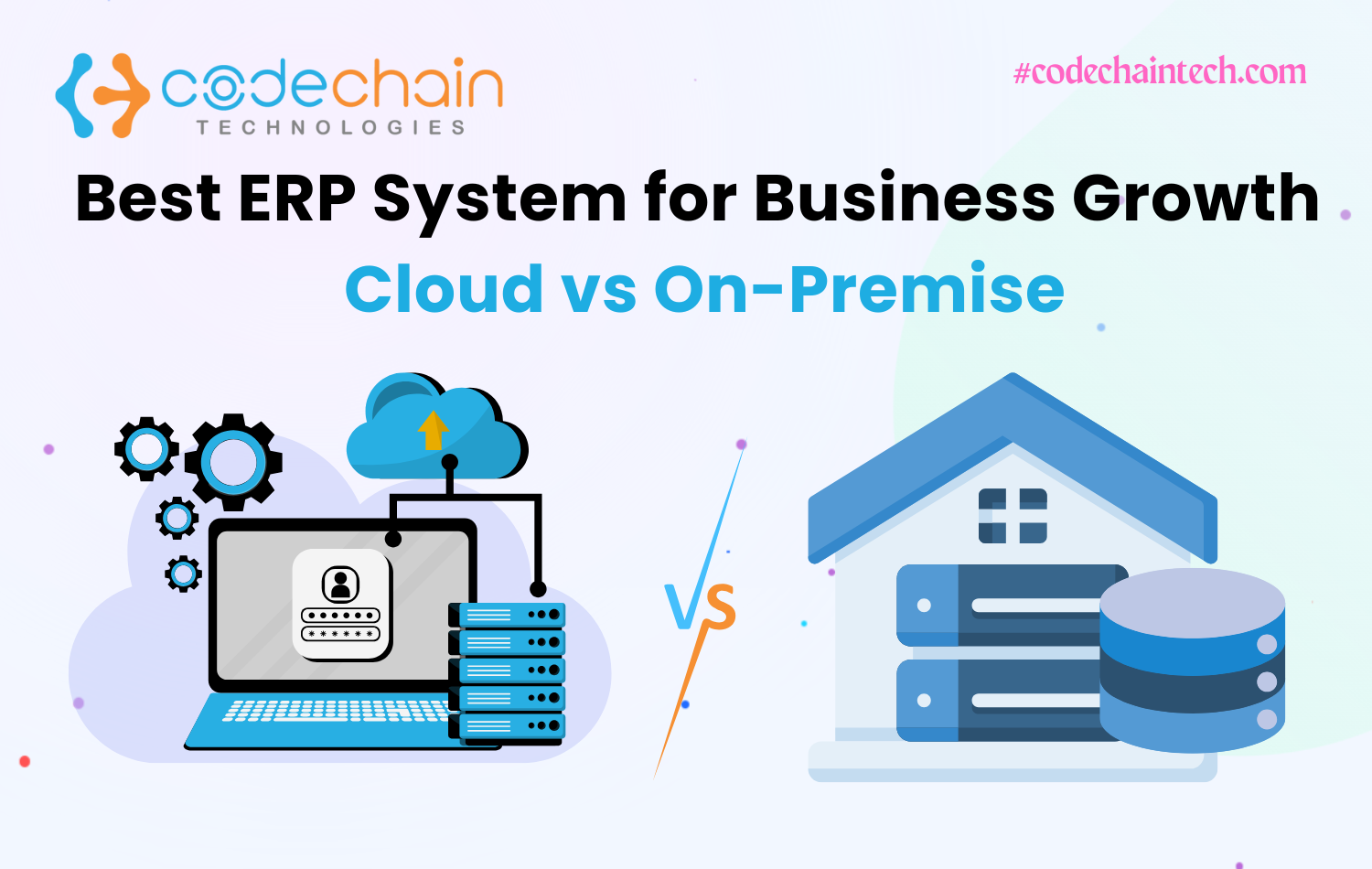
Cloud ERP systems are maintained by the vendor and made available to customers over the Internet. On-premise ERP systems are maintained on the business's IT infrastructure. Both options have their benefits and the best option is determined by a number of factors, including, resources available for IT and security, required customization, the size of the business, how fast the business is expected to grow, and costs.
At CodeChainTech, we strive to improve understanding of these solutions for our clients and integrate ERP systems where we see best fit. This guide attempts to compare Cloud ERP and On-Premise ERP to understand the applicability of each.
What Is an ERP System?
ERP systems are tools that help integrate the separate parts of a business. Normally these sections get separated due to the different business management tools implemented to cover each section. ERP systems are meant to capture and unify critical business data. They are designed to create a single place for the various business sections to collaborate, manage, and keep track of business functions. An ERP system can manage many functions, including
Business decision-making processes can be improved by integrating the various business sections that an ERP system manages and simplifying the processes that were previously manual and increasing the accuracy of the captured data.
What Is Cloud ERP?
A cloud ERP solution is managed and maintained in the vendor's data centers and is provided as a subscription or lease service instead of being purchased and installed on the client's data centers. The vendor usually maintains the system's infrastructure and a good bit of its security.
Key Benefits of Cloud ERP
- Less investment in infrastructure
- Systems get implemented quicker
- Access from anywhere, at any time
- Easier to scale as the business grows
- Automatic updates
- Less internal maintenance work
Cloud ERP is especially popular with fast-growing businesses, start-ups, and small- to medium-sized enterprises.
What Is On-Premise ERP?
An on-premise ERP system is installed and operated on servers owned or controlled by a company. The company takes on the burden of system control and administration, as well as maintenance, upgrades, and security.
Key Benefits of On-Premise ERP
- Greater control over infrastructure
- Greater flexibility over systems
- Greater control over data
- Better integration with specific systems
- Ideal for companies with qualified IT staff
On-premise ERP is most often utilized by large companies with complex IT infrastructures and restrictive business practices.
Cloud ERP vs. On-Premise ERP
The primary difference between cloud ERP and on-premise ERP systems is the way the systems are deployed and managed. However, there are many other differences as well.
Cloud ERP vs. On-Premise ERP Comparison
Which ERP is Best for Business Growth?
There is no singular ERP deployment model best suited for an individual business. The most advantageous model will depend on the specific present and future circumstances of the business.
Cloud ERP is more advantageous if:
- The business is a startup or gaining clients.
- The business wants to limit initial investment in infrastructure.
- The business employs people in multiple locations.
- The business wants to implement the model quickly.
- The business is expected to grow quickly.
- The business has a small IT workforce.
You want the Cloud ERP vendor to take responsibility for administering, maintaining, and updating systems.
Flexible scaling is the biggest benefit of Cloud ERP, according to most companies.
On-Premise ERP May Be More Appropriate If:
- Your organization has complicated business processes.
- You need significant system customizations.
- You have a competent and extensive internal IT workforce.
- Your organization needs more direct control of the ERP system.
- You have significant IT resources.
- Your organization is in a regulated industry
On-premise ERP is a viable option for extensive and highly specialized organizations.
ERP Developments to Watch
As technologies continue to evolve, the rapid development of intelligent, integrated business systems causes ongoing change to ERP technologies and systems. Some developments in modern ERP have included artificial intelligence, automation, advanced analytics, mobile, and cloud.
Some other major developments in ERP are
Modern ERP systems are the foundation of business management and operations improvement.
CodeChainTech offers the following services related to ERP:
CodeChainTech and ERP Solutions
When it comes to evaluating ERP systems, the differentiation of offerings is not a major consideration for most organizations. Rather, the key focus areas are evaluating business processes, future requirements, and resource and integration considerations, and the model of choice.
CodeChainTech evaluates and picks an ERP system that caters to the exclusive requirements of the business.
ERP services offer businesses an ERP system and the required support to carry out their business operations regularly.
Final Thoughts
The most important step for business growth when selecting an ERP system is addressing the specific requirements of the business in relation to its processes and budgets and selecting an ERP system that meets business goals. Of the existing options, many businesses that are in a growth stage would benefit from a cloud ERP solution due to the relative ease of flexibility, scalability, and the reduced burden of deployment and infrastructure. Conversely, businesses that are larger in size and have more complex requirements would benefit from the level of control and owned infrastructure that is offered by On-Premise ERP.
Prior to the selection of an ERP system, a business must perform a comprehensive evaluation of the various factors that would impact the overall system cost. An ERP system should have the flexibility to evolve and grow with the business and, more so, solve the immediate challenges of the business.
At CodeChainTech, we assess, design, and implement desired ERP systems for businesses. Businesses that integrate apt technologies and ERP systems enjoy improved operational processes and increased effectiveness in their decision-making, and they also have a more solid foundation for achieving prospective growth.
FAQs
-
1
What is the ERP system that can assist the most in business growth?
The best ERP system for business growth will vary depending on the size, budgets, and goals for growth. For many businesses, Cloud ERP is a strong option, as it provides flexibility and scalability.
-
2
Are there advantages of Cloud ERP over On-Premise ERP?
Cloud ERP is a superior option for businesses wanting flexibility and rapid scalability with a lower initial infrastructure investment; Cloud ERP is a better option for businesses that need farther control and greater customization of their ERP system.
-
3
What is the primary distinction between Cloud ERP and On-Premise ERP?
With On-Premise ERP, businesses are responsible for the installation and management of the ERP system, whereas Cloud ERPs are built and maintained by the service provider.
-
4
Which ERP system do you recommend for small businesses?
Cloud ERPs generally require less of a capital investment for business infrastructure, and with greater pricing flexibility and greater scalability, Cloud ERPs are the best recommendation for small businesses.
-
5
Cloud ERP is safe for businesses?
With proper construction, management of users, and active monitoring, Cloud ERPs can be just as safe as any other system of enterprise resource planning. Security also relies on the configuration of the system and the management of users.
-
6
Which ERP has more options for customizations?
With On-Premise ERPs, businesses are responsible for the management and control of the ERP system and IT infrastructure, therefore, On-Premise ERPs have more options for customizations.
-
7
Which is more cost-effective, Cloud ERP or On-Premise ERP?
Cloud ERPs tend to be more cost-effective in the short-term, as businesses do not have to invest in large system and infrastructure builds. The total cost of the Cloud ERP will vary based on the licensing, customizations, number of users, and the costs for implementation.
-
8
In what ways does ERP contribute to business growth?
With the advent of features such as data centralization, automation of routine tasks, improved reporting, less manual interventions, and faster data-driven decisions by teams, all contributed by ERP software, business processes have improved tremendously. This hardly leaves any doubt of the potential of ERP software in driving business processes.
-
9
Are you able to help with ERP systems?
Absolutely, CodeChainTech is able to support your business with ERP systems starting from consulting to customizing, implementing, integrating, migrating data, upgrading, and offering technical support and maintenance.
-
10
What factors should a business consider when choosing between Cloud ERP and On-Premise ERP?
While choosing the deployment model for ERP, a business should consider its budget, how it views data security, how much they want to manage data on their own, how much they’d want to let ERP scale on their behalf, how flexible the ERP should be, and how complex their business is.