Every growing business eventually faces the same question: should we build an in-house development team or outsource the work to a software development company? This is one of the biggest decisions a founder or CTO makes, because it affects your budget, your speed to market, and how much control you keep over your product. At CodeChain Technologies, we work with both types of clients, from startups outsourcing their first MVP to enterprises that keep a core in-house team and outsource specific projects. This guide breaks down both models in detail so you can decide with confidence.
What Is In-House Development?
In-house development means hiring developers directly as full-time employees who work exclusively on your projects. They are part of your company, follow your internal processes, and usually sit in your office or work as dedicated remote employees. You manage them directly, control their day-to-day priorities, and build long-term product knowledge that stays inside your organization.
This model works well for companies where software is the core product, not just a supporting tool. A SaaS company or a fintech platform, for example, often needs developers who live and breathe the product every single day.
What Is Outsourced Development?
Outsourced development means hiring an external software development company to design, build, test, and often maintain your software. The outsourcing partner brings its own developers, project managers, testers, and established processes. You pay for the project, for a dedicated team, or for hourly work, rather than employing staff directly.
Outsourcing can mean many things in practice: a single freelance developer, a boutique agency, or a full-service company that handles everything from UI/UX design to backend architecture and deployment. The right fit depends on your project size and how much support you need beyond writing code.
Why This Decision Matters So Much
Choosing the wrong model can be expensive in ways that are not always obvious upfront. An in-house team that sits idle between projects still costs full salary. An outsourced team chosen purely on low price, without checking technical depth, can lead to rewrites and missed deadlines. Getting this decision right early saves both money and time later, especially for startups where runway is limited.
Pros and Cons of In-House Development
Advantages:
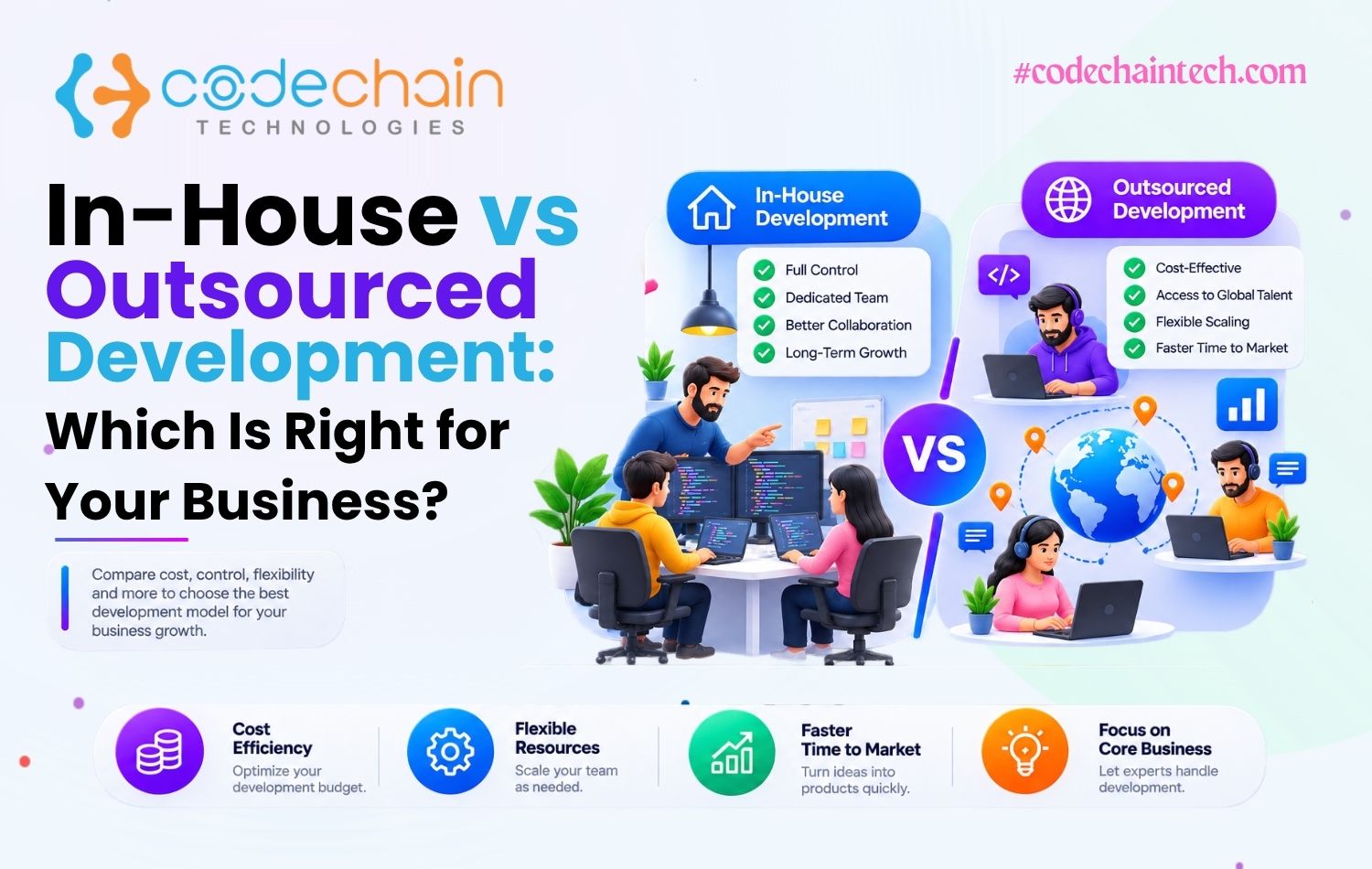
Full control: You set priorities daily and can shift direction instantly without renegotiating a contract.
Deep product knowledge: Developers who work on your product for years understand its history, edge cases, and business logic in ways an outside team cannot match quickly.
Easier real-time collaboration: In-house developers sit closer to sales, marketing, and customer support, which speeds up feedback loops.
Stronger culture alignment: Employees are invested in the company's long-term success, not just the current project.
Disadvantages:
High fixed costs: Salaries, benefits, office space, equipment, and software licenses add up, and these costs continue whether or not there is active development work.
Slow hiring process: Finding developers with specialized skills, such as AI and machine learning expertise, can take months in a competitive job market.
Hard to scale quickly: Adding five developers for a big launch, then reducing the team afterward, is difficult and often not realistic with full-time staff.
Risk of key-person dependency: If a critical in-house developer leaves, their knowledge can leave with them.
Pros and Cons of Outsourced Development
Advantages:
Lower, more predictable costs: Outsourcing avoids the overhead of salaries, benefits, and office space, and fixed-price projects give you cost certainty from the start.
Faster project start: Most outsourcing partners can begin work within one to two weeks, compared to months for hiring full-time staff.
Access to specialized skills: You are not limited to your local talent pool. Need a team experienced in Go for a high-performance backend or Flutter for a cross-platform app? An outsourcing partner likely already has that expertise ready.
Easy to scale: You can add developers for a big push and reduce the team once the work is done, without layoffs or severance.
Disadvantages:
Less daily visibility: Unless your partner provides regular updates and access to project tools, it can feel less transparent than having the team down the hall.
Time zone differences: Working with a team in a different country can mean less real-time overlap, though many outsourcing partners now structure hours to overlap with US and European working days.
Partner selection risk: Choosing the wrong company can lead to quality issues, missed deadlines, or communication problems.
Some loss of continuity: If your outsourcing partner rotates staff between projects, you may need to re-explain context more often than with a stable in-house team.
Cost Comparison: In-House vs. Outsourced
Industry research backs this pattern. Deloitte's Global Outsourcing Survey consistently finds that companies outsource not just to cut costs but also to access skills and speed that would take far longer to build internally, especially for cloud, AI, and automation projects.
When In-House Development Makes Sense
Your software is the core product, not a supporting tool, and needs continuous, long-term iteration.
You have the budget to cover salaries, benefits, and management overhead comfortably, even during slower periods.
You need developers who build deep, multi-year understanding of your internal systems and industry regulations.
You are building a large, permanent engineering organization with its own internal culture and processes.
You already have strong technical leadership in place to manage and mentor a growing team.
When Outsourced Development Makes Sense
You need to launch an MVP or test a new product idea quickly, without a long hiring cycle eating into your runway.
Your project has a clearly defined scope, such as a specific feature, an ERP system, or a customer-facing app.
You want to try a new technology stack before committing to full-time hires in that skill set.
Your team needs extra hands temporarily for a big release, a migration, or a seasonal peak in demand.
You are a non-technical founder who needs a full team, not just a developer, including project management and QA.
The Hybrid Model: Best of Both Worlds
Many companies do not choose one model exclusively. A common and effective approach is to keep a small in-house team focused on core product strategy and long-term ownership while outsourcing specific projects, new features, or peak workloads to an external partner. This structure gives you control over what matters most for your business while staying flexible on cost and speed for everything else.
For example, a company might keep two senior in-house engineers who own the product roadmap while outsourcing a new mobile app build, a cloud migration, or a data analytics dashboard to a specialized outsourcing partner. This way, institutional knowledge stays in-house, but the company is not stuck hiring for every new skill it needs.
How to Choose the Right Outsourcing Partner
If you decide to outsource, the partner you choose matters as much as the decision to outsource itself. Look for:
Relevant experience: Ask for case studies in your industry or with similar technology, not just a generic portfolio.
Clear communication process: Regular updates, a defined point of contact, and working hours that overlap with yours.
Transparent pricing: A clear breakdown of costs upfront, with no hidden fees added later in the project.
Technical depth across the stack: A team that can speak knowledgeably about frontend frameworks like React and Angular, as well as backend technologies such as Python and Node.js.
Database and infrastructure expertise: Ask how they handle PostgreSQL or other databases your project depends on.
Security practices: Clear agreements on data protection, IP ownership, and confidentiality before any code is written.
Red Flags to Watch For
Vague or generic answers when you ask about their development process.
No willingness to share references, case studies, or past client contacts.
Pricing that seems unrealistically low for the scope you described.
Poor communication or slow responses during the sales process, which usually predicts how the actual project will go.
No clear contract covering ownership of code, intellectual property, and confidentiality.
Industry-Specific Considerations
Some industries lean more heavily toward one model than the other. Regulated sectors like banking and fintech often need outsourcing partners with proven compliance experience, since data security and regulatory requirements are strict. Retail and e-commerce businesses, on the other hand, often outsource seasonal projects, such as a website redesign before a major sales event, where speed matters more than long-term ownership.
Making the Final Decision
Start by answering three questions honestly. First, is this software core to your competitive advantage or a supporting tool? Second, how much budget can you commit for the next 12 to 24 months, regardless of workload? Third, how quickly do you need to launch? If the project is core to your business and you have a stable, long-term budget, in-house may be worth the investment. If you need speed, flexibility, or specialized skills without a long hiring cycle, outsourcing is usually the more practical choice.
Conclusion
There is no universal winner between in-house and outsourced development. In-house teams offer control, deep product knowledge, and long-term alignment with your company culture. Outsourcing offers speed, flexibility, and access to specialized skills at a lower, more predictable cost. Many businesses get the best results from a hybrid approach: a lean in-house core team supported by trusted outsourcing partners for specific projects. Developer surveys consistently show that global talent access is one of the biggest reasons companies now look beyond their own city or country for development work, and that trend is only growing.
If you are weighing your options, start by clearly defining your project scope, timeline, and budget, then decide which model, or combination of models, fits best for where your business is today.
Not sure which model fits your project? Talk to our team for a free consultation.
FAQs
-
1
Is outsourcing cheaper than hiring in-house developers?
Usually yes, especially for defined projects. Outsourcing avoids costs like salaries, benefits, office space, and recruitment fees, though very long-term, large-scale products can sometimes be more cost-effective in-house over many years.
-
2
Is outsourced software development safe for my business data?
Yes, when you work with a reputable partner. Look for clear contracts covering data protection, IP ownership, and confidentiality agreements (NDAs) before any work begins.
-
3
Can I switch from outsourced to in-house development later?
Yes. Many companies start with an outsourced team to launch quickly and validate their idea, then build an in-house team once the product and budget are more established.
-
4
How do I manage an outsourced development team effectively?
Set clear expectations upfront, use project management tools for visibility, schedule regular check-ins, and choose a partner with working hours that overlap with yours for real-time communication.
-
5
Is a hybrid model better than choosing just one option?
For many growing businesses, yes. A hybrid model lets you keep core product knowledge in-house while using outsourced developers for specific projects, new technologies, or temporary workload spikes.
-
6
How long does it take to start an outsourced development project?
Much faster than hiring in-house, usually within one to two weeks, compared to one to three months for recruiting and onboarding full-time developers.
-
7
What questions should I ask before choosing an outsourcing partner?
Ask about their experience with similar projects, how they handle communication and reporting, what their pricing model includes, who owns the code and IP, and whether they can share references from past clients.
-
8
Does outsourcing mean I lose control over my project?
Not if you choose the right partner and process. Regular check-ins, shared project management tools, and clear milestones keep you informed and in control, even though a third party is doing the development work.
-
9
In-house vs outsourcing: who owns the code and IP?
With in-house teams, you own everything by default. With outsourcing, ownership is defined by contract, but the team's product knowledge leaves when the engagement ends.
-
10
Should startups choose in-house or outsourced development?
Most early-stage startups should outsource first to build their MVP faster and cheaper, then hire in-house once the product and funding are established.