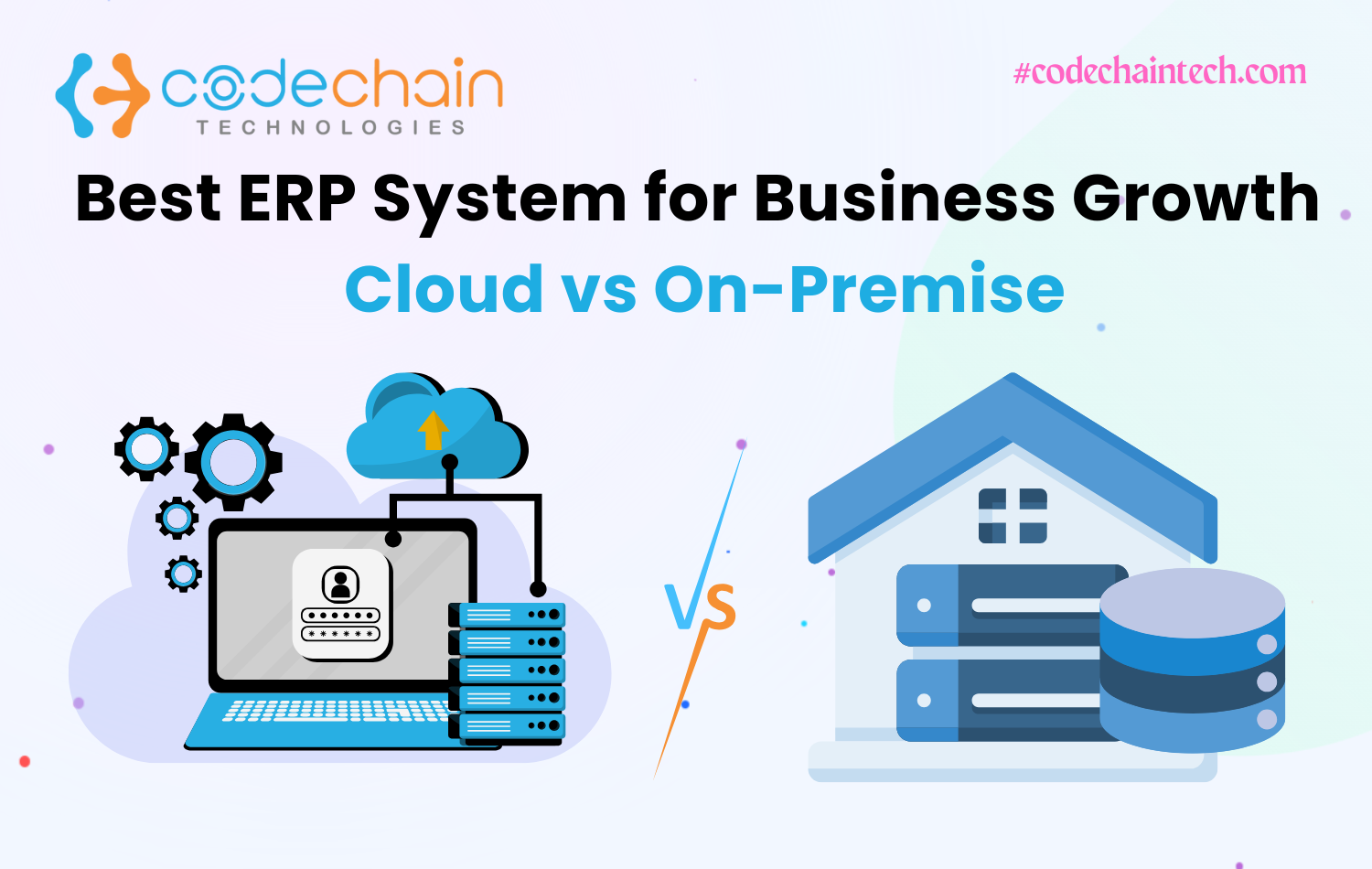
Cloud vs. On-Premise: Which ERP System is Best for Business Growth?
Premise is no more simply a popular topic; it's a key business choice for firms that want to grow, make their operations more efficient, and stay competitive in a digital-first market. In today’s fast-paced market, Enterprise Resource Planning (ERP) systems play a vital role in integrating core business processes such as finance, human resources, supply chain, inventory, manufacturing, and customer relationship management into a single, unified platform. Choosing the right ERP deployment model can directly impact efficiency, cost control, security, and long-term growth.
At CodeChainTech, we work closely with startups, SMEs, and large enterprises to help them select, customize, and implement ERP solutions that align with their business goals. This in-depth guide explores Cloud ERP vs. On-Premise ERP in an easy-to-understand way, helping you make the right choice for sustainable business growth.
ERP Decision Guide
Choose the right model for growth
Understanding ERP Systems and Their Role in Business Growth
An ERP system is designed to centralize data, automate workflows, and improve decision-making across departments. Businesses utilize ERP software to get real-time insights and operational transparency instead of dealing with separate tools and spreadsheets.
Key benefits of ERP systems include:
However, the true value of an ERP system depends heavily on how it is deployed. The two most common deployment models are Cloud ERP and On-Premise ERP.
What Is Cloud ERP?
Cloud ERP is a web-based ERP system hosted on the vendor's or a third-party provider's servers. Users access the software development through the internet, usually on a subscription-based pricing model.
Key Characteristics of Cloud ERP
- Hosted on remote servers
- Accessible anytime, anywhere
- Subscription or pay-as-you-go pricing
- Automatic updates and maintenance
- Minimal upfront infrastructure cost
Cloud ERP solutions are ideal for businesses looking for flexibility, faster implementation, and lower IT overhead.
What Is On-Premise ERP?
On-premise ERP is installed and hosted on a company's own servers and infrastructure. The business is responsible for system maintenance, updates, and security.
Key Characteristics of On-Premise ERP
- Installed on local servers
- Higher upfront investment
- Full control over data and customization
- In-house IT management required
- Suitable for strict compliance environments
On-premise ERP is often chosen by large enterprises or industries with regulatory constraints.
A Detailed Comparison between Cloud ERP and On-Premise ERP
Let's look at how these two ERP models stack up against each other in terms of important business factors.
1. Structure of Costs and Prices
Cloud ERP: Lower upfront cost, monthly/yearly subscription. On-Premise: High upfront cost for licenses/hardware.
Best for saving money: Cloud ERP
2. Time to put into action
Cloud ERP: Weeks to months. On-Premise: Months to years.
Cloud ERP is the winner for faster deployment
3. The ability to grow and change
Cloud ERP: Highly scalable. On-Premise: Requires additional hardware.
Cloud ERP is the best for business growth
4. The ability to customise
Cloud ERP: Moderate customization. On-Premise: Deep customization.
On-premise ERP is the best choice for customization
5. Control and security of data
Cloud ERP: Off-site storage, vendor security. On-Premise: Full on-site control.
On-premise ERP is the best choice for data control
6. Upkeep and changes
Cloud ERP: Vendor managed. On-Premise: In-house IT team.
Winner for Easy Maintenance: Cloud ERP
7. Access and working from home
Cloud ERP: Any device, internet required. On-Premise: Requires extra setup for remote access.
Cloud ERP is the best for accessibility
Difference Between Cloud ERP and On-Premise ERP
| Aspect | Cloud ERP | On-Premise ERP |
|---|---|---|
| Deployment | Hosted on vendor's cloud servers | Installed on company's local servers |
| Cost Structure | Subscription-based, low upfront cost | High upfront cost for licenses and hardware |
| Implementation Time | Fast (weeks to a few months) | Slow (several months to years) |
| Scalability | Highly scalable and flexible | Limited; requires additional infrastructure |
| Maintenance | Managed by the ERP vendor | Managed by in-house IT team |
| Updates | Automatic and regular updates | Manual updates, often costly |
| Accessibility | Accessible anytime via internet | Mostly limited to office network |
| Customization | Moderate customization | Deep and full customization |
| Data Control | Data stored off-site | Full control over data on-site |
| Best For | Startups, SMEs, growing businesses | Large enterprises, regulated industries |
Which ERP is best for helping your business grow?
Your firm size, industry, budget, and long-term goals will all affect the response.
Cloud ERP is great for:
- Small- to medium-sized enterprises and startups
- Companies that have teams that work from home or throughout the world
- Companies that want things done faster ROI
- Companies that don't have a lot of IT resources
- Businesses that want to grow quickly
When to Use On-Premise ERP:
- Big businesses with complicated operations
- Industries with a lot of rules
- Businesses requiring deep customization
- Organizations with strong in-house IT teams
Cloud ERP Trends Shaping the Future
The ERP landscape is evolving rapidly, and cloud ERP is leading the change.
Key trends include:
These trends make cloud ERP a future-ready solution for business growth.
How CodeChainTech Helps You
Choosing the best ERP system is not just about technology—it's about strategy. At CodeChainTech, we follow a consultative approach to ERP implementation.
Our ERP services include:
- ERP consulting & requirement analysis
- Cloud & on-premise implementation
- Customization & integration
- Data migration & upgrades
- Ongoing support & maintenance
We work with your team to align ERP with your technology business objectives.
Final Thoughts
Best ERP System for Business Growth: Cloud vs. On-Premise is ultimately about aligning technology with your business vision. Cloud ERP offers flexibility, scalability, and cost-efficiency, making it ideal for modern, growth-oriented businesses. On-premise ERP provides control, customization, and compliance, making it suitable for complex enterprise environments.
FAQs
-
1
What is the cloud vs. on-premise comparison?
Cloud ERP is hosted online and accessed via the internet, while on-premise ERP is installed on local servers and managed internally. Cloud offers flexibility, while on-premise provides full control.
-
2
What are the pros and cons of cloud vs. on-premise?
Cloud ERP is cost-effective and scalable but depends on internet access. On-premise ERP offers high customization and data control but requires a higher upfront investment.
-
3
What is an example of on-premise vs. cloud ERP?
Cloud ERP example: SAP S/4HANA Cloud.
On-premise ERP example: SAP ECC installed on company servers.
-
4
What are cloud vs on-premise ERP examples
Cloud ERP: Oracle NetSuite, Microsoft Dynamics 365
On-premise ERP: SAP Business Suite, Oracle E-Business Suite -
5
What is cloud vs on-premise vs cloud-based
On-premise runs locally, cloud is hosted by providers, and cloud-based refers to software designed specifically for cloud environments with web access.
-
6
How does AWS relate to cloud vs. on-premise?
AWS provides cloud infrastructure that replaces on-premise servers, enabling businesses to run ERP systems securely and scalably in the cloud.
-
7
What is the cost difference between cloud and on-premise ERP?
Cloud ERP has lower upfront costs with subscription pricing, while on-premise ERP requires higher initial investment and ongoing maintenance expenses.
-
8
Which is more secure: cloud or on-premise?
Both can be secure. Cloud ERP uses advanced encryption and compliance standards, while on-premise ERP offers direct data control—security depends on implementation.
-
9
Which ERP is better for small businesses?
Cloud ERP is better for small businesses due to lower costs, faster deployment, and easy scalability, as recommended by CodeChainTech.
-
10
Which ERP is best for business growth?
For most growing businesses, cloud ERP is ideal due to flexibility and scalability, while large enterprises may prefer on-premise ERP for customization.